E-commerce is no longer optional for UK small businesses. It is now a core growth driver. Today, small firms face intense competition from major marketplaces and digital-first brands.
Recent UK retail reports show that online sales account for roughly 27-30% of total retail spending. At the same time, thousands of SMEs still lack a fully optimised online store. This gap creates a strong opportunity for businesses ready to move quickly.
However, success online depends heavily on choosing the best ecommerce platform for small business needs. The wrong choice can lead to rising costs, limited flexibility, and painful migrations later.
This is where a trusted ecommerce development company in the UK becomes valuable. With the right guidance, you can select a platform that fits your budget, supports growth, and delivers a smooth customer experience.
In this guide, we review the leading small business ecommerce platforms used across the UK. We also highlight what matters most for SMEs, including real costs, scalability, and ease of management.
The UK eCommerce Landscape – What Small Businesses Must Know
Small businesses in the UK operate in one of the world’s most competitive digital markets. Consumers expect fast websites, secure payments, and smooth mobile shopping.
Key market realities:
- UK shoppers are highly mobile-first, with over 65% of ecommerce traffic coming from smartphones.
- SMEs make up over 99% of UK businesses, which increases online competition.
- Yet, a notable share of small firms still underuse ecommerce, creating room for growth.
- Cities like London, Manchester, and Leeds continue to see rapid SME digital adoption.
For many sectors – including retail, fashion, health products, homeware, and specialty foods – online sales now drive a large share of revenue. As a result, investing in eCommerce website development for small businesses is no longer just a digital upgrade. It is a survival move.
What Is an eCommerce Platform and Why It Matters for Small Businesses?
An eCommerce platform is the digital engine that powers your online shop. It allows businesses to display products, manage variations such as size or colour, and process secure payments in one place.
For UK SMEs, this technology has become essential. It creates a structured storefront that works around the clock. Customers can browse, compare, and buy without needing to visit a physical location.
Today, many firms rely on small business ecommerce platforms because they simplify daily operations. Tasks such as order tracking, stock updates, and customer communication become largely automated. As a result, even one-person businesses can run efficiently without heavy manual work.
Modern platforms also reduce technical pressure. Many SaaS solutions handle hosting, security, and updates automatically. This makes ecommerce website development for small businesses far more accessible than it was a few years ago.
Why is eCommerce No Longer Optional for UK SMEs?
Online selling has moved from “nice to have” to business critical. UK consumers now expect to shop whenever and wherever they choose.
Recent market data shows:
- Over half of UK shoppers research products online before buying
- Mobile commerce continues to grow year on year
- Cities like London, Manchester, and Leeds show strong SME digital adoption
- Businesses without an online store risk losing visibility during the buying journey
If customers cannot buy from you online, they will likely choose a competitor who makes it easier.
However, the real value of ecommerce goes far beyond simply being online.
Data-Driven Insights That Traditional Retail Cannot Match
One of the biggest advantages of ecommerce is access to customer intelligence. Physical shops provide limited behavioural data. In contrast, digital stores generate actionable insights every day.
With the best ecommerce platform for small business, you can track:
- Page views – Identify which products attract the most interest
- Time on site – Spot engaged visitors versus quick exits
- Cart abandonment rate – Find friction points in your checkout
- Products bought together – Build bundles that increase order value
For example, a UK homeware retailer might discover that kettle buyers often add matching mugs. By bundling these items, the business can raise average order value without increasing traffic.
Used correctly, this data supports smarter decisions and stronger growth.
1. Stronger Search Visibility and Organic Growth
Search visibility remains a major growth channel for SMEs. Studies show that a large share of UK buyers start their journey on Google.
Without proper optimisation, your products remain hidden.
Leading platforms – especially scalable SaaS solutions – now include built-in SEO features such as:
- Search-friendly URLs
- Structured data support
- Fast content delivery networks
- Automated redirects
- Mobile optimisation
These tools help small firms compete for organic traffic without needing a large in-house Search Engine Optimisation team. For businesses working with an ecommerce development company UK, proper platform setup can significantly improve discoverability and click-through rates.
2. Automated Marketing That Works While You Sleep
Modern ecommerce platforms act as powerful marketing engines. They connect advertising, customer journeys, and follow-up communication into one smooth system.
Key automation capabilities include:
- Personalised product recommendations
- Abandoned basket recovery emails
- Targeted promotions
- Customer segmentation
- Repeat purchase reminders
This level of automation helps small businesses scale marketing without increasing headcount. Traditional retail simply cannot match this efficiency.
3. Friction-Free Customer Experience Across Channels
UK shoppers expect convenience at every step. They want to research online, compare prices on mobile, and choose flexible delivery options.
Therefore, successful SMEs now focus on omnichannel experiences.
A well-configured scalable ecommerce platform for SMEs supports:
- Home delivery
- Click and collect
- Real-time stock visibility
- Easy returns
- Customer reviews and trust signals
Trust plays a major role online. Because customers cannot touch products, your store must provide detailed images, clear descriptions, and transparent policies. Businesses that remove friction consistently outperform competitors.
Best eCommerce Platforms for Small Business at a Glance (UK Guide)
Choosing the best ecommerce platform for small business is easier when you compare the leading options side by side. UK SMEs across retail, fashion, homeware, health products, and B2B sectors tend to favour platforms that balance ease of use with long-term scalability.
Below is a practical overview based on what matters most to British businesses today – cost clarity, SEO strength, multichannel selling, and growth potential.
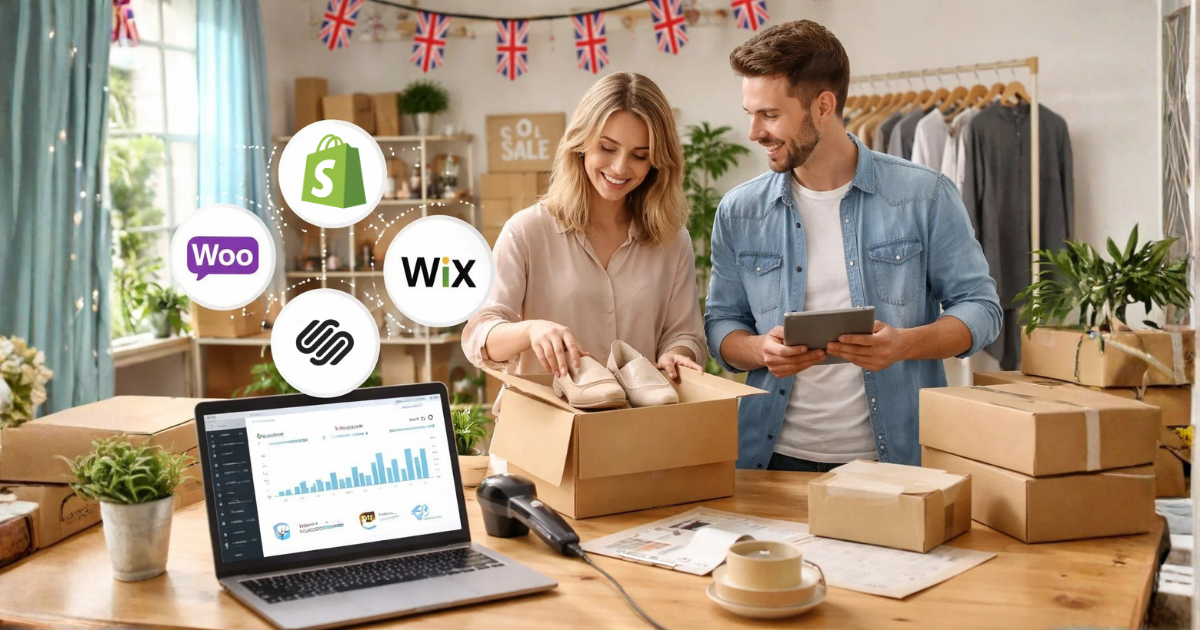
1) Shopify – Best All-Rounder for UK SMEs
Starting price: from $29/month (approx. £25)
Free trial: 3 days
Sales channels: Online store, POS, social media, marketplaces, B2B
Mobile app: Yes
POS: Native
Shopify continues to rank among the small business ecommerce platforms most widely adopted in the UK. It offers a fully hosted environment, which means hosting, security, and updates are handled for you.
For many SMEs in London and Manchester, Shopify’s biggest advantage is speed to market. Businesses can launch quickly without heavy technical work.
Key strengths:
- 100+ mobile-friendly themes
- Built-in SEO and marketing tools
- Shopify Magic AI for content and automation
- Reliable UK payment integrations
- Competitive shipping options
Shopify POS also helps retailers blend online and in-store sales. This is particularly useful for high-street shops moving into ecommerce.
Watch outs:
- Transaction fees apply unless using Shopify Payments
- Design flexibility is lower than open-source platforms
- Monthly costs can rise with add-ons
Best for: Retailers, fashion brands, subscription products, and fast-growing SMEs.
2) WooCommerce – Best for Flexible WordPress Stores
Cost: Free plugin (hosting and extras paid separately)
Free trial: Not required
Sales channels: Online, marketplaces, social
Mobile app: Yes (limited)
POS: Via extensions
WooCommerce remains popular among UK businesses that want full control. Built for WordPress, it transforms content-driven websites into fully functional online stores.
Many Leeds-based SMEs prefer WooCommerce because of its SEO flexibility and open ecosystem.
Why businesses choose WooCommerce:
- Open-source and highly customisable
- Strong organic search potential
- Large plugin marketplace
- No platform lock-in
However, costs can increase once you add hosting, security, and premium plugins.
Best for: Content-led businesses, niche retailers, and firms with technical support.
3) Wix eCommerce – Best for Beginners and Micro Businesses
Starting price: from $29/month
Free trial: Not always available
Sales channels: Online, social, marketplaces
Mobile app: Yes
POS: Native
Wix is often chosen by start-ups and sole traders who want a simple launch path. Its drag-and-drop builder removes much of the technical barrier.
Across the UK micro-business segment, Wix adoption remains strong among service providers and small product sellers.
Key benefits:
- 500+ ready-made templates
- Easy visual editor
- Built-in marketing tools
- Social selling integrations
- Subscription and dropshipping support
Limitations:
- Not ideal for very large catalogues
- SEO controls are less advanced than WooCommerce or Shopify
- Migration flexibility is limited
Best for: Start-ups, local services, and small catalogue stores.
4) Squarespace – Best for Design-Led Brands
Starting price: from $28/month
Free trial: 14 days
Sales channels: Online, social, POS via mobile
Mobile app: Yes
Squarespace is widely used by creative businesses across the UK. It combines strong visual design with built-in ecommerce tools.
Many photographers, consultants, and boutique brands in cities like London favour Squarespace for its polished templates.
Standout features:
- High-quality design themes
- Drag-and-drop editing
- Built-in email marketing
- Appointment scheduling
- Subscription billing support
Things to consider:
- Smaller app ecosystem
- Fewer advanced ecommerce extensions
- Slightly higher transaction costs on lower plans
Best for: Creative brands, service providers, and premium lifestyle businesses.
5) Square Online – Best for Retailers Moving Online
Price: Free plan available
Sales channels: Online, in-person, social
Mobile app: Yes
POS: Native
Square Online evolved from Square’s payment ecosystem. It works especially well for physical retailers and restaurants entering ecommerce.
Many UK local shops use Square because payment processing is tightly integrated.
Key advantages:
- Built-in payment processing
- Simple setup
- Retail-focused templates
- Competitive transaction fees
Limitations:
- Less scalable for large product ranges
- Fewer advanced customisation options
Best for: Local retailers, cafés, and small multi-channel sellers.
6) BigCommerce – Best for Scaling and Multichannel Growth
Starting price: from $29/month
Free trial: 15 days
Sales channels: Online, marketplaces, social, comparison engines
Mobile app: Yes
POS: Not native
BigCommerce is gaining traction among ambitious UK SMEs that expect rapid growth. It offers strong built-in functionality with fewer required plugins.
For businesses planning international expansion, BigCommerce supports over 140 currencies and numerous payment providers.
Key strengths:
- Advanced SEO capabilities
- Strong multi-channel integrations
- No additional transaction fees
- Scalable architecture
- Detailed analytics and reporting
Potential drawbacks
- Slightly steeper learning curve
- Fewer free design themes
- Higher-tier plans can become expensive
Best for: Growing retailers, B2B sellers, and multi-channel brands.
7) Weebly – Best for Simple Starter Stores
Price: Free plan available
Sales channels: Online store
Mobile app: Yes
POS: Not native
Weebly, now part of Square, offers a straightforward entry into ecommerce. It suits very small businesses that want to test online selling without heavy investment.
Core features:
- Secure shopping cart
- Basic inventory tools
- Mobile-optimised checkout
- Flexible shipping settings
However, the platform focuses on simplicity rather than advanced growth features.
Best for: Very small businesses and early-stage sellers.
| Platform | Best For | Key Strengths | Limitations | Typical Starting Price* |
| BigCommerce | Growing SMEs needing a scalable ecommerce platform for SMEs | No transaction fees, strong built-in SEO, 65+ payment gateways, unlimited bandwidth, rich native features | Smaller app marketplace, migration complexity if leaving platform | ~£25–£30/month |
| Shopify | Start-ups and retailers wanting fast launch | Easy admin, large app store, strong multichannel selling, mobile-ready themes, AI tools | Transaction fees (unless Shopify Payments), limited deep customisation, costs rise with apps | ~£25/month + fees |
| WooCommerce | WordPress users wanting full control | Open-source flexibility, excellent SEO control, huge plugin ecosystem, strong community | Requires hosting and security management, plugin costs add up, more technical work | Free plugin + ~£10–£40/month hosting |
| Wix eCommerce | Solo founders and micro businesses | Drag-and-drop builder, beginner friendly, built-in marketing tools, quick setup | Limited scalability, weaker for large catalogues, storage caps on lower plans | ~£16–£25/month |
| Squarespace | Creative and design-led brands | Premium templates, integrated blogging, good mobile design, simple interface | Fewer ecommerce extensions, limited payment flexibility, smaller app market | ~£20–£35/month |
| Volusion | Basic product sellers with simple needs | Built-in SEO basics, simple onboarding, multiple payment options | Limited modern features, weaker design flexibility, less popular in the UK | ~£30/month |
| Weebly | Beginners testing online sales | Very easy to use, free plan available, simple store setup | Basic functionality, limited scalability, professional design can be restrictive | Free to ~£10/month |
| Adobe Commerce (Magento) | Large enterprises with development teams | Deep customisation, enterprise-grade scalability, strong B2B capability | High setup cost, requires developers, heavy maintenance | Custom enterprise pricing |
How to Choose the Best eCommerce Platform for Small Business?
Selecting the best ecommerce platform for small business is not just a technical decision. It directly affects your costs, growth speed, and customer experience.
Across the UK, many SMEs rush this step and regret it later. They either outgrow the platform too quickly or struggle with hidden costs and limitations.
Working with an experienced ecommerce development company in the UK can reduce this risk. However, even before speaking to experts, you should understand what truly matters.
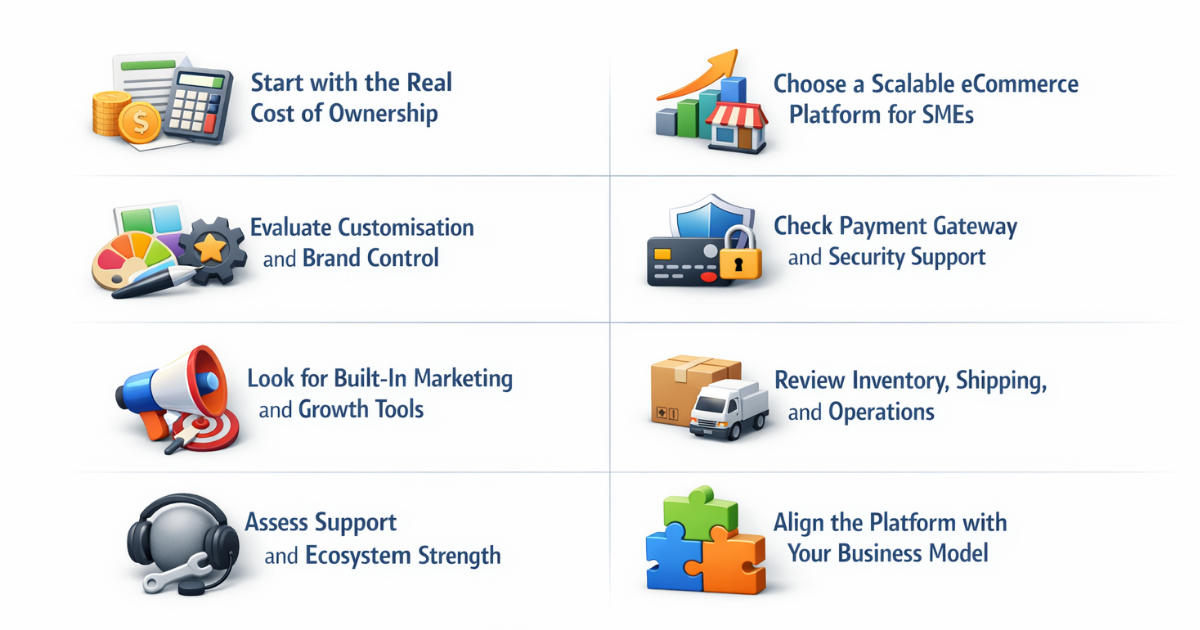
Below is a practical checklist based on what successful UK businesses prioritise in 2026:
1. Start with the Real Cost of Ownership
Budget always matters, but monthly fees tell only part of the story. Many platforms appear affordable at first. However, additional costs often surface later.
When reviewing ecommerce website development for small business, always factor in:
- Platform subscription fees
- Transaction charges
- Payment gateway costs
- Premium plugins or apps
- Hosting (for open-source platforms)
- Ongoing maintenance
For example, WooCommerce may start free, but hosting, security, and plugins can increase spend quickly. In contrast, SaaS platforms bundle many costs upfront.
Pro tip: UK SMEs should project costs for at least three years, not just year one.
2. Choose a Scalable eCommerce Platform for SMEs
Growth planning is often overlooked. Yet switching platforms later can be expensive and disruptive.
A scalable ecommerce platform for SMEs should comfortably handle:
- Rising traffic volumes
- Larger product catalogues
- Multichannel selling
- International expansion
- B2B or subscription models
Many growing retailers in London and Manchester now prioritise scalability from day one. It prevents costly migrations later.
Before deciding, ask: Will this platform still work when my sales double?
3. Evaluate Customisation and Brand Control
Your online store should reflect your brand clearly. Limited design flexibility can restrict marketing and user experience.
Strong custom ecommerce development services typically focus on platforms that allow:
- Flexible storefront layouts
- Theme customisation
- Third-party integrations
- API connectivity
- Content control
For example:
- WooCommerce and BigCommerce offer deeper flexibility
- Shopify balances ease with moderate customisation
- Wix and Squarespace prioritise simplicity over deep control
- Choose based on how unique your store needs to be.
- Prioritise Mobile Responsiveness and Speed
Mobile commerce dominates UK browsing behaviour. Recent studies show that most ecommerce traffic now comes from smartphones.
Therefore, your platform must deliver:
- Fast mobile load times
- Responsive themes
- Thumb-friendly navigation
- Frictionless checkout
Poor mobile performance directly impacts conversion rates. Many SMEs in Leeds and other regional hubs now treat mobile optimisation as a top priority.
4. Check Payment Gateway and Security Support
Trust remains critical for UK online shoppers. Customers expect secure, familiar payment options.
Your platform should support:
- Stripe and PayPal integration
- Apple Pay and digital wallets
- SSL encryption
- Two-factor authentication
- Fraud protection tools
Strong security builds confidence and reduces cart abandonment.
5. Look for Built-In Marketing and Growth Tools
Modern platforms should help you grow, not just sell.
The best ecommerce platform for small business typically includes:
- SEO controls
- Email marketing tools
- Discount and coupon features
- Social media integrations
- Abandoned basket recovery
- Customer segmentation
These features reduce reliance on third-party tools and lower long-term costs.
6. Review Inventory, Shipping, and Operations
Operational efficiency becomes critical as orders increase.
Your platform should support:
- Real-time stock tracking
- Low-stock alerts
- UK courier integrations
- Flexible shipping rules
- Order management dashboards
Retailers and D2C brands especially benefit from strong native inventory tools.
7. Assess Support and Ecosystem Strength
Even the best platforms face occasional issues. When that happens, support quality matters.
Hosted platforms usually provide direct support channels. Open-source solutions rely more on developers and community forums.
Before choosing, consider:
- Do you have internal technical skills?
- Will you rely on an ecommerce development company in the UK?
- How quickly must issues be resolved?
Reliable support reduces downtime and protects revenue.
8. Align the Platform with Your Business Model
Finally, your platform must match how you actually sell.
Different UK business verticals have different needs:
- Retail and fashion brands need strong inventory and multichannel tools
- Service providers need booking and content features
- Subscription businesses need recurring billing
- B2B sellers need pricing tiers and account management
Choosing based on business model prevents expensive workarounds later.
7 Smart Questions Before Choosing the Best eCommerce Platform for Small Business
Even after shortlisting platforms, many UK SMEs still make costly mistakes. The reason is simple. They focus on surface features instead of asking the right questions.
The cheapest plan often becomes the most expensive over time. Hidden fees, weak security, and missing native features can quickly increase costs.
Before you commit to any small business ecommerce platforms, use the checklist below. These questions reflect what experienced teams and every reliable ecommerce development company UK reviews in 2026.
1. What Is the Real Monthly and Long-Term Cost?
Sticker price rarely tells the full story. Many platforms advertise low entry pricing but require paid add-ons later.
When reviewing ecommerce website development for small business, check for:
- Domain charges (often £10–£20 yearly)
- SSL and security costs
- Paid themes or templates
- App and plugin subscriptions
- Hosting (for open-source platforms)
- Extra transaction fees
For example, a platform starting near £25/month can realistically exceed £120/month once essential tools are added.
Smart move: Build a three-year cost estimate before choosing.
2. Is Security Fully Managed or Partly Your Responsibility?
UK shoppers expect strong data protection. One breach can damage trust and create legal exposure under UK GDPR rules.
Not all platforms handle security equally.
Look for platforms that include:
- Level 1 PCI compliance
- Automatic security updates
- SSL encryption by default
- Fraud detection tools
- Secure payment integrations
Hosted SaaS platforms typically manage most of this. Open-source solutions often require manual setup.
If your team lacks technical support, security should be largely hands-off.
3. Will Transaction Fees Reduce Your Margins?
Payment processing fees are normal. Platform transaction fees on top are where costs escalate.
Some providers charge additional percentages when you use third-party gateways. Over time, this becomes significant.
Quick example:
£8,000 monthly revenue × 2% platform fee = £160 lost each month.
That equals nearly £2,000 per year.
When evaluating the best ecommerce platform for small business, always check:
- Whether extra transaction fees apply
- Which payment gateways are supported
- Whether you are locked into a specific processor
UK SMEs focused on tight margins should pay close attention here.
4. Can the Platform Support Your Brand Properly?
Templates help you launch quickly. However, strong brands need flexibility.
Many free themes look similar across different stores. Over time, this can limit brand differentiation.
Before selecting a platform, review:
- Number of quality free themes
- Customisation depth
- Layout flexibility
- Ability to edit product and content pages
- Availability of developers if needed
Platforms that balance ease of use with design control usually perform best long term.
5. Will Inventory Management Handle Future Growth?
Inventory problems quickly damage customer trust. Nothing frustrates buyers more than ordering items that later show as unavailable.
A scalable ecommerce platform for SMEs should support:
- Real-time stock updates
- Variant tracking (size, colour, style)
- Low-stock alerts
- Bulk product uploads
- Multi-channel inventory sync
Small catalogues can survive basic tools. Growing retailers in London, Manchester, and Leeds cannot.
Always plan for where your catalogue will be in 18–24 months.
6. What Analytics and Reporting Come Built In?
Data-driven decisions separate growing stores from struggling ones.
Some platforms only provide basic visitor counts. Others deliver full commercial insights.
Look for built-in reporting on:
- Traffic sources
- Conversion rates
- Average order value
- Customer lifetime value
- Basket abandonment points
- Best-selling products
Strong native analytics reduce reliance on third-party tools and support smarter marketing decisions.
7. Which Features Are Native and Which Require Apps?
This is one of the most overlooked factors.
Every additional plugin increases:
- Monthly costs
- Site complexity
- Maintenance workload
- Risk of technical conflicts
Modern custom ecommerce development services typically favour platforms with strong native functionality.
Ideally, your platform should include built-in support for:
- SEO controls
- Multi-channel selling
- Abandoned basket recovery
- Customer segmentation
- Product reviews
- Discount and gift card tools
Native features usually deliver better performance and lower long-term costs.
8. Does the Platform Support UK Payments, Tax, and Compliance Needs?
Many small businesses overlook localisation until problems appear. However, UK-specific support can affect conversions, reporting accuracy, and customer trust.
The best ecommerce platform for small business in the UK should handle local requirements smoothly from day one.
Check whether the platform supports:
- UK-friendly payment methods (Stripe, PayPal, Apple Pay)
- Automatic VAT calculations and reporting
- GBP as the default currency
- Royal Mail and major UK courier integrations
- UK GDPR and cookie compliance support
- Multi-currency selling if you plan to expand internationally
For example, retailers in London and Manchester often see higher checkout completion when familiar local payment options appear.
Final Verdict – Choosing the Best eCommerce Platform for Small Business
Choosing the best ecommerce platform for small business ultimately comes down to your goals, budget, and growth plans. There is no single platform that fits every UK SME. What matters most is selecting a solution that removes friction, supports your customers, and scales with your business over time. Small businesses rarely win on size alone. Instead, they succeed by moving quickly, offering smooth buying experiences, and using automation to work smarter.
Across the UK market, Shopify remains a strong all-round option for businesses that want fast setup and multichannel selling.
WooCommerce suits firms that need deeper control and strong SEO flexibility. Squarespace and Wix work well for design-led brands and early-stage businesses that prioritise ease of use. Meanwhile, BigCommerce continues to gain attention among growing SMEs that require more built-in functionality and long-term scalability. Weebly, powered by Square, still provides a simple starting point for very small sellers testing ecommerce.
However, features alone should never drive your decision. Smart UK businesses focus on total cost of ownership, built-in marketing capabilities, flexible payment support, mobile performance, and the ability to grow without expensive migrations. Many platforms look affordable upfront but become costly once apps, transaction fees, and upgrades are added. For this reason, it is always wise to test platforms properly. Add products, run trial orders, and evaluate the daily management experience before committing.
How IDS Logic Can Help?
If you want expert guidance, IDS Logic can help you make the right choice and build a future-ready store. As an experienced ecommerce development company UK, IDS Logic supports businesses with platform selection, custom development, integrations, and performance optimisation. Explore our Ecommerce Website Development services.
The right platform, combined with the right partner, will position your online business for steady and sustainable growth.

Frequently Asked Questions
Q1. How long does it take to build an ecommerce website for a small business?
The timeline depends on your platform choice and store complexity. A basic hosted store can go live in 2-4 weeks. However, a fully customised solution may take 8-12 weeks. Partnering with an experienced ecommerce development company UK can speed up delivery and reduce costly revisions.
Q2. Can we change our ecommerce platform later if our business grows?
Yes, but migration can be complex and expensive. You must carefully move products, customer data, and SEO settings. This is why many SMEs prefer to start with a scalable ecommerce platform for SMEs that supports long-term growth and reduces the need for replatforming.
Q3. Which ecommerce platform handles UK VAT and payments best?
Most leading small business ecommerce platforms support UK VAT configuration and popular payment gateways such as Stripe and PayPal. Hosted platforms typically include built-in tax settings, while open-source solutions may require additional plugins. Always confirm VAT automation before choosing.
Q4. How important is SEO when selecting the best ecommerce platform for small business?
SEO is critical for long-term visibility and low-cost traffic. The best ecommerce platform for small business should offer search-friendly URLs, fast page speeds, mobile optimisation, and editable metadata. Strong built-in SEO features help your products rank higher on Google and attract qualified buyers.
Q5. Should small businesses sell only through their website or also use marketplaces?
In most cases, a combined strategy works best. A company’s own website gives you full control of branding, margins, and customer data. Meanwhile, marketplaces can provide early visibility and sales. To manage everything from one platform, many UK SMEs employ a multichannel approach supported by custom ecommerce development services.