Key Takeaways
- SharePoint communication sites work best for organisation-wide news, policies, announcements, and leadership messages.
- SharePoint team sites suit smaller groups that actively create, edit, and discuss shared work.
- SharePoint hub sites connect related sites through shared navigation, branding, search, and news.
- A SharePoint home site can become the main entry point for your intranet.
- The SharePoint app in Teams brings intranet content closer to employees already working inside Teams.
- Audience targeting helps prioritise relevant content, but it does not replace permissions.
- Page analytics help communication teams understand whether employees actually engage with published content.
- Good governance prevents duplicate sites, outdated information, and confusing navigation.
- SharePoint News can support targeted updates, email digests, and organisation-wide communication.
- Custom development should solve a genuine communication gap rather than recreate native SharePoint features.
Important updates can disappear inside email threads while policies sit in separate folders. Hybrid teams may then receive different versions of the same message.
A well-planned SharePoint internal communication model gives employees a clearer place for trusted news, resources, policies and business updates.
SharePoint can connect that experience with Microsoft Teams and wider Microsoft 365 services. Its value still depends on structure, publishing ownership, permissions and content quality.
Effective SharePoint workplace communication also gives each site a clear role. Communication sites support broad publishing, while team sites enable active collaboration. Hub sites connect related areas.
A SharePoint home site can provide an organisation-wide entry point and extend that experience into the SharePoint app in Teams.
This guide shows how to combine those capabilities without creating another information silo.
Why Workplace Communication Becomes Fragmented
Most organisations already have enough communication tools. The friction comes from information being spread across email, Teams, shared folders, meetings and departmental portals.
Employees may miss announcements, compare competing versions or spend time searching for routine resources. A poorly organised intranet adds to that effort.
Good SharePoint intranet communication reduces those hand-offs and gives people a clearer route to trusted information.
Start with three questions:
- What information should every employee see?
- What content belongs only to a specific department or role?
- Where should teams actively collaborate rather than simply read?
Those answers usually determine which SharePoint site type fits the requirement.
SharePoint Communication Sites: Publish to a Wider Audience
A SharePoint communication site is built for broad publishing. A small editorial group can manage updates for a much larger readership.
Microsoft recommends communication sites for news, reports, status updates and other information intended for wide distribution.
Common uses include:
- company announcements
- leadership updates
- HR policies
- employee benefits
- internal campaigns
- departmental news
- organisational changes
- events
- learning resources
- service information
HR might use one for policies, benefits, onboarding resources and employee updates. Leadership could use another for strategy, priorities and company news.
Choose the site type around what people need to do. Communication sites suit publishing, while team sites suit co-authoring and day-to-day collaboration.
Make Communication Sites Easier to Scan
Readers usually arrive with a question, not a desire to browse every page.
Put the highest-priority information first, then reveal supporting detail where needed. A useful page should help employees answer a few questions quickly.
- What changed?
- Does it affect me?
- What do I need to do?
- Where can I learn more?
Use clear headings, short summaries, visual hierarchy, and direct calls to action. Employees should not need to read a wall of text before understanding the message.
Team Sites: Where SharePoint Collaboration Happens
SharePoint team sites give smaller groups a working space for shared files, lists, tasks and project information.
Most members contribute, edit or coordinate work rather than only reading published updates.
Microsoft describes team sites as collaborative spaces for shared content and resources.
Typical uses include:
- project delivery
- departmental working areas
- document collaboration
- shared planning
- operational tracking
- working documents
- team-specific news
- project status information
This makes team sites a strong fit for active SharePoint workplace collaboration.
A marketing group, for example, can co-author campaign files and manage shared resources there.
Company-wide announcements belong in a publishing space where the audience and ownership model better fit the message.
SharePoint Team Site vs Communication Site
Use a team site when members need to work together on shared material. Choose a communication site when a smaller publishing group needs to reach a broader audience.
Mixing those purposes usually creates clutter. Project content can take over the intranet homepage, while important news disappears inside working areas.
Good information architecture keeps collaboration and organisation-wide publishing separate without disconnecting them.
SharePoint Hub Sites: Connect Related Communication Areas
Large intranets work better as a network of connected areas.
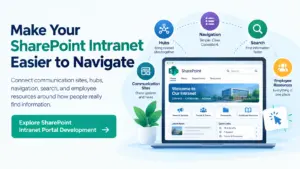
SharePoint hub sites bring related sites together through shared navigation, branding, search context and rolled-up content.
A hub can group sites by department, region, programme or business function.
For example, an HR hub could connect:
- HR news
- learning and development
- employee benefits
- recruitment
- policies
- wellbeing resources
Each site can retain its own ownership while the hub provides a more consistent route through related information.
News can also roll up from associated sites without bypassing existing permissions.
For larger or decentralised organisations, this creates a practical SharePoint communication hub without forcing every department into one structure.
SharePoint Home Sites Create an Organisation-Wide Starting Point
A SharePoint home site provides an organisation-wide landing experience for the intranet.
Microsoft describes it as a special communication site that reflects the organisation’s brand, voice and priorities.
A home site can become the main destination for:
- company news
- employee resources
- global navigation
- leadership communication
- important links
- corporate campaigns
- business-wide announcements
Departments and projects still need their own sites. The home site should surface priority news, resources and navigation, then guide employees towards deeper information.
Trying to place every resource on the homepage usually creates clutter instead of a clearer employee experience.
2026 Update: The SharePoint App in Teams and Viva Connections
Microsoft began rolling out the rename of the default Viva Connections experience to the SharePoint app in Teams during 2026.
The underlying experience still uses SharePoint home site capabilities.
Employees can therefore reach key intranet content inside Teams, where many already spend much of their working day.
The SharePoint app in Teams can bring:
- News
- employee resources
- dashboards
- home site content
- navigation
This brings intranet resources closer to everyday work.
The shorter route can improve discovery, but clear navigation and useful content still determine whether employees use the experience.
Use SharePoint News for More Than Announcements
SharePoint News gives communication teams a reusable channel for SharePoint employee communication.
Posts can surface across communication sites, team sites, hub sites and other Microsoft 365 experiences.
Teams can therefore publish once and extend the same trusted story across several channels.
Useful News content can include:
- leadership updates
- policy changes
- employee stories
- project milestones
- operational notices
- internal events
- recognition posts
- service updates
Editors can also curate SharePoint News into email digests for colleagues who prefer updates in their inbox.
The intranet can remain the source while email and Teams extend the reach of each message.
Employees then have more than one practical route to the same trusted update.
Audience Targeting Makes Communication More Relevant
Sending everything to everyone creates noise. SharePoint audience targeting helps prioritise content for specific groups.
You can target news, navigation, pages, links, and selected web parts to relevant audiences.
For example:
A Manchester office could see location-specific updates.
Managers could receive leadership resources.
A finance group might see reporting deadlines that do not concern the wider workforce.
Used well, audience targeting makes Microsoft 365 internal communication more relevant without creating separate copies of the same page.
Use it for relevance, not access control. A targeted page can still appear in search for an authorised user because targeting does not secure the underlying content.
Apply SharePoint permissions when information must be restricted. Use audience targeting when you want to prioritise what different groups see.
Home Site Announcements for Time-Sensitive Messages
The Announcements web part gives SharePoint home sites a place for short, high-visibility messages.
Suitable uses include:
- urgent operational notices
- planned outages
- building closures
- security reminders
- short company-wide updates
Reserve Announcements for messages that genuinely need immediate visibility.
Routine updates fit better in News or departmental channels. Clear publishing rules stop the homepage from turning every update into an urgent notice.
Link Communication to Actions and Workflows
Some messages need a next step, not another page.
- A policy update may require acknowledgement.
- An onboarding announcement might link to tasks.
- A process change may need forms, approvals, or supporting documentation.
SharePoint can connect these experiences with Microsoft 365 and Power Platform workflows.
Keep the message itself simple, then direct employees to the task, approval or form they need.
IDS Logic provides SharePoint workflow and collaboration services for organisations connecting content with business processes.
Give Employees Ways to Respond
Not every update needs comments, but some communication benefits from visible feedback.
SharePoint pages and News posts can support likes, comments and author notifications.
Policy changes may need a controlled feedback route instead. Employee stories, community updates and internal campaigns can suit open interaction better.
That improves SharePoint employee engagement without forcing every page into the same template.
Measure Whether Employees Read the Content
Publishing tells you a message went live. Analytics help show whether people actually found it.
SharePoint page analytics can show:
- page viewers
- page views over time
- average time spent
- traffic patterns
These measures can also apply to News posts.
High traffic does not prove understanding, while low traffic may expose weak discoverability or distribution.
Use the data to investigate placement, promotion and follow-up rather than treating views as the final measure of communication quality.
Make Important Information Findable After the Announcement
News loses visibility over time, so search and navigation carry the long-term load.
SharePoint search helps employees find sites, files, people, News and other content. Hub and local navigation can create predictable routes into related areas.
The labels matter as much as the links themselves.
Employees will usually recognise “Book leave” faster than an internal label such as “People Operations Systems”.
Use the language employees already use when looking for a task or piece of information.
Where SharePoint Internal Communication Still Breaks Down
SharePoint can support strong internal communication, but governance and publishing habits decide whether the experience stays useful.
Common problems include:
- nobody owns outdated content
- every department creates its own navigation
- too many people can publish company-wide news
- employees receive irrelevant updates
- duplicate sites contain competing information
- important pages use unclear titles
- permissions grow without review
- pages become overloaded with web parts
Most of these failures come from ownership and governance rather than missing platform features.
Fix the publishing model first. Add custom development only when a genuine requirement remains.
Build a Simple Internal Communication Model
A practical SharePoint structure does not need dozens of site types. Use a small number of clear patterns.
- Organisation-wide information: Use a communication site or SharePoint home site.
- Departmental publishing: Use communication sites connected through appropriate hubs.
- Project and team collaboration: Use team sites.
- Related business areas: Connect them through hub sites.
- Targeted employee news: Use audience targeting with SharePoint News.
- Urgent short messages: Use the home-site Announcements capability where available.
- Daily access through Teams: Use the SharePoint app in Teams where it fits your employee experience.
Giving each channel a defined role makes ownership clearer and reduces overlap between publishing and collaboration.
Secure SharePoint Communication Without Making It Hard to Use
Secure communication starts with knowing who should see what. Define ownership first, then apply permissions around the real audience.
Limit unnecessary site owners and review guest or external access where those capabilities are enabled.
Audience targeting only changes which content gets prioritised. It does not restrict access to the underlying page.
For team sites, privacy controls and sensitivity labels can add further governance where administrators configure them.
Bring IT into the publishing process when pages contain sensitive HR, financial, legal or operational information.
When Does Custom SharePoint Development Make Sense?
Native SharePoint capabilities already cover many internal communication requirements.
Custom development becomes useful when standard configuration cannot support a clear business need.
Examples include:
- specialist employee dashboards
- connected line-of-business data
- custom navigation experiences
- tailored web parts
- complex integrations
- role-specific employee journeys
Check the native option first because every custom component introduces ownership, testing and maintenance.
IDS Logic provides SharePoint development services when organisations need functionality beyond standard Microsoft 365 configuration.
The right outcome is a simpler employee experience, not a larger custom codebase.
Plan the Communication Model Before the Intranet Layout
Begin with how employees receive, find and act on information. Then match each requirement to the SharePoint experience that fits it.
Communication sites can handle broad publishing. Team sites give working groups space to collaborate, while hubs connect related areas.
A home site can provide the organisation-wide entry point. The SharePoint app in Teams can bring that experience closer to daily work.
Together, these choices support clearer SharePoint intranet communication when ownership remains defined.
Regular review matters as teams, content and priorities change. Without it, even a well-designed intranet gradually becomes harder to trust and navigate.
Conclusion – Build SharePoint Communication Around How Employees Work
Strong SharePoint internal communication does not come from adding more sites, web parts or channels.
Employees need a clear place to find trusted information and understand what requires action. Communication sites handle broad publishing, while team sites support active collaboration. Hub sites connect related areas across the intranet.
A SharePoint home site can provide the main entry point. News, audience targeting and Teams can then extend the reach. Governance still decides whether that experience stays useful over time.
Clear ownership, sensible permissions, consistent navigation and regular content reviews prevent the intranet from becoming another information silo. Use custom development only when native SharePoint capabilities cannot meet a clear business need.
With the right structure, SharePoint intranet communication becomes easier to manage and more useful for employees.
SharePoint Communication Projects Need More Than Page Design
Internal communication work quickly expands into information architecture, governance, permissions, integration and adoption.
IDS Logic brings 19+ years of digital delivery experience across SharePoint development and related Microsoft solutions.
With delivery teams based in Leeds and a strong UK-wide presence, support can continue beyond the initial launch.
A practical project should leave employees with trusted information, communication teams with a manageable publishing process, and IT with sustainable governance.