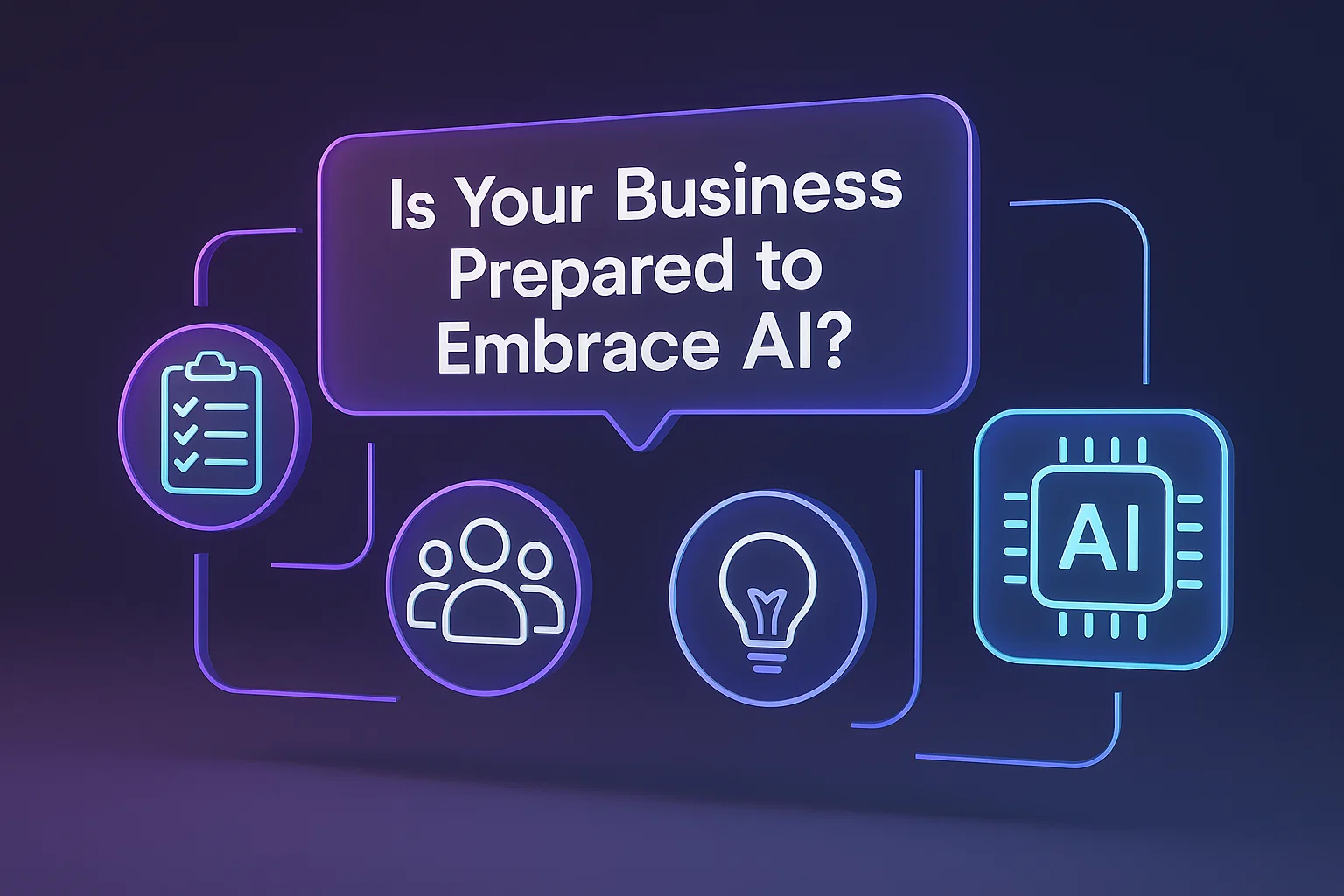
Not sure if your business is AI-ready? In this blog, we break down everything you need to know about becoming truly prepared for AI adoption.
Is Your Business AI-Ready?
Only a few years ago, Artificial Intelligence felt like something out of a sci-fi film. Today, the question is not if you should use AI, but how ready your business is to embrace it. From improving customer experiences to streamlining operations and driving smarter decisions, AI is no longer a trend – it’s a necessity. Which brings us to the critical question every organisation must ask: Is your business AI-ready?
The rise in AI adoption is a direct response to today’s fast-moving, data-driven world. Embracing AI is not simply about adding new tools; it is a deeper shift in how businesses think, plan and operate. To stay competitive, UK companies need to assess their business readiness for AI and build strong foundations that support change.
Making your business AI-compatible is only the first step. The real challenge lies in ensuring you have the right culture, data, people and technology to support it. Without preparation, investments in AI can end up wasted, leading to failed projects and frustration.
One thing shared by companies that succeed is the use of a structured AI readiness assessment. This isn’t just a checklist for IT. It’s a strategic review that spans every department, focusing on how AI will improve data quality, enhance resource management and strengthen decision-making. In short, it’s as important as the implementation itself.
Another misconception is that embracing AI is purely a technical job. In reality, adopting AI effectively requires cross-departmental collaboration and a clear understanding of where it delivers value. Leadership, culture and processes matter just as much as IT systems.
AI is moving fast. Analysts predict that over the next few years, the technology will evolve even further, creating both major opportunities and serious risks for businesses. Those with outdated systems, manual processes or poorly managed data will struggle to keep up. On the other hand, companies that modernise their digital infrastructure and make their data AI-ready will gain a clear competitive advantage.
So, pause and think: is your company genuinely ready to embrace AI? Many organisations get excited about the promise of AI but overlook warning signs that suggest they’re not prepared yet. Starting without the right tools, people or processes often wastes time and resources. Instead, it’s smarter to know what readiness looks like and act early.
In this blog, we’ll explore what it means to be AI-ready, why businesses should embrace AI now, and the key steps you can take to prepare your organisation for adoption with confidence.
Why Does AI Readiness Matters Today?
Artificial Intelligence is moving faster than most businesses expected. In just a few years, it has shifted from a futuristic idea to a practical tool that influences everything from customer service to supply chains. For UK businesses, the ability to embrace AI is no longer a nice-to-have — it is becoming a competitive requirement.
Being AI-ready is about more than buying new software. It starts with making sure your business has the right digital infrastructure. Strong hardware, flexible platforms, and secure networks are the backbone of any AI project. But even with the latest technology, progress will stall if your data is not prepared. AI relies on clean, structured, and accurate information to deliver meaningful insights. Poor data management can undermine even the most advanced solutions.
Equally important is culture. A business can have modern systems and well-organised data, but without a workforce that embraces change, progress will be slow. Staff at all levels should understand how AI supports their daily work. Upskilling, collaboration, and open communication are critical in making sure AI adoption feels like a shared opportunity rather than an imposed change.
Finally, AI readiness is about alignment. AI should never be added just because it’s a trend. It must tie directly into business goals, whether that’s improving customer experience, boosting decision-making, or streamlining operations. When aligned with strategy, AI delivers tangible results and supports long-term growth.
In short, being AI-ready means preparing your organisation holistically: modern infrastructure, quality data, skilled people, and a culture that values innovation. These elements together position your business to use AI effectively and stay ahead in a rapidly evolving marketplace.
Read More: Magento AI Solutions: Real-World Applications and Sales-Boosting Strategies
Assessing Your Current AI Readiness
Before you jump into adopting AI, it’s important to take a step back and evaluate where your organisation stands today. A structured AI readiness assessment helps identify strengths and gaps across key areas such as infrastructure, data, skills, and culture.
-
Infrastructure and Technology
Does your business have the systems, platforms, and networks capable of supporting AI integration? Outdated technology, manual processes, or a lack of scalability will create barriers. A modern, flexible infrastructure makes it easier to embed AI into operations.
-
Data Quality and Governance
AI depends on data. To be AI-ready, your data must be accurate, complete, properly labelled, and secure. It should also be accessible from a central location and updated regularly. Without this foundation, AI models risk producing unreliable insights that could damage decision-making.
-
Skills and Expertise
Do you have the right people in place to design, deploy, and manage AI tools? If not, can your teams be trained or supported by external experts? Building a workforce with strong AI awareness is essential. Even the best technology will not succeed if people do not know how to use it.
-
Culture and Processes
Is your organisation open to innovation and change? A culture that values continuous learning, experimentation, and collaboration across departments is far more likely to succeed with AI. Resistance to change is one of the biggest barriers companies face.
-
Business Strategy Alignment
Finally, ask: how does AI fit into your wider objectives? AI adoption should support your business vision directly, not exist in isolation. Aligning projects with clear goals, such as reducing costs, improving customer experience, or driving innovation – ensures AI delivers real value.
By reviewing these areas, businesses can identify where they are prepared and where more investment is needed. A thoughtful readiness check not only avoids wasted resources but also sets the stage for AI adoption that brings measurable, long-term benefits.
Benefits of Being AI Ready
Being AI-ready gives your business an edge in today’s fast-changing world. Embracing AI adoption doesn’t just mean using smart tools, it means unlocking a set of real, practical benefits that can reshape how your organisation works. When combined with automation, artificial intelligence can streamline operations, cut down on wasted effort, and help teams focus on what matters most. Below are some of the key benefits of AI in business that show why being AI-ready is no longer optional, but essential.
-
Improved Efficiency with AI Automation
Artificial intelligence makes it simple to take care of routine, repetitive tasks that often eat up valuable time. From data entry to customer support queries, automation frees employees to concentrate on higher-value and strategic work. This shift not only speeds up operations but also increases overall productivity across departments.
-
Smarter and Faster Decision-Making
AI has the power to process huge amounts of data in a fraction of the time it would take humans. With AI-driven insights, businesses can rely on accurate, up-to-date information instead of guesswork. These insights make decision-making sharper, more reliable, and more aligned with real-world data. For leaders, this means confidence in every decision backed by solid evidence.
-
Predicting Market Trends and Customer Needs
One of the most valuable benefits of AI readiness is the ability to forecast what’s coming next. AI can spot emerging market trends, shifts in customer behaviour, and even highlight risks before they become major issues. This foresight gives companies the breathing space to adapt, innovate, and solve problems early, helping them stay ahead of competitors and closer to their customers.
Read more: Sitefinity 15.3: The AI-Driven CMS Empowering Smart Marketers & Agile Developers
Challenges in Becoming AI Ready
Getting your business AI-ready is not always a smooth journey. While the rewards of AI adoption are huge, there are certain hurdles that many organisations face along the way. Understanding these challenges in becoming AI ready is the first step to overcoming them and building a strong foundation for the future.
-
Shortage of Skilled Talent and Expertise
One of the most common challenges of AI in business is the lack of skilled professionals who understand how to use it effectively. Without the right expertise, companies often struggle to unlock the real value of AI. Training employees to work with AI systems also adds extra costs and takes time, which can stretch business budgets and delay implementation. This skill gap is a major barrier that organisations need to address before they can fully embrace AI adoption.
-
Integration with Existing Systems
Another big hurdle in becoming AI-ready is the integration process. Bringing AI into existing business systems is rarely straightforward. It requires careful planning, technical knowledge, and the involvement of experts who can handle complex integrations. Without proper guidance, businesses risk running into delays, added costs, or inefficient systems. However, with structured planning and support, AI can be blended seamlessly into current operations.
-
Cost and Budget Pressures
AI solutions bring clear benefits, but the upfront investment in tools, training, and infrastructure can feel heavy for some businesses. Managing these costs is one of the key challenges of AI readiness. Without a cost-effective approach, businesses may hesitate to adopt AI at the right pace. Choosing scalable AI solutions, those that can grow with the business, helps reduce this risk and ensures long-term sustainability.
-
Overcoming the Challenges
The good news is that these AI adoption hurdles are not roadblocks, they are opportunities to rethink strategy. By focusing on upskilling employees, investing in scalable solutions, and working with a trusted AI technology partner, businesses can turn these challenges into stepping stones. A well-planned approach ensures employees feel confident, costs stay manageable, and integration runs smoothly.
When businesses prepare in the right way, the challenges of AI readiness become manageable. Instead of being barriers, they become pathways that lead to efficiency, innovation, and a stronger competitive edge.
Steps to Prepare Your Business for AI Adoption
Adopting AI is not something that happens overnight. It takes preparation, planning, and the right mindset. Businesses that succeed with AI adoption don’t just install tools, they create a roadmap that connects technology with their bigger goals. Here are five practical steps to prepare your business for AI readiness.
Step 1: Build a Thoughtful AI Adoption Strategy
The first step in preparing for AI is to take a calculated, well-rounded approach. Start by reviewing your business objectives and ask yourself, where can AI make the biggest impact? Whether it’s improving customer experience, streamlining operations, or driving better decision-making, your AI projects should tie directly to these goals. By aligning AI initiatives with long-term strategies, you make sure your investments are purposeful and measurable.
Step 2: Select the Right AI Tech Stack
Once you know your goals, choosing the right technology becomes crucial. The success of AI adoption depends on selecting tools, platforms, and frameworks that match your business needs. Beyond the software itself, building partnerships with trusted technology providers can make the journey smoother. A reliable partner can help you navigate the technical details and integrate AI with your existing systems without disruption.
Step 3: Prioritise Data Quality and Security
AI is only as strong as the data it uses. Preparing for AI means making sure your data is clean, structured, secure, and scalable. Poor-quality or scattered data can lead to inaccurate insights, which reduces the value of your AI investment. Take the time to improve your data management processes, organise your information, protect it with security measures, and build a solid infrastructure. This step lays the foundation for accurate and actionable AI-driven results.
Step 4: Train and Upskill Your Workforce
Technology alone is not enough, your people matter just as much. For AI adoption to succeed, your employees must know how to use these new tools effectively. This may involve targeted training programs or hiring professionals with AI expertise. Upskilling your team helps reduce resistance to change and builds confidence in working with AI. When employees feel empowered, the business as a whole benefits.
Step 5: Start Small with Pilot Projects
Jumping straight into large-scale AI projects can be overwhelming and risky. Instead, begin with small pilot projects. Test AI in specific areas where you can clearly measure its value, such as customer support chatbots or automated reporting. These trial runs allow you to identify challenges, calculate ROI, and fine-tune your approach. Once you see success in smaller projects, you can confidently expand AI across more areas of the business.
Why Businesses Struggle with AI Readiness?
Becoming AI-ready sounds exciting, but many organisations face obstacles that slow down their progress. These challenges are real, yet they can be managed with the right strategy. Let’s look at some of the biggest roadblocks businesses encounter when preparing for AI adoption.
1. Fear of Change and Cultural Resistance
One of the toughest challenges is not technical at all, it’s cultural. Employees often worry that AI will replace their jobs, which creates hesitation and even pushback. Without building awareness and showing how AI can support people rather than replace them, adoption becomes much harder. A culture that embraces innovation is just as important as the technology itself.
2. Poor Data Management and Information Silos
AI is only as strong as the data it uses. Many businesses have valuable data, but it’s scattered across different systems and departments. These data silos prevent companies from getting a clear, unified picture, making it difficult to train AI effectively. Without clean, accessible, and centralised data, even the most advanced AI tools cannot deliver meaningful results.
3. Limited Expertise and Over-Reliance on Vendors
Another common hurdle is the lack of in-house skills. Few organisations have enough people trained in data science, machine learning, or AI tools. As a result, they depend heavily on external vendors, which increases costs and often slows down timelines. Building internal skills through training or hiring the right talent helps reduce this dependency and ensures long-term success.
4. Unrealistic Expectations Around Results
AI is not a quick-fix solution. It requires testing, refining, and constant learning before delivering strong results. Yet, many organisations expect immediate transformation. When instant results don’t appear, leaders sometimes view AI as a failed investment. Setting realistic goals and understanding that AI adoption is a journey, not a one-time project, can make the difference between success and frustration.
Turning Challenges into Opportunities
These hurdles may seem overwhelming, but they’re not impossible to overcome. With the right planning, scalable AI tools, and a focus on cultural readiness, businesses can move past these barriers. The key is to see challenges as opportunities to strengthen your foundation, whether that means cleaning up your data, upskilling your workforce, or aligning expectations with reality.
By addressing these issues early, organisations can prepare themselves to embrace AI confidently and build a sustainable, competitive future.
Getting Along with AI
Businesses that adopt AI successfully are the ones willing to adapt and grow with changing trends. Instead of treating AI as just another buzzword, they see it as a real opportunity to sharpen their competitive edge. These companies usually have a clear vision of how AI can support their operations and strengthen their long-term strategy.
Getting along with AI starts with aligning your business capabilities with its actual needs. This means running a proper evaluation—looking at your goals, resources, and readiness, before jumping in. When this is done carefully, AI adoption becomes smoother and more rewarding.
The real value of AI lies in its ability to transform the way you work. From streamlining daily operations to powering smarter decision-making, AI helps businesses unlock higher productivity and growth. The key is to focus on areas where AI can deliver measurable improvements, like reducing inefficiencies, improving workflows, or providing actionable insights. When you align AI projects with real business outcomes, the results are not just innovative but strategically beneficial. This is how AI becomes a growth driver, not just a passing trend.
In Conclusion
AI readiness is no longer optional – it’s a necessity for businesses that want to remain relevant and competitive in a fast-changing world. Preparing for AI adoption means more than investing in technology. It requires strong infrastructure, reliable data, skilled people, and a culture that welcomes innovation.
By taking these steps, businesses can harness AI to fuel efficiency, spark innovation, and deliver better customer experiences. As artificial intelligence continues to evolve, those who plan ahead will be best placed to benefit.
If your organisation is ready to take the first step toward AI adoption, now is the time. Start building your AI readiness strategy today, and if you need expert guidance, get in touch with us. Together, we can help you unlock the full potential of AI and position your business for long-term success.
Frequently Asked Questions
Q1. How long does it usually take for a business to become AI-ready?
The timeline varies widely, depending on the size of the organisation and the current state of its data and technology. For some small to mid-sized businesses, the preparation may take a few months. Larger enterprises with fragmented systems often need a year or more to align infrastructure, clean data, and train staff. The key is to treat AI readiness as an ongoing journey rather than a one-time project.
Q2. Do small and mid-sized businesses really need to embrace AI now?
Yes. While AI adoption once seemed relevant only for big enterprises, 2025 has changed that. Affordable cloud-based AI-ready IT solutions now allow smaller businesses to automate tasks, improve customer experiences, and compete with bigger players. Ignoring AI could mean missing out on efficiency gains and cost savings that competitors are already enjoying.
Q3. What industries in the UK are leading the way in AI adoption?
According to 2025 market reports, finance, healthcare, retail, and logistics are currently leading the charge in AI adoption across the UK. Financial firms are using AI for fraud detection, healthcare providers for diagnostics, retailers for personalised shopping experiences, and logistics companies for route optimisation. These industries set strong examples of how being AI-ready transforms operations.
Q4. What risks should businesses consider before implementing AI?
Beyond costs and skills gaps, businesses must think about ethical and legal risks. These include data privacy concerns, bias in algorithms, and regulatory compliance, especially under UK and EU data protection laws. Companies that rush into AI without governance frameworks risk damaging their reputation and customer trust. Preparing for AI means addressing these issues early on.
Q5. How do you measure if your business is truly AI-ready?
Readiness is measured across five main areas: data quality, infrastructure, skills, culture, and strategic alignment. If your organisation has clean, accessible data; scalable technology systems; trained staff; an open mindset toward innovation; and AI goals tied to business objectives, you’re on the right track. Independent AI readiness assessments, offered by technology partners, can provide a clear score and roadmap for improvement.