Customer Relationship Management (CRM) plays a vital role in helping businesses grow and stay connected with their customers. Keep reading to explore why it matters and how it can benefit your business.
Boosting Businesses with Must-Have CRM Integrations
Running a business online today is both a huge opportunity and a daily challenge. Customers want quick answers, smooth service, and a personal touch. This is why CRM integration has become a must-have for UK businesses of every size. A modern integrated CRM system does far more than store customer details, it connects with your other tools, automates routine work, and frees up your team to focus on what matters most: building strong relationships and growing sales.
A customer relationship management (CRM) system helps companies understand their customers and manage data more effectively. But the real value comes when you go beyond using CRM as a standalone tool. With the right CRM integration tools, you can link your e-commerce platform, marketing campaigns, customer service channels, and even payment systems, creating a single connected view of every customer touchpoint.
The numbers speak for themselves. Studies show that CRM systems can increase sales by up to 29%, improve productivity by 34%, and boost forecast accuracy by 42%. Yet, over 17% of sales reps report lack of integration with other software as their biggest hurdle. That gap highlights why CRM integration services in the UK are now so critical. By connecting your CRM to the rest of your business ecosystem, you cut down manual tasks, reduce errors, and improve customer satisfaction.
And customers notice. According to the latest Small and Medium Business Trends Report, 65% of customers expect businesses to keep up with their fast-paced needs. Without integration, most SMEs find themselves stretched thin across sales, marketing, operations, and service. With integration, you get automation that keeps everything in sync, fewer repeat tasks, quicker response times, and more meaningful interactions with customers.
Whether you’re a small retailer using Shopify or a growing enterprise relying on Salesforce or HubSpot, the principle remains the same: the key to unlocking CRM potential lies in choosing the right integrations. Done well, this improves efficiency, increases productivity, and builds trust with your customers.
In the following sections, we’ll take a closer look at the most important CRM integrations for business today, why they matter, and how they can transform the way your business operates.
What is CRM Integration?
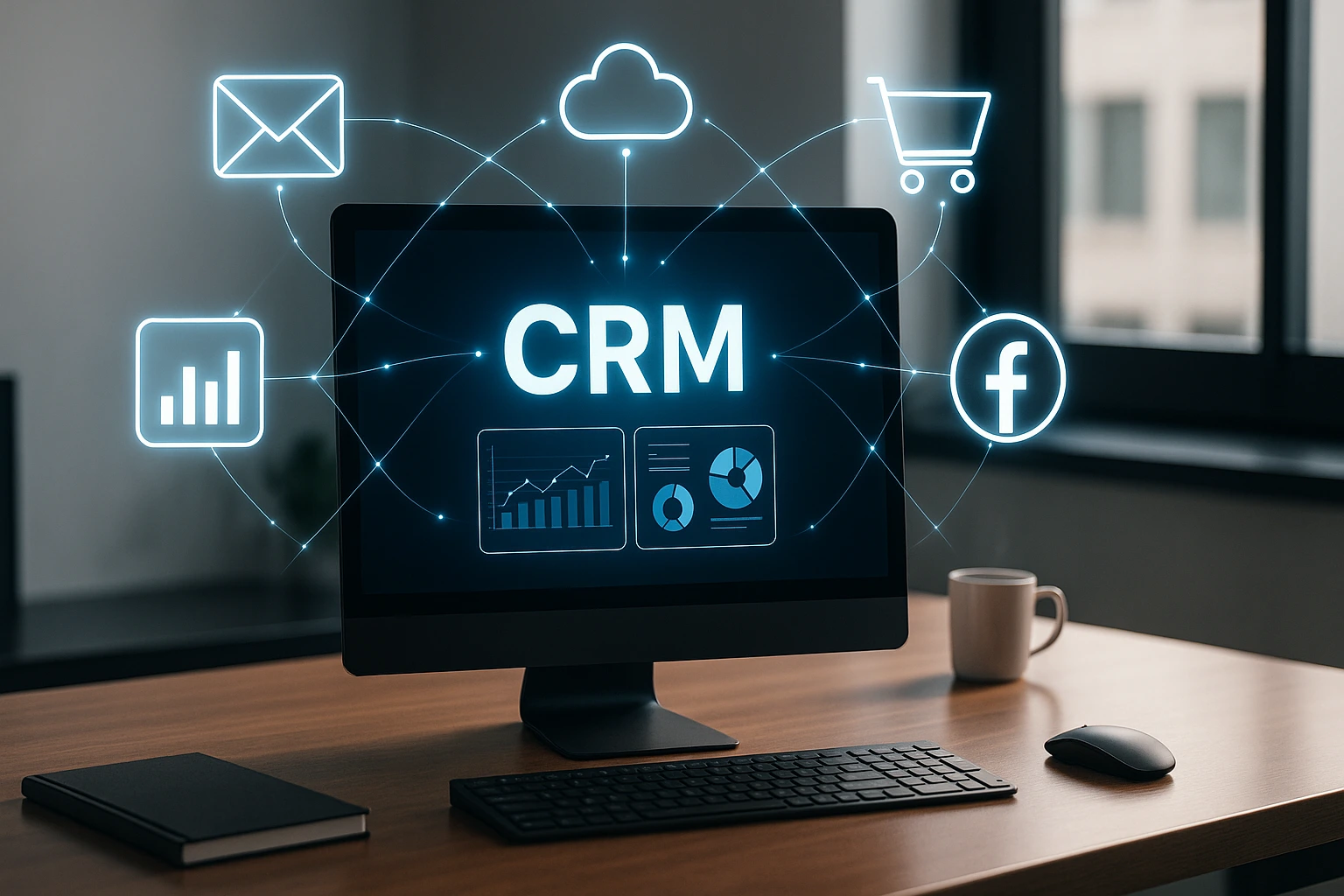
CRM integration is the process of connecting your customer relationship management (CRM) system with the other tools your business uses every day, from email and marketing platforms to e-commerce sites, accounting software, and customer service apps. Instead of switching between separate systems, all your data and processes work together in one unified place.
Think of your CRM as the central hub of your business, much like a smartphone. On its own, it can store customer details, track interactions, and manage accounts. But just as you add apps to your phone to make it more useful, you can connect your CRM to other systems through CRM integration tools. This turns your CRM into a powerful integrated CRM system that can automate tasks, provide real-time updates, and create a complete view of your customers.
For example, a platform like Salesforce or HubSpot can become much more valuable when linked to your e-commerce store, your email marketing platform, or your support desk. This ensures that sales, marketing, and service teams all see the same accurate information without duplication.
And the benefits are clear. Research shows that businesses using CRM effectively can boost sales by 29%, increase team productivity by 34%, and improve forecast accuracy by 42%. Yet more than 17% of sales professionals say poor integration with other software is their biggest challenge when using CRM. That gap highlights why CRM integration services UK are now in such demand.
Why Businesses Need Integrated CRM?
When your tools don’t “talk” to each other, your team wastes time on admin work, copy-pasting details, updating the same information in multiple places, or trying to piece together customer history. Integrated CRM systems solve this by enabling:
-
Seamless data sharing
Real-time updates across all platforms mean your staff always has the latest information.
-
Less manual work
No more re-entering customer data into multiple apps; integration handles it automatically.
-
Better reporting
With data flowing across systems, you get a complete picture of sales, marketing, and customer behaviour.
-
Improved customer experience
Teams can see order history, previous conversations, and preferences at a glance.
Customers expect quick responses and personal service. In fact, 65% of people now expect businesses to adapt quickly to their fast-changing needs. With CRM integration for the UK businesses, you can reduce delays, personalise service, and scale operations with confidence.
So, it can be said that CRM integration is not just a technical upgrade. It’s a way to run your business smarter, keep your teams connected, and deliver the seamless experiences that today’s customers expect. The right CRM integration services can transform your CRM into the backbone of your business.
Why Consider CRM Systems for Businesses?
As a business grows, manually keeping track of every customer interaction, sales detail, or preference becomes overwhelming. This is where CRM systems for businesses step in. A CRM offers a single, central place to store customer data, contact details, purchase history, and even preferences. Having this organised information at hand gives businesses deeper insights and helps them build stronger relationships. Simply put, a good CRM system makes it easier to deliver a more personalised and effective customer experience.
Key Reasons to Use CRM Systems

-
Streamlined Processes
One of the biggest advantages of a CRM system is how it streamlines processes. Repetitive tasks like sending follow-up emails, preparing quotes, or generating invoices can be automated. This not only saves valuable time but also reduces human error. According to Nucleus Research, businesses using CRM automation report a 14.6% boost in productivity. Freeing staff from manual tasks means they can focus on more important work, such as building client relationships or closing deals.
-
Improved Customer Experience
Modern customers expect personalisation. With CRM integration, businesses can track purchase history and preferences to understand customer needs better. This makes it possible to offer tailored recommendations, personalised offers, and more relevant communication. Research shows that 80% of customers are more likely to buy from brands that personalise their experience, making CRM an essential tool for creating loyal customers.
-
Higher Customer Retention
Keeping a customer is often cheaper than finding a new one. By studying customer behaviour, CRM systems can flag risks of churn early. This allows businesses to take timely action, such as offering support or incentives, before losing the client. Data from Bain & Company suggests that a 5% increase in customer retention can boost profits by 25–95%, making CRM-driven insights invaluable for long-term growth.
-
Efficient Lead Management
Managing leads without a system can be messy. A CRM makes it simple to track every lead’s progress through the sales pipeline. It highlights which leads are most likely to convert so businesses can prioritise wisely. This structured approach ensures no potential customer is overlooked, and conversion chances improve significantly.
-
Better Customer Service
When customer service teams have access to full communication history, feedback, and past interactions in one place, they can respond faster and more effectively. This quick resolution not only improves satisfaction but also builds trust. A CRM allows businesses to deliver service that feels personal and consistent across every touchpoint.
-
Stronger Team Collaboration
A CRM system centralises customer information, giving access to sales, marketing, and customer support teams alike. With everyone working from the same data, collaboration improves. Teams are better aligned, handovers are smoother, and customers get a seamless experience at every stage of their journey.
CRM Features That Make It Crucial for Businesses
For modern businesses, especially those in growth and client-focused industries, CRM features are no longer optional — they’re a necessity. A well-integrated CRM system doesn’t just store data; it simplifies workflows, strengthens relationships, and helps companies make smarter decisions. Below are the key CRM features for businesses that drive efficiency and growth.
-
Contact Management
At the heart of every CRM system is contact management. Instead of scattered spreadsheets and notes, businesses get a central hub for storing customer information. This includes contact details, purchase history, and personal preferences. Having all this data in one place makes it easier to track conversations and provide a personalised touch. Studies show that companies using CRM systems improve customer retention by up to 27%, thanks to better organisation and stronger engagement.
-
Order Management
Managing sales data manually can be chaotic. With CRM integration, order handling becomes smoother. From processing invoices to tracking shipments, businesses can manage sales and fulfillment in a single system. This not only reduces errors but also speeds up delivery, leading to happier customers and fewer complaints.
-
Marketing Automation
One of the most powerful CRM features is automation. Marketing automation tools help businesses design and send targeted email campaigns, schedule social media posts, and run promotions without manual effort. According to HubSpot, businesses that use marketing automation see an average 451% increase in qualified leads. By saving time on repetitive marketing tasks, teams can focus on strategy and creativity.
-
Reporting and Analytics
Data drives growth and CRM analytics make that data easy to understand. With detailed reports on sales performance, customer trends, and pipeline health, businesses can make smarter, evidence-based decisions. These insights also help spot growth opportunities that might otherwise be missed. A Salesforce report shows that 74% of businesses using CRM reporting improved their access to real-time customer data, giving them a competitive edge.
-
Third-Party Tool Integration
Modern CRM systems are flexible enough to connect with the tools businesses already use. This includes email marketing platforms, social media channels, payment gateways, and accounting software. By pulling everything into one place, CRM integration reduces duplication and ensures smoother workflows across departments. This kind of connectivity boosts overall efficiency and makes collaboration easier.
Must-Have CRM Systems for Businesses
Choosing the right CRM system is no longer a luxury, it’s a must for businesses that want to grow and stay competitive. A well-integrated CRM doesn’t just store data; it connects sales, marketing, and customer service into one smooth workflow. According to Gartner, businesses that fully adopt CRM systems can increase revenue by up to 41% per salesperson. Here are some of the most trusted CRM solutions for businesses today.
-
Zoho CRM
Zoho CRM is a flexible, cloud-based solution popular among small and mid-sized businesses. It covers all the essentials, contact and order management, marketing automation, and detailed reporting and analytics. Zoho’s biggest advantage is affordability, offering pricing plans to fit most budgets without compromising on features. Its easy CRM integration also makes it a go-to choice for businesses that need a balance of simplicity and power.
-
Salesforce CRM
Salesforce is often called the “gold standard” of CRM systems, and for good reason. It’s a powerful, cloud-based platform that helps large and growing businesses manage complex customer data. With tools for advanced analytics, order management, and marketing automation, Salesforce is designed for scale. While it comes at a premium price, its ability to integrate with thousands of third-party apps makes it one of the most complete CRM solutions on the market. IDC research shows that companies using Salesforce see an average 37% improvement in sales productivity.
-
Konnektive CRM
Konnektive is a dynamic option built to simplify customer management and sales tracking. It includes features like contact management, order processing, marketing automation, and performance analytics. What makes Konnektive stand out is its flexibility, it offers multiple pricing tiers and smooth integrations with other business tools, making it easy to adapt as your company grows.
-
Capsule CRM
Capsule is a clean, straightforward, and cloud-based CRM system that helps businesses keep track of contacts, sales, and tasks in one place. It offers contact management, order tracking, automated marketing campaigns, and strong reporting features. Capsule is especially appealing to small businesses and startups because of its simplicity, budget-friendly plans, and seamless integration with eCommerce platforms and accounting tools. This makes it ideal for businesses wanting to optimise sales strategies without overcomplicating workflows.
Each of these CRM platforms has its own strengths, but all share a common goal, helping businesses streamline operations, improve customer experience, and make smarter, data-driven decisions. Whether you’re a startup or a growing enterprise, investing in the right CRM system can transform the way you work.
Final Thoughts
In today’s fast-moving business world, customer relationships are everything. A well-integrated CRM system is no longer just a “nice-to-have” tool, it is a core part of building long-term success. By combining your CRM software with tools like email marketing platforms, messaging apps, accounting systems, and sales trackers, you can save time, reduce manual work, and deliver a seamless customer experience.
Reports show that companies using CRM integrations can improve sales productivity by up to 34% and boost customer retention by 27%. That means businesses not only work smarter but also keep their customers happier.
Whether you are a small business trying to organise contacts or a growing enterprise aiming for a complete digital workflow, CRM integrations help create one reliable system where all your data lives. Instead of switching between apps or struggling with scattered information, everything you need is right there in one place.
The bottom line? CRM integrations are one of the smartest investments you can make in 2025. They help simplify processes, improve collaboration, and give your team more time to focus on what really matters, building stronger customer relationships.
Frequently Asked Questions
Q1. Can CRM integrations help small businesses compete with bigger brands?
Yes. CRM integrations level the playing field for small businesses. By automating routine tasks, managing leads better, and connecting with customers through one platform, smaller companies can deliver the same level of service as larger enterprises, but with fewer resources.
Q2. How do CRM integrations support remote and hybrid teams?
With more people working remotely, integrated CRMs allow teams to access the same real-time data from anywhere. Sales, support, and marketing teams can collaborate without delays, ensuring customers always get timely responses, even if your staff isn’t in the same office.
Q3. Do CRM integrations improve customer satisfaction directly?
Absolutely. Customers notice when businesses respond faster, remember their preferences, and offer personalised communication. A CRM integration ensures no lead or query is lost between platforms, which means customers feel valued and heard.
Q4. What are some future trends in CRM integrations for 2025?
AI-powered insights, chatbots connected to CRMs, and predictive analytics are becoming standard. Businesses are moving towards CRMs that don’t just store data but also forecast customer needs and suggest the best actions.
Q5. Are CRM integrations secure for sensitive customer data?
Yes, most modern CRM solutions follow strict data protection standards like GDPR. When set up properly, integrations are encrypted and secure, ensuring customer information is safe across all platforms. Still, it’s wise to choose a trusted CRM provider and review their security certifications.