The question of whether to choose Agile or Waterfall is often posed early in the discussion when companies start planning a new website, software platform, mobile application, or digital transformation initiative.
For years, this debate has divided opinions across the technology sector. Agile supporters often promote flexibility and rapid delivery. Waterfall advocates highlight structure, predictability, and control.
However, after managing projects across software platforms, customer portals, internal business applications, and digital transformation programmes, one thing becomes clear.
Methodology is rarely the reason a project succeeds or fails.
In most cases, problems appear much earlier. Requirements aren’t fully understood, stakeholders pull in different directions, decision-making slows down, or teams try to squeeze too much into a single release.
I have seen organisations spend weeks debating Agile versus Waterfall while giving very little attention to the actual business problem they’re trying to solve. That’s usually where the bigger risk sits.
Read on to see how experienced delivery teams balance flexibility, predictability, and business objectives when planning successful digital projects.
Why the Agile vs Waterfall Debate Often Misses the Point?
Many discussions about project delivery start with a simple question: “Which methodology is better?”
Unfortunately, that question often leads organisations in the wrong direction. The better question is: “What does this project need to succeed?”
Every organisation operates differently. Some businesses have mature internal product teams and established digital processes. Others rely on a small group of stakeholders who balance project responsibilities alongside their day-to-day roles.
Likewise, every project has different goals. Some projects involve creating an entirely new digital product. Others focus on improving an existing platform that already serves customers and generates value.
These differences matter because the delivery model should support the business context rather than dictate it.
Successful project management begins with understanding:
- Business objectives
- User requirements
- Organisational structure
- Stakeholder availability
- Budget expectations
- Technical complexity
- Future growth plans
Only after these factors are understood does it make sense to determine the most appropriate delivery approach.
Understanding Waterfall and Why It Still Matters
Waterfall often receives criticism in modern software development discussions. Yet many organisations continue to use it successfully.
At its core, Waterfall follows a structured sequence of activities.
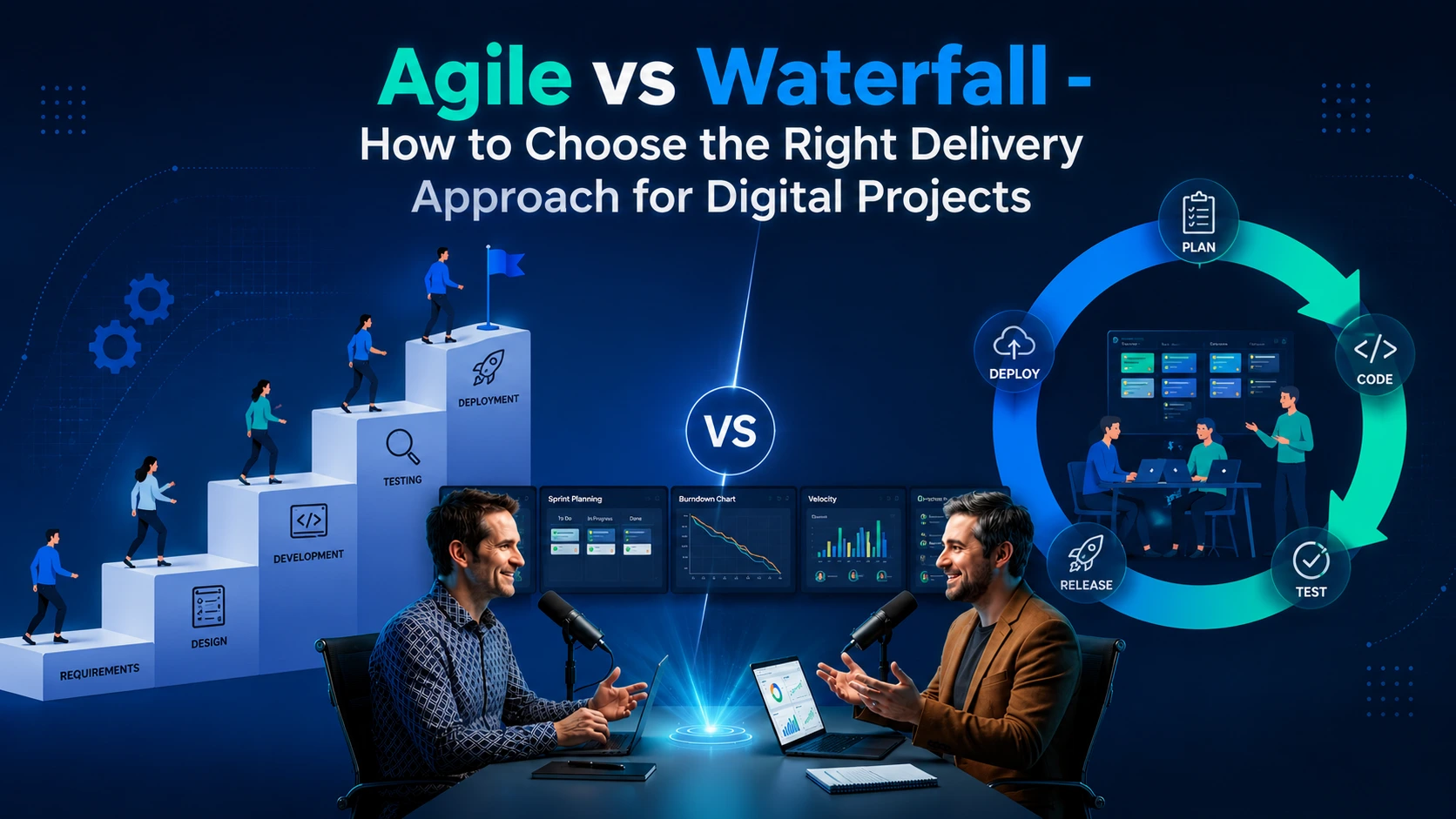
Requirements are defined first, followed by design, development, testing, and deployment. Each phase builds on the work completed before it, creating a structured path from project planning through to launch.
This structure creates a clear path from project initiation through to launch. For businesses investing in a new digital platform, this approach can provide significant advantages.
Predictable Costs and Timelines
Many organisations need clarity before committing to a project. Senior stakeholders often require approved budgets, defined timelines, and clear expectations regarding project scope.
Waterfall supports these requirements because planning happens early in the project lifecycle. By investing time in requirements gathering and project discovery, teams can create reliable estimates and establish realistic delivery expectations.
This predictability often provides reassurance to stakeholders responsible for financial planning and business performance.
Strong Governance and Control
Some industries operate within strict compliance frameworks. Others require extensive approval processes before changes can be implemented. In these environments, structured planning and documentation remain valuable.
Waterfall allows organisations to establish clear governance procedures while maintaining visibility over project progress.
Effective for Early Planning and Discovery
When you’re exploring a new product idea, jumping straight into development can create unnecessary risk.
A structured discovery phase gives you time to validate assumptions, understand user needs, define technical requirements, and identify potential challenges before significant investment takes place.
That doesn’t mean every feature needs to be documented upfront.
Many successful digital products begin with MVP thinking and evolve over time.
What matters is creating enough clarity to make informed decisions without spending months planning functionality that may never be needed.
The strongest projects often combine structured discovery with iterative delivery once development begins.
The Challenges of a Pure Waterfall Approach
Although Waterfall offers many benefits, it is not without limitations.
- The biggest challenge is time.
- Business requirements rarely remain static.
- Markets evolve.
- Customer expectations change.
- New opportunities emerge.
The longer a project takes to move from requirements gathering to launch, the greater the risk that original assumptions become outdated. This creates a common problem.
A project may successfully deliver everything specified at the beginning while failing to address what the business needs at the end.
Dan Sacker has seen this challenge play out on projects of all sizes.
“When projects run for several months, requirements often evolve before development is complete. That doesn’t mean the original plan was wrong. It simply reflects the reality that businesses change. The real challenge is creating enough structure to stay on track while leaving room for sensible adjustments.”
That does not mean Waterfall is ineffective. It simply means organisations must manage scope carefully and focus on delivering value quickly.
Why Agile Became the Preferred Choice for Many Digital Teams?
Agile emerged as a response to the limitations of traditional project delivery. Instead of defining everything upfront, Agile focuses on continuous improvement and incremental delivery.
Rather than waiting months for a complete solution, teams release smaller improvements more frequently. This results in shorter feedback loops and allows organisations to adapt as circumstances change.
Faster Delivery of Value
One of Agile’s greatest strengths is speed. Teams focus on high-priority requirements first. They deliver functionality in smaller increments. Stakeholders receive working solutions sooner. This type of approach allows businesses to generate value earlier while gathering feedback throughout the proces
Greater Flexibility
Business priorities rarely stay fixed. New opportunities emerge. Customer behaviour changes. Market conditions shift.
Agile enables organisations to respond without waiting for an entire project lifecycle to finish. Requirements can evolve as new information becomes available.
Continuous Improvement
- Digital products are rarely finished.
- Successful platforms evolve over time.
- New features are added.
- User experiences improve.
- Performance is refined.
Agile supports this ongoing evolution by creating a framework for continuous enhancement. For many established digital products, Agile becomes the natural delivery model once the initial platform is live.

The Organisational Reality Behind Agile Success
Many organisations say they want an Agile development partner. However, Agile success depends on more than selecting a supplier.
It requires commitment from both sides.
This is where many businesses underestimate the demands of Agile delivery.
Effective Agile environments rely on:
- Continuous collaboration
- Regular stakeholder feedback
- Clear prioritisation
- Fast decision-making
- Product ownership
- Cross-functional teamwork
Without these ingredients, Agile becomes difficult to sustain. Stakeholders must remain engaged throughout the process. Feedback needs to be timely. Priorities need to be reviewed regularly. When organisations cannot support this level of involvement, a purely Agile approach may struggle to deliver its intended benefits.
This does not reflect a failure of Agile. It simply reflects the reality that delivery methodologies must align with organisational culture.
One thing we regularly see is organisations asking for Agile delivery when what they actually want is faster delivery.
The two are not always the same.
If stakeholders aren’t available, priorities remain unclear, or feedback takes weeks to arrive, even an experienced Agile team will struggle to maintain momentum.
Agile works best when the organisation is prepared to participate, not simply observe.
Why MVP Thinking Matters More Than Methodology?
One of the most valuable lessons in digital project delivery has little to do with Agile or Waterfall.
It revolves around focus.
Many projects become difficult because scope grows faster than expected. New features get added, stakeholders introduce fresh requirements, and priorities shift as teams learn more about the problem they’re trying to solve.
Before long, timelines stretch, budgets come under pressure, and progress starts to slow.
That’s where MVP thinking becomes valuable. Instead of asking what else can be included, teams focus on what is genuinely required to deliver business value and start learning from real users.
Instead of asking: “What can we include?”
Teams ask: “What do we absolutely need?”
This shift creates clarity. It reduces complexity. And most importantly, it accelerates delivery.
Successful organisations challenge their own assumptions about what constitutes a must-have feature.
By focusing on core requirements first, they reduce risk and reach the market faster.
What We See Across Real Digital Projects
After delivering projects across healthcare, education, manufacturing, membership organisations, professional services, and the public sector, we have noticed the same pattern repeatedly.
Across software development projects, business applications, customer portals, and digital transformation programmes, projects rarely struggle because Agile or Waterfall was chosen. They struggle when expectations aren’t aligned, requirements remain unclear, or too much functionality is pushed into an early release.
In our experience, the delivery methodology is rarely the biggest risk. Most project challenges stem from unclear requirements, competing stakeholder priorities, underestimated technical complexity, or trying to launch too much functionality at once.
That’s why our teams place significant emphasis on discovery, stakeholder workshops, technical planning, and MVP definition before major development begins.
The goal isn’t to force a project into Agile or Waterfall.
The goal is to build a delivery approach that reflects how your organisation actually works.
Why Hybrid Delivery Often Produces Better Results
The Agile versus Waterfall debate assumes organisations must choose one methodology. In reality, many successful digital projects combine elements of both.
A hybrid approach allows businesses to benefit from the strengths of each model. This often works particularly well for new digital products.
- The project begins with Waterfall principles.
- Requirements are gathered.
- Objectives are defined.
- Budgets are agreed.
- Architectural decisions are made.
- The overall roadmap becomes clear.
Once development begins, Agile practices can be introduced. Development work moves through structured sprints. Features are delivered incrementally. Stakeholders review progress regularly. Feedback informs future work.
This approach provides both predictability and flexibility. The organisation gains confidence in project scope and budget while maintaining the ability to adapt as development progresses.
For many modern digital projects, this balance creates a practical middle ground.
Dan Sacker believes this is where many organisations find the most success.
“Very few projects fit neatly into a single methodology. Most benefit from having clear direction at the start and enough flexibility to adapt as new information emerges during delivery.”
| Factor | Waterfall | Agile | Hybrid |
|---|---|---|---|
| Requirements | Defined upfront | Expected to evolve | Core requirements defined early |
| Budget Control | High predictability | More flexible | Balanced |
| Timeline Certainty | High | Variable | Moderate to High |
| Stakeholder Involvement | Lower after planning | Continuous | Regular checkpoints |
| Managing Change | More difficult | Easier | Controlled flexibility |
| Best Fit | Well-defined projects | Evolving products | Most modern digital initiatives |
Important Questions to Ask Before Choosing a Delivery Approach
Before selecting Agile, Waterfall, or a hybrid model, organisations should evaluate their circumstances honestly.
Consider the following questions:
How clearly are the requirements defined?
Well-defined requirements often support structured delivery.
Evolving requirements may benefit from Agile practices.
Do stakeholders require fixed budgets and timelines?
Projects with strict financial controls may need greater upfront planning.
How available are key stakeholders?
Agile delivery depends on regular involvement and decision-making.
Does the organisation have product ownership capability?
Dedicated product owners often strengthen Agile environments.
Are there significant third-party dependencies?
Integrations and external systems may require additional planning and coordination.
Is the project creating something new or improving something existing?
New platforms often benefit from stronger planning.
Existing products frequently benefit from iterative improvement.
The answers to all these questions provide valuable guidance when selecting the right approach.
The Most Important Lesson – Start with the Problem, Not the Methodology
- Teams often spend more time debating frameworks than discussing the problem they’re trying to solve.
- In reality, successful projects begin by understanding the problem that needs solving.
- Your objectives, stakeholders, budget, internal processes, and appetite for change should shape the delivery approach, not the other way around.
- Methodologies are tools.
- Good outcomes come from selecting the right tool for the situation and applying it with discipline.
Final Thoughts
The Agile versus Waterfall debate has been going on for years, and I suspect it will continue for years to come.
Personally, I think many organisations focus on the wrong question.
The real challenge isn’t choosing a methodology. It’s creating the conditions that allow delivery teams to succeed.
If objectives are unclear, decisions take too long, or scope keeps expanding, the project will struggle regardless of which framework you choose.
Get those fundamentals right and several delivery approaches can work successfully.
Get them wrong and no methodology will rescue the project.
In practice, many of the most successful digital projects don’t follow a pure Agile or pure Waterfall model. They borrow principles from both. They use structure where it’s needed and flexibility where it creates value.
That’s usually where the strongest outcomes happen.
The organisations that consistently succeed aren’t loyal to a methodology. They’re loyal to solving business problems efficiently, reducing risk, and delivering value sooner.
Planning a New Digital Project?
Choosing the right delivery approach can have a significant impact on project success. Whether you’re building a new platform, modernising an existing application, or planning a complex digital transformation initiative, having the right strategy from the outset helps reduce risk and maximise value.
At IDS Logic, we work closely with organisations across the UK to define requirements, select the most effective delivery model, and develop scalable digital solutions that align with business goals.
Ready to discuss your project?