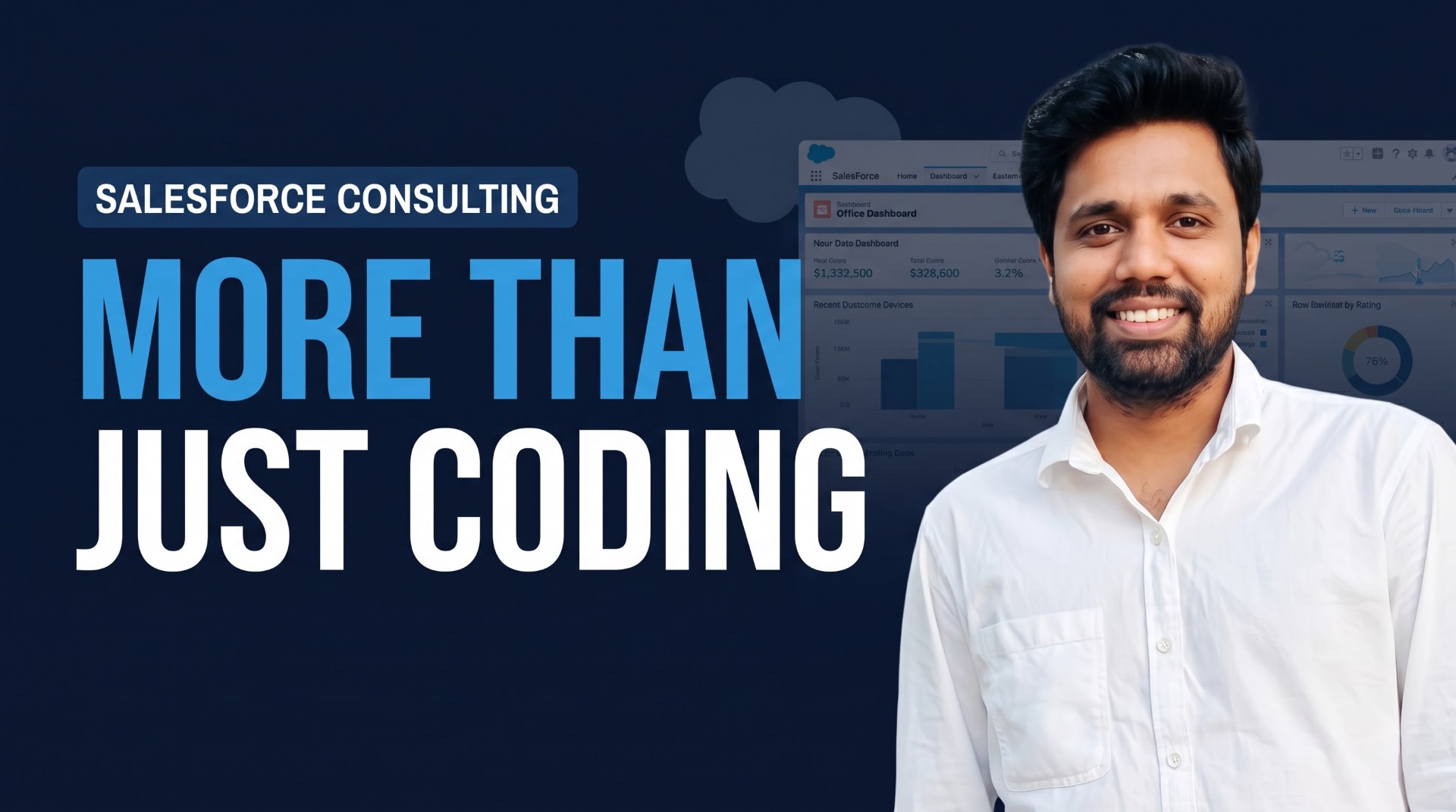
Salesforce can do far more than manage customer records. When it is properly designed and continuously optimised, it can help businesses automate repetitive processes, improve management visibility, connect systems and give teams a more effective way to work.
But there is an important distinction between having Salesforce and getting business value from Salesforce.
Many organisations invest in Salesforce licences, customisations and integrations but still rely on spreadsheets, manual processes and workarounds. The problem is often not the platform itself. It is how Salesforce has been designed, adopted and managed.
So, what does effective Salesforce consulting actually involve?
We spoke with Anurag Bhardwaj, who leads the overseas Salesforce consulting practice at IDS Logic, to understand how organisations can move beyond simply adding more Salesforce functionality and instead focus on measurable business outcomes.
“Salesforce consulting starts with understanding the business — not simply deciding which Salesforce feature to implement.”
Watch the Salesforce Expert Interview
Want to hear the Salesforce perspective directly from our expert?
In this interview, Anurag Bhardwaj explains how businesses can get more value from Salesforce through better processes, automation, managed support, release planning and continuous improvement.
What Does Salesforce Consulting Actually Mean?
Salesforce consulting is often misunderstood as simply configuring Salesforce or developing new features.
In practice, effective Salesforce consulting starts much earlier.
A consultant should first understand:
- What the business is trying to achieve
- How different teams currently work
- Where employees lose time
- Which processes are repetitive or manual
- Where information is difficult to access
- Which systems need to integrate with Salesforce
- Whether the existing Salesforce setup is actually being used effectively
Only after understanding these areas should a solution be designed.
For example, a business may believe it needs another Salesforce feature when the real problem is an unnecessarily complicated process.
In some situations, simplifying Salesforce can create more value than adding functionality.
This business-first approach is particularly important for organisations that have accumulated years of customisations, workflows, integrations and data.
Why There Is No One-Size-Fits-All Salesforce Solution
Salesforce is a broad ecosystem rather than a single-purpose application.
Organisations may use:
- Sales Cloud
- Service Cloud
- Experience Cloud
- Health Cloud
- Nonprofit Cloud
- Custom Salesforce Platform solutions
- Integrations with external applications
Each environment introduces different requirements.
A startup implementing Salesforce for the first time may need a relatively straightforward CRM foundation.
A larger organisation may already have complex opportunity processes, integrations, user permissions, reporting requirements and legacy automation.
The right Salesforce strategy therefore depends on the organisation’s business model, processes, users, data and technology environment.
That is why copying another company’s Salesforce configuration rarely produces the same results.
The Real Salesforce Problem: Too Much Manual Work
One of the strongest opportunities for Salesforce optimisation is reducing repetitive work.
Consider a sales team where employees manually:
- Update opportunity stages
- Enter customer information
- Prepare management reports
- Create follow-up tasks
- Clean duplicate records
- Build spreadsheets for reporting
Individually, these activities may appear small.
Across an entire sales organisation, however, they can consume significant amounts of employee time.
Salesforce consulting should therefore ask a different question:
“Which business processes can we make simpler, faster or more automated?”
That shift from feature implementation to process improvement can have a much greater business impact.
Salesforce Managed Support Is More Than Break/Fix
Another common misconception is that Salesforce support means fixing problems when something stops working.
For growing organisations, that approach is often insufficient.
A managed Salesforce service can operate more like an extension of the internal team, providing ongoing expertise across areas such as:
- Salesforce administration
- User management
- Development
- Architecture
- Salesforce Flow
- Apex development
- Lightning Web Components
- Integrations
- Feature enhancements
- Performance improvements
- Technical advisory
- Release management
This can be particularly valuable for organisations that need Salesforce expertise but do not want to hire multiple specialists internally.
Instead of waiting for a problem to occur, a managed support model provides continuous improvement.
What Do Businesses Actually Ask Salesforce Consultants to Do?
The most valuable Salesforce projects are often driven by practical business problems rather than requests for a particular feature.
For example, organisations may need help with:
Automating Manual Processes
A process that currently requires employees to complete several manual steps may be redesigned using Salesforce automation.
Improving Management Visibility
Leadership teams may need better dashboards and reporting to understand sales performance, pipeline activity or operational trends.
Managing User Access
As organisations grow, new employees may require different roles, permissions and access levels.
A structured approach to user and permission management helps maintain both usability and control.
Improving Opportunity Management
Sales teams may need changes to opportunity stages, processes or approval workflows to better reflect how the business actually sells.
Cleaning Duplicate Data
Duplicate records can affect reporting quality, user confidence and operational efficiency. Salesforce’s low-code/no-code capabilities can support structured data-cleaning processes.
The common theme is simple:
The technology should support the business process – not the other way around.
Salesforce Release Management: Why Businesses Need to Prepare
Salesforce regularly introduces platform changes, new functionality and deprecations.
For businesses running important operations through Salesforce, treating these releases as something that can simply be ignored creates unnecessary risk.
A sensible release-management process includes:
- Reviewing Salesforce release notes.
- Identifying features or processes that could be affected.
- Testing critical processes in a sandbox.
- Checking integrations and custom functionality.
- Identifying deprecated functionality.
- Preparing users for relevant changes.
- Deploying changes in a controlled manner.
This is especially important when Salesforce technologies or automation approaches are being retired or replaced.
Example: Moving from Process Builder and Workflow to Flow
Salesforce has been moving customers towards Flow as the strategic automation technology.
For organisations with older automation, this creates an important consulting question:
Should we simply migrate the existing automation, or should we redesign the process?
A direct migration may reproduce unnecessary complexity.
A better approach can be to review the existing business process and consolidate multiple automations into a cleaner, more maintainable solution.
Salesforce Cost Optimisation Isn’t Just About Reducing Licences
When businesses discuss Salesforce costs, the conversation often focuses on licence numbers.
That is only one part of the equation.
A larger opportunity can come from improving the efficiency of the processes running on the platform.
For example, a business could reduce operational costs by:
- Eliminating unnecessary manual work
- Consolidating multiple automations
- Improving data quality
- Reducing duplicate processes
- Increasing user adoption
- Improving reporting
- Integrating disconnected systems
- Making better use of existing Salesforce capabilities
The objective should not simply be:
“How can we spend less on Salesforce?”
It should be:
“How can we generate more business value from the Salesforce investment we already have?”
Where Does AI Fit Into Salesforce?
AI is increasingly becoming part of the Salesforce conversation, but organisations should avoid treating AI as a standalone solution.
Before introducing AI-driven automation, businesses should understand:
- What data is available?
- Is the data accurate?
- Which processes are suitable for automation?
- What decisions still require human oversight?
- How should access and permissions be managed?
- What measurable business outcome is expected?
Agentic AI and intelligent automation could increasingly help organisations automate reporting, workflows and repetitive activities.
However, AI should be introduced where it solves a clearly defined business problem.
The goal isn’t to add AI because it is available. The goal is to use AI where it creates measurable value.
How Should You Measure Salesforce Success?
A Salesforce implementation should not be judged by the number of features delivered.
A better question is:
What changed for the business?
Useful measures can include:
- Increased user adoption
- Reduced manual administration
- Faster sales processes
- Improved management visibility
- Better data quality
- Faster customer response
- Reduced duplicate work
- Improved reporting accuracy
- Better integration between systems
For example, implementing a new dashboard is not necessarily a success.
If managers previously spent two hours preparing reports and can now access the required information immediately, that is a measurable business improvement.
5 Questions to Ask Before Changing Your Salesforce Environment
Before adding another Salesforce customisation, ask:
- What business problem are we solving?
Start with the problem rather than the technology. - Can the existing Salesforce configuration be simplified?
More functionality does not always mean a better solution. - Is this process genuinely worth automating?
Automation should reduce meaningful effort rather than simply move work from one place to another. - Will users actually adopt the change?
A technically successful implementation can still fail if employees do not understand or use it. - How will we measure the outcome?
Define the expected business improvement before implementation.
Why Ongoing Salesforce Optimisation Matters
Salesforce environments rarely remain static.
Businesses change. Teams grow. Processes evolve. New integrations are introduced. Salesforce releases new capabilities. Older technologies are deprecated.
This means Salesforce optimisation should be treated as an ongoing process rather than a one-time project.
A mature Salesforce strategy combines:
Business strategy → Process improvement → Salesforce architecture → Automation → Integration → Adoption → Continuous optimisation
This approach helps organisations keep Salesforce aligned with the way the business actually operates.
How IDS Logic Approaches Salesforce Consulting
At IDS Logic, we believe Salesforce consulting should begin with the business outcome, not a list of features.
Our approach focuses on understanding how teams work, identifying operational bottlenecks and then determining where Salesforce can create measurable improvements.
Depending on the organisation’s requirements, this may involve:
- Salesforce consulting
- Salesforce implementation
- Salesforce customisation
- Salesforce integration
- Salesforce managed support
- Salesforce administration
- Salesforce automation
- Salesforce Flow development
- Salesforce data management
- Salesforce architecture
- Release and upgrade planning
- Ongoing optimisation
The objective is not to make Salesforce more complicated.
It is to make the platform more useful, more efficient and more aligned with the business.
Final Thoughts
The biggest Salesforce opportunity for many businesses isn’t another feature.
It is finding a better way to use the platform they already have.
When Salesforce consulting starts with business processes, organisations can identify where automation, better data, improved reporting and stronger system integration can create measurable value.
For UK businesses, the right Salesforce strategy should therefore go beyond implementation. It should focus on adoption, optimisation, continuous improvement and business outcomes.
If your Salesforce environment has become difficult to manage, relies heavily on manual processes or isn’t delivering the value you expected, it may be time to step back and review the bigger picture.
Is Your Salesforce Environment Delivering Enough Business Value?
IDS Logic can help you assess your Salesforce environment, identify process and automation opportunities, improve platform efficiency and create a practical roadmap for continuous Salesforce improvement.