Moodle LMS advantages offers an edge to the learners using the system. Here is everything to know about Moodl.
Choosing an LMS can look straightforward until you start comparing what each platform can actually support. The difficult part is rarely finding an LMS with enough features. It is finding one that fits your learners, existing systems and long-term plans without creating unnecessary complexity or cost.
Moodle takes a different approach. The Moodle learning management system is open-source software for creating, delivering and managing online learning. You can shape the platform around your learners, courses, assessments, reporting requirements and existing technology through Moodle development and configuration tailored to your learning requirements.
That flexibility has helped Moodle establish a substantial global footprint. Official Moodle statistics currently list more than 145,000 registered sites, 523 million users and 58 million courses across 235 countries. More than 4,400 registered sites are in the UK.
Yet popularity alone does not make an LMS right for your organisation. You need to understand what Moodle does well, where it needs configuration, and how it fits your learning model.
This guide explains Moodle LMS features, uses and benefits from that practical perspective. It also covers Moodle 5.2 and what UK organisations should consider before implementation.

What Is Moodle LMS?
Moodle is an LMS, or learning management system, designed to manage learning through one digital environment.
It lets you create courses, enrol learners, deliver resources, run assessments and monitor progress. Administrators can also manage permissions, reports and learning activities centrally.
The name Moodle originally stands for Modular Object-Oriented Dynamic Learning Environment. The platform first appeared in 2002. Since then, it has developed into a mature Moodle learning platform used across education, training and workplace learning.
Unlike many proprietary platforms, Moodle LMS is open source. That means organisations can access and adapt the underlying software rather than depending entirely on one commercial vendor.
Open source does not mean your LMS costs nothing to operate. Hosting, implementation, integrations, custom development, security, upgrades and support still require investment.

Is Moodle an LMS or a Course Management System?
You may sometimes see Moodle described as a course management system because courses sit at the heart of the platform. That description is now too narrow.
Modern Moodle manages users, learning pathways, assessments, collaboration, reporting, permissions, mobile experiences and external integrations. So, while the phrase Moodle course management system still appears in searches, Moodle is more accurately described as a full LMS.
Key Moodle LMS Features You Should Know
Features only become useful when they solve a learning or administrative need. For Moodle, the value lies in how its course, assessment, reporting and integration tools work together. The core Moodle LMS software provides a broad foundation without requiring every organisation to use the platform in the same way.
Course Creation and Structured Learning
Course creators can organise material around topics, dates, competencies or specific learning journeys. Moodle supports resources alongside activities such as assignments, quizzes, forums, workshops, lessons and H5P interactive content.
SCORM packages can also form part of Moodle courses. LTI support allows external learning tools to connect with the platform. This gives course teams room to create more than a library of PDFs and videos. You can combine content with discussion, assessment, practice and feedback.
Assessments, Grades and Completion Tracking
Moodle provides quizzes, assignments, gradebooks and course-completion controls.
Educators can define completion criteria and track how learners progress through different activities.
This becomes useful when learning needs evidence. Completion evidence may support compliance, while academic teams need structured assessment and training providers require reliable progress records.
Moodle 5.2 has also introduced enhanced multiple-marker workflows for assignments. This gives institutions more flexibility when several assessors need to grade work.
Reporting and Learning Analytics
Good learning platforms should answer more than “How many people completed the course?”
Moodle provides course and activity reporting alongside grade and completion information. Administrators can use this information to examine participation, achievement and engagement.
More complex reporting may still require configuration, custom reports or integration with external analytics tools. Installing Moodle alone will not create the reporting model your organisation needs. More complex management or compliance reporting may require careful configuration or additional development.
Roles, Permissions and Controlled Access
Not every user needs the same access. Moodle supports roles and permissions so administrators can control what learners, teachers, managers and other users can do.
Granular access becomes particularly useful when you manage several learner groups or sensitive learning information. Authentication can also connect with wider identity systems, depending on the implementation.
Mobile and Flexible Learning
Learners increasingly move between devices and locations.
The Moodle App supports mobile course access and can provide offline access to supported learning content and activities. Organisations requiring a more tailored mobile learning experience can also consider Moodle mobile app development for branded journeys, integrations and specific learner requirements.
Accessibility
Accessibility is an important consideration for UK learning platforms. Moodle LMS achieved WCAG 2.2 Level AA accessibility conformance following an external audit in October 2025. The core platform also supports assistive technologies and accessibility checks.
This does not make every course automatically accessible. Themes, plugins, third-party tools and uploaded content still affect the learner experience.
Plugins, Integrations and Customisation
Much of the Moodle platform’s extensibility comes from its plugin and integration ecosystem. Where standard functionality does not meet a specific requirement, Moodle plugin development can extend the platform with tailored activities, reporting, workflows or integrations.
Moodle can also connect with systems such as:
- HR platforms;https://www.idslogic.co.uk/moodle-plugin-development.php?utm_source=chatgpt.com
- CRM solutions;
- identity and SSO services;
- video conferencing tools;
- payment services;
- student information systems;
- reporting platforms;
- external learning applications.
Plugins should still solve a real requirement. Installing extensions simply because they exist can create future compatibility and upgrade problems.
AI with Governance and Choice
AI is now part of Moodle’s core direction rather than an external trend sitting around the platform. Moodle provides a configurable AI subsystem that lets organisations decide how approved AI providers enter their learning environment.
Moodle 5.2 expanded this further by adding Gemini AI and Amazon Bedrock integrations in core. That creates opportunities around content creation, explanation and learning support. However, organisations still need clear rules around data, acceptable use, academic integrity and human oversight. The technology is only part of the decision. Organisations also need clear policies for data use, academic integrity, acceptable use and human oversight.
Planning a Moodle LMS Around Your Learners and Business Requirements?
IDS Logic can help you plan, customise, integrate or modernise a Moodle-based learning environment.
What Is Moodle Used For?
A well-designed Moodle learning system can support education, workforce development, public-sector learning and commercial training. How you configure it depends on the audience.
Moodle LMS for Education
Education remains one of Moodle’s strongest use cases. Schools, colleges and universities can use Moodle to bring course material, activities, assessments and communication together.
A lecturer might combine reading material with quizzes, forums and assignments. Students can see deadlines, submit work and track their progress from the same environment. For blended learning, classroom activity can sit alongside digital resources rather than competing with them.
How Universities Use Moodle LMS
Universities typically face a different problem from smaller training teams: scale and complexity. They may need to support thousands of learners, large course catalogues and different faculties.
Assessment workflows, accessibility, integrations and reporting also become more demanding. A well-architected Moodle environment can support these requirements, but infrastructure and governance need equal attention. Successful growth therefore depends as much on infrastructure and governance as the Moodle software itself.
Moodle LMS for Government and Public-Sector Learning
A Moodle LMS for government can support workforce learning, induction, policy training and professional development. Public-sector learning also places greater emphasis on accessibility, governance and controlled access.
The platform’s flexibility helps organisations create different experiences for roles, departments or learner groups. For UK public bodies, accessibility and data governance should form part of the design from the beginning.
Employee and Corporate Training
Moodle is not limited to schools and universities.
Businesses can use it for:
- employee onboarding;
- mandatory training;
- product knowledge;
- skills development;
- partner education;
- professional development;
- internal knowledge programmes.
Where Moodle needs to exchange learner, enrolment or training data with existing business systems, Moodle integration and migration can help connect or transition the learning environment with greater control.
Training Providers and Commercial Learning
Training businesses have another set of requirements. They may need course catalogues, paid enrolment, assessments, certificates and reporting across different customer groups.
Moodle can support paid enrolment and connect with payment services. However, a complex training business may need additional ecommerce, CRM or reporting integration. Moodle should not automatically become your ecommerce platform simply because you sell courses.
The right setup may connect Moodle with a dedicated commerce or CRM system rather than forcing one platform to handle every function.
How Does Moodle LMS Work in Practice?
The basic workflow is straightforward, although the setup can become more sophisticated as your learning requirements grow.
- Set up the learning environment: Configure branding, authentication, permissions and key platform settings.
- Create courses and learning pathways: Structure resources, activities, assessments and completion criteria.
- Enrol learners: Add users manually, enable self-enrolment or connect Moodle with another business system.
- Deliver and assess learning: Learners complete activities while educators provide feedback and evaluate progress.
- Review learning evidence: Grades, completion data and reports help teams understand participation and outcomes.
Complexity usually appears around integrations, migrations, permissions, reporting and multiple learner groups. Addressing those areas during planning is far easier than fixing them after launch.
What’s Changed in Moodle LMS in 2026?
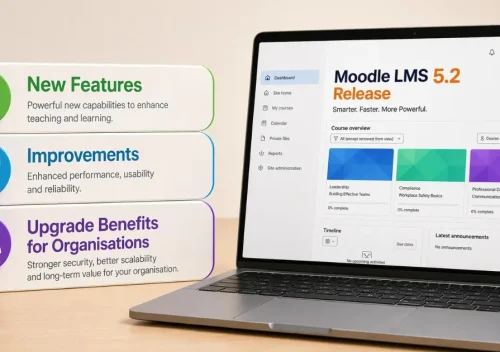
As of August 2026, Moodle 5.2 is a current stable release. Moodle 5.2.2 arrived on 10 August 2026.
Moodle 5.2 includes improvements around:
- multiple-marker assignment workflows;
- quiz and question-bank management;
- reporting flexibility;
- dashboard and login experiences;
- Gemini AI and Amazon Bedrock integration;
- course navigation;
- administrator workflows;
- mobile controls.
It also introduces underlying platform improvements such as React foundations and OpenTelemetry support. These are more relevant to development and operations teams.
There is another practical point for organisations planning upgrades. Moodle 4.5 remains the current LTS branch, with security support scheduled until October 2027. Moodle 5.3 is scheduled as the next LTS release for October 2026.
That means “install the newest version” is not always the complete upgrade strategy. You also need to assess plugin compatibility, custom code, support windows and your preferred release model.
Key Benefits of a Moodle-Based LMS
The strongest Moodle LMS benefits become clear when you look beyond the feature list and consider how much control the platform gives your organisation.
You Can Shape the Platform Around the Learning Model
A Moodle-based LMS can adapt to different course structures, audiences and delivery models. You can configure branding, workflows and functionality without rebuilding the complete platform. That makes Moodle useful when a rigid off-the-shelf LMS creates too many compromises.
You Retain More Control Over Technology and Data
Open-source software gives organisations greater control over deployment and customisation. You can make decisions about hosting, integrations and development around your own requirements. Greater control also means taking ownership of architecture, upgrades, security and support. Someone still needs to manage architecture, upgrades, security and support properly.
Moodle Supports Both Structured and Flexible Learning
Not every learning programme follows the same path. Some require strict completion rules and assessments. Others rely more heavily on discussion, resources, workshops or self-directed learning. Moodle accommodates both models. This makes it useful across academic learning, compliance programmes and professional development.
It Can Grow Beyond the Initial LMS Requirement
A platform may begin with ten courses and one learner group. Later, the organisation may introduce SSO, new departments, mobile learning or external audiences. Its plugin and integration ecosystem allows the learning environment to evolve as requirements change. Every customisation should have an owner, purpose and future maintenance plan.
Accessibility Is Built into the Platform Direction
Accessibility should not depend entirely on custom development. Moodle’s WCAG 2.2 Level AA conformance gives organisations a stronger starting point for inclusive learning. Course creators still need to produce accessible content. Third-party integrations also need separate evaluation.
There Is a Large Global Ecosystem
Moodle benefits from a substantial open-source community, documentation base and plugin ecosystem. That reduces dependence on one development team. It also makes specialist help easier to find when the platform becomes more sophisticated.
Where Moodle Can Become Difficult
Moodle’s extensibility is valuable, but poorly governed implementations can become harder to upgrade, support and scale over time.
Too many plugins or unnecessary core customisations are common examples. Reporting can become another pressure point as organisational requirements grow.
Standard reports may be enough initially. Larger organisations often need more specific management, compliance or operational reporting. Integrations can also expose weak planning.
An HR system, CRM, SSO service and LMS may all hold information about the same learner. Someone needs to decide which system owns each piece of data.
Performance deserves similar thought. Adding more users does not automatically cause trouble, but infrastructure, caching and database design matter at scale.
The same applies to upgrades. A heavily customised Moodle platform needs more testing than a standard installation.
This is why Moodle expertise should cover more than course setup. Architecture, interoperability, learning analytics, competency frameworks and upgrade governance all influence long-term platform quality.
Is Your Existing Moodle LMS Becoming Difficult to Maintain?
IDS Logic can review performance, integrations, upgrades, plugins and ongoing support requirements.
Moodle LMS or Moodle Workplace – Which One Fits Better?
The names are similar, but the products serve slightly different requirements.
Moodle LMS is the open-source learning management system discussed throughout this guide. It works well for education, training providers and organisations needing a flexible learning foundation.
Moodle Workplace builds on Moodle LMS for more complex workplace learning. It adds business-focused capabilities around organisational structures, programmes, automation and multi-tenant environments. Moodle Workplace is distributed through Moodle’s certified partner ecosystem rather than as the same open-source download.
A business does not automatically need a Moodle Workplace. The decision should come from requirements such as organisational hierarchies, automation, programmes and multi-tenancy.
If standard Moodle LMS already covers your audiences and processes, extra enterprise functionality may add unnecessary complexity.
How Do You Know Whether Moodle Is Right for Your Organisation?
Start with your learning problem, not the platform. Five questions usually expose what you actually need:
Who will learn?
Employees, students, customers and external partners often require different journeys.
What must you prove?
Consider completion, competency, certification, assessment and compliance evidence.
Which systems must connect?
Think about HR, CRM, identity, payments, video conferencing and business intelligence.
Who will operate the LMS?
A flexible system still needs clear platform ownership.
How much change do you expect?
Consider new audiences, acquisitions, international growth and evolving training models.
Once those answers are clear, you can assess whether standard Moodle configuration is enough. You may instead need plugins, custom development, integrations, Moodle Workplace or a bespoke LMS architecture.
Why Choose IDS Logic for Moodle and LMS Development?
Choosing Moodle is only one part of the decision. The harder work is turning the technology into something learners can use and administrators can manage confidently.
IDS Logic supports Moodle LMS development, customisation, integration, migration, testing and ongoing platform evolution. Our UK services also include custom Moodle development for organisations with specific learning journeys, reporting needs or enterprise integrations.
Many LMS problems start before development. Poor learner journeys affect adoption, disconnected systems create administration work, and weak reporting leaves managers without useful evidence.
That approach matters because many LMS problems begin before development. Poor learner journeys reduce adoption. Disconnected systems create manual administration. Weak reporting leaves managers without useful evidence.
IDS Logic brings 19+ years of industry experience, 750+ satisfied customers, 100+ technology professionals and 83% repeat and referral business across its wider delivery capability.
The objective is not to customise Moodle simply because you can. It is to create a learning platform that fits your users, operating model and long-term ownership requirements.
Build a Moodle LMS Around Real Learning and Business Requirements
Discuss your learners, existing platform, integrations or future LMS plans with the IDS Logic UK team.
Conclusion – Moodle Works Best When the Platform Fits the Learning Model
Moodle has remained relevant because organisations can shape it around very different learning environments.
Its open-source foundation, course tools, assessments, reporting, integrations and plugin ecosystem provide a strong starting point. The Moodle LMS features available in 2026 also go much further than basic course delivery.
In 2026, the platform combines stronger accessibility with evolving AI capabilities, improved assessment workflows and greater administrative control. Yet Moodle’s flexibility should not become an excuse for unnecessary complexity.
A successful implementation starts with your audience, learning outcomes, evidence requirements and operating model. Moodle’s extensibility should then be used where it improves learning, simplifies administration or solves a genuine integration need.
That is how Moodle LMS software becomes a sustainable learning environment rather than another system teams have to manage.