Websites today have more demands on them than ever before. They have to load quickly, remain secure, and provide a smooth user experience every time. This is why updating their Sitefinity websites has become a priority for many UK organisations.
Progress Sitefinity is a trusted CMS known for strong content management and digital experience tools. It powers thousands of enterprise websites worldwide. However, even a reliable platform needs regular updates to perform at its best.
When businesses delay a Sitefinity website update, they often face slower pages, security gaps, and rising support issues. In contrast, keeping your CMS current helps you meet modern user expectations and business demands.
In this guide, we explain why to update Sitefinity website now and how upgrading supports performance, security, and long-term growth.
Sitefinity Website Update: Why Security, Stability, and Savings Start with an Upgrade
When websites fall behind on updates, problems grow quietly. Security gaps appear. Performance dips. Support becomes harder to access. This is why a Sitefinity website update matters more than ever for UK organisations.
Progress Sitefinity releases regular updates to improve security, performance, and usability. Yet many businesses delay upgrades because their site still “works”. In 2026, that delay often leads to higher risk and cost.
Below are the most important reasons why update Sitefinity website now, based on real customer pain points and the latest platform improvements.
Top Reasons to Update Your Sitefinity Website to the Latest Version
Security remains the top driver for a Sitefinity website update.
Cyber threats continue to rise across the UK. In recent years, most website attacks have targeted known weaknesses in outdated systems. When a CMS version falls behind, it no longer receives full security patches.
Upgrading ensures access to regular Sitefinity security updates, including stronger authentication, safer admin access, and improved data protection. Newer versions also support modern compliance standards, which helps protect customer trust and business reputation.
For organisations managing sensitive data, staying current is no longer optional.
Ongoing protection works best with structured Sitefinity support and maintenance, which ensures updates stay consistent and risk-free.
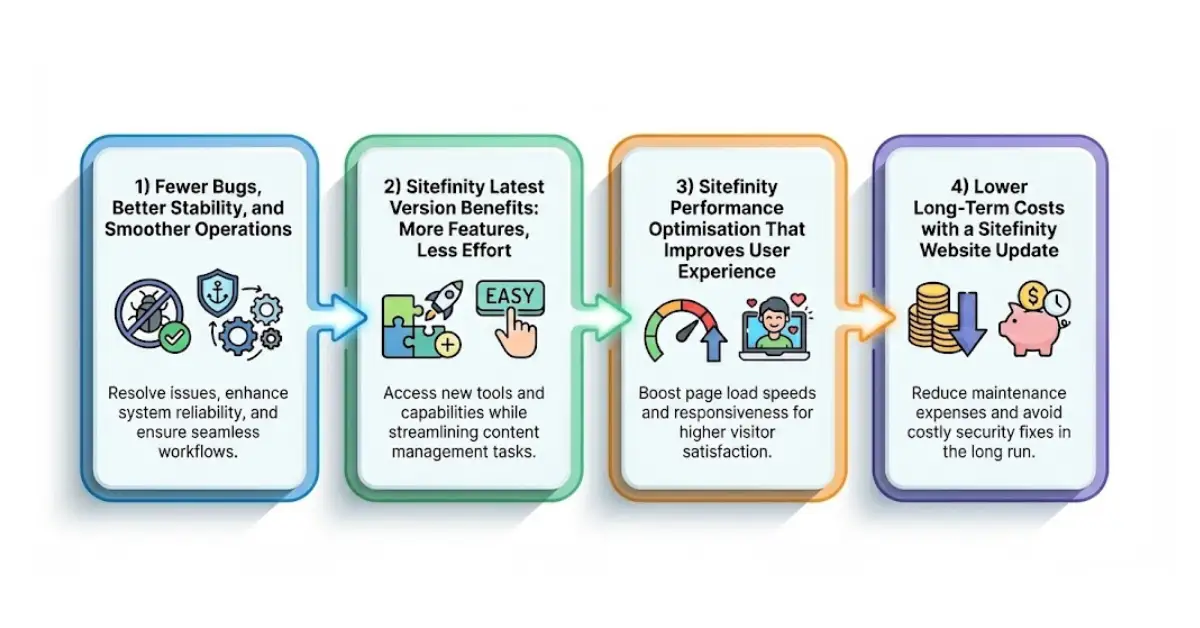 1) Fewer Bugs, Better Stability, and Smoother Operations
Every Sitefinity release fixes known issues from earlier versions.
Bug fixes improve reliability across content editing, publishing, and backend processes. Over time, these fixes reduce errors that slow teams down or disrupt visitors.
When businesses skip upgrades, bugs pile up. This leads to manual fixes, emergency patches, and wasted development time. A modern CMS upgrade UK organisations rely on prevents these problems before they escalate.
Upgrading keeps your website stable and easier to manage day to day.
2) Sitefinity Latest Version Benefits: More Features, Less Effort
A key reason to upgrade Sitefinity CMS is access to new features.
Recent versions focus on better content tools, improved personalisation, and easier workflows. Marketing teams can launch campaigns faster. Editors manage content with fewer steps.
These Sitefinity latest version benefits reduce reliance on developers for small changes. As a result, teams move quicker and work more confidently.
This balance between control and simplicity matters in competitive digital markets.
3) Sitefinity Performance Optimisation That Improves User Experience
Website speed directly affects user behaviour.
Upgrading unlocks built-in Sitefinity performance optimisation, including faster load times, better caching, and improved scalability. These improvements support higher traffic without slowing the site.
Even small speed gains can improve engagement and search visibility. In 2026, performance remains a key ranking and conversion factor.
4) Lower Long-Term Costs with a Sitefinity Website Update
Running an outdated CMS often costs more than expected.
Older versions need frequent fixes and manual security work. Support options also reduce once versions reach end-of-life. Over time, these issues increase operational spend.
A Sitefinity website update reduces this burden. It lowers maintenance effort and creates predictable upgrade cycles.
For businesses planning growth, this approach saves time and money.
Many organisations combine upgrades with expert Sitefinity development services to improve code quality and future-proof their platform.
Common Risks of Delaying a Sitefinity Upgrade
Delaying a Sitefinity website update may seem harmless at first. However, the risks increase quietly over time.
- Older Sitefinity versions stop receiving regular Sitefinity security updates once they reach end-of-support. This leaves your website exposed to known threats. Hackers often target these gaps first.
- Performance also suffers. Outdated systems struggle with modern browsers, devices, and user expectations. Pages load slower, and errors become more frequent. This directly affects user trust and search rankings.
- Another common issue is rising upgrade costs. The longer you wait, the bigger the version gap becomes. As a result, upgrading later requires more effort, testing, and fixes.
- For UK businesses, these risks often lead to unplanned downtime and rushed decisions. A proactive upgrade avoids these problems and keeps your digital platform stable.
Best Practices for a Safe Sitefinity Upgrade
A successful upgrade Sitefinity CMS project starts with proper planning.
- The first step is a detailed audit. This reviews your current version, custom features, integrations, and content. It helps identify risks early and avoids surprises later.
- Next, upgrades should always happen in a staging environment. This allows testing without affecting live users. Teams can check performance, content accuracy, and functionality safely.
- Code optimisation is another key step. A Sitefinity website update is the right time to clean up outdated code and improve Sitefinity performance optimisation.
- Finally, post-upgrade testing ensures everything runs smoothly. This includes security checks, speed testing, and content validation.
- Working with experienced professionals ensures each step follows best practices and avoids disruption.
IDS Logic supports safe upgrades through expert Sitefinity development services designed for UK businesses.
Why Work with a Sitefinity Specialist in the UK?
Upgrading a CMS is not just a technical task. It is a business decision. A UK-based Sitefinity specialist understands local compliance needs, accessibility expectations, and user behaviour. This insight matters during a modern CMS upgrade UK organisations rely on.
IDS Logic UK brings 15+ years of hands-on experience with Sitefinity upgrades, custom development, and long-term optimisation. The team focuses on reducing risk, improving performance, and delivering measurable outcomes. Beyond the upgrade, ongoing care matters. Regular updates, monitoring, and support keep your platform secure and reliable.
IDS Logic provides trusted Sitefinity support and maintenance to ensure your website stays protected and future-ready.
Conclusion: Is Updating Your Sitefinity Website Worth It?
Website updates for Sitefinity are more than just keeping your site current. They are also about protecting your business, improving performance, and preparing for future growth. Sitefinity’s latest versions provide better security, faster performance, and content and marketing tools. Long-term maintenance costs are reduced and unsupported software risks are eliminated as well.
It is important for UK organisations to upgrade at the right time to prevent rushed decisions in the future. Updating Sitefinity is a smart and future-focused move whether you’re looking for improved security, smooth performance, or long-term stability.
Frequently Asked Questions
Q1. How often should a Sitefinity website be updated?
As Sitefinity releases major updates and security improvements, most UK businesses should review their Sitefinity version at least once every 12 months. By updating regularly, you remain protected from new vulnerabilities.
Additionally, they ensure compatibility with modern browsers, devices, and third-party tools. By skipping updates for several years, you increase risk and upgrade costs by leaving larger version gaps. A planned update cycle is always safer and more cost-effective than an emergency upgrade.
Q2. Will a Sitefinity website update affect our existing content?
In most cases, your pages, media, and content structure remain unchanged. Sitefinity upgrades are designed to preserve existing data. However, older templates or custom components may behave differently after an update. This is why pre-upgrade audits and testing are important. They help identify formatting issues or outdated elements early. A structured approach ensures your content looks and performs as expected once the update goes live.
Q3. Can a Sitefinity upgrade be completed without website downtime?
Yes, downtime can usually be avoided. Professional upgrades are performed in a staging environment, not on the live website. This allows teams to test performance, security, and content thoroughly before launch.
Once everything is verified, the updated version replaces the live site during a controlled release window. For most businesses, this process results in little to no visible downtime for users.
Q4. Is it possible to upgrade Sitefinity without redesigning the website?
Yes. A Sitefinity website update focuses on the CMS platform, not the visual design. You can keep your existing layout, branding, and structure if they still meet business needs. Many organisations choose to upgrade purely for security, performance, and support reasons.
That said, an upgrade can be a good opportunity to refresh design elements if user expectations or accessibility standards have changed. This decision is optional, not mandatory.
Q4. What happens if our Sitefinity version is no longer supported?
When a Sitefinity version reaches end-of-support, it no longer receives security patches or technical assistance. This leaves your website exposed to known threats. Unsupported versions also struggle with modern integrations and compliance requirements. Over time, this can lead to performance issues, broken features, and higher operational risk.
Upgrading before support ends is always safer and less disruptive than reacting after issues appear.
Q5. How do we know if our Sitefinity website needs expert help for an upgrade?
In cases where your website has custom development, third-party integrations, or multiple environments, expert support is recommended. These setups require careful planning during an upgrade. Professional assistance becomes even more vital if your site has been operating on the same version for several years. Expert involvement makes a complex upgrade predictable and stress-free for most UK businesses by reducing risk, controlling timelines, and ensuring a smooth transition.