Planning Salesforce in 2026? Know your real budget. Learn actual UK implementation costs and how to maximize ROI. Read the blog - then book your free Salesforce consultation.
Businesses are always striving to work faster, serve customers better, and close more sales. One proven way to accomplish this is to use a CRM system that stimulates growth instead of slowing teams down.
Salesforce is the world’s leading CRM platform. Businesses across the UK rely on Salesforce consulting services to manage customer data, streamline sales processes, and improve decision-making. From small teams to large enterprises, Salesforce helps bring sales, service, and marketing into one connected system.
However, before investing, most organisations ask the same question: how much does Salesforce implementation cost in the UK?
This question has become more important in 2026. Salesforce has added more features, automation, and AI-driven tools. As a result, implementation now goes far beyond buying licences. Costs can include system configuration, data migration, integrations, user training, and ongoing support.
Industry research shows that Salesforce holds over 22% of the global CRM market, making it the most widely adopted CRM platform worldwide. At the same time, studies reveal that nearly 70% of sales teams’ time still goes into admin tasks. Without the right Salesforce setup, many businesses fail to see real value.
Whether you are a small business or a large organisation, understanding the average Salesforce implementation cost helps you plan with confidence. This guide explains Salesforce implementation costs in 2026, highlights key pricing factors, and helps UK businesses avoid hidden expenses while maximising return on investment.
Why Businesses Invest in Salesforce Implementation for Scalable Growth?
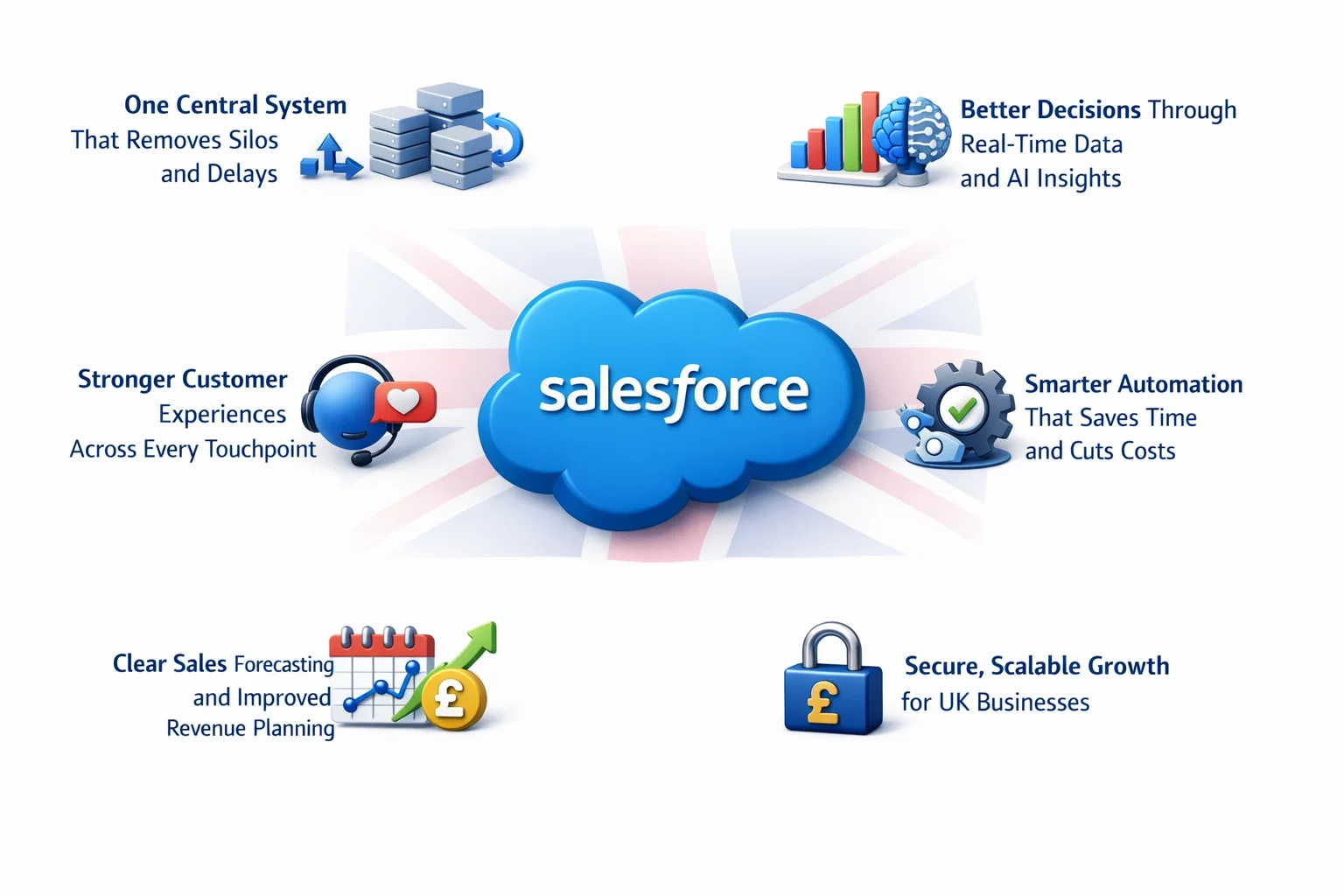
To understand the Salesforce implementation costs, it is important to understand why so many UK businesses choose Salesforce to begin with. The platform is more than a CRM. It is an integrated system that connects people, data, and processes across an organization.
In 2026, growth depends on speed, accuracy, and customer experience. Salesforce helps businesses improve all three when implemented the right way. Below are the key reasons Salesforce implementation plays a direct role in business growth.
1. One Central System That Removes Silos and Delays
Many businesses still work with disconnected tools. Sales uses one system. Marketing uses another. Support teams rely on spreadsheets or inboxes.
Salesforce fixes this problem. It gives teams one shared platform to store and access customer data. Sales, marketing, and support see the same information in real time. This reduces confusion and speeds up decisions.
According to recent CRM studies, businesses using a single customer platform report up to 30% faster response times. Faster responses lead to higher conversions and better customer trust.
2. Better Decisions Through Real-Time Data and AI Insights
In 2026, data-driven decisions are no longer optional. Businesses that rely on guesswork fall behind quickly. Salesforce provides built-in reporting, dashboards, and AI-powered insights. Teams can track performance, forecast sales, and spot trends early.
UK organisations using CRM analytics are over 40% more likely to hit revenue targets. Salesforce makes this possible by turning raw data into clear actions. When implemented correctly, Salesforce removes manual reporting and reduces errors offering real value for the average Salesforce implementation cost.
3. Stronger Customer Experiences Across Every Touchpoint
Customer expectations are higher than ever. People want quick responses, personalised messages, and consistent service across channels. Salesforce supports this through automated journeys, personalised emails, and omni-channel support. Customers receive the right message at the right time.
Studies show that businesses delivering personalised experiences can increase customer retention by up to 25%. Salesforce enables this at scale when configured to match business goals.
4. Smarter Automation That Saves Time and Cuts Costs
Sales teams still spend too much time on admin tasks. In fact, remembering earlier figures, nearly 70% of sales time goes into non-selling activities.
Salesforce automates lead assignment, follow-ups, reminders, and updates. This gives teams more time to sell and support customers. And automation plays a key role in reducing the long-term cost of Salesforce implementation, as teams become more productive without adding headcount.
5. Clear Sales Forecasting and Improved Revenue Planning
Salesforce helps businesses understand where revenue comes from and where it is heading. By analysing past and current data, Salesforce enables accurate sales forecasting. Managers can track pipelines, spot risks, and adjust strategies early.
With full visibility into leads and opportunities, sales teams deliver faster updates and better service. This improves trust and closes deals sooner.
6. Secure, Scalable Growth for UK Businesses
Salesforce is cloud-based and scalable. Businesses can start small and expand features as they grow. It supports remote work, mobile access, and strong data security. This matters even more in the UK, where compliance and data protection remain critical.
When planned properly, Salesforce implementation supports growth without repeated system changes or costly migrations later.
The Salesforce Pricing Model for UK Businesses (2026)
Salesforce offers more than a single CRM product. It provides a suite-based pricing model that combines sales, service, marketing, and AI-powered tools under one platform.
Salesforce pricing is charged per user, per month, with most plans billed annually. While UK customers are billed in GBP, Salesforce sets global list prices in USD and applies regional currency conversion at the time of contracting.
Below is a clear breakdown of the official Salesforce Sales Cloud pricing tiers, based on Salesforce’s published pricing as of 2026.
This section explains how much Salesforce licences cost in the UK as of 2026. Salesforce pricing here is charged per user, per month, and billed annually unless otherwise stated. These figures reflect official UK pricing listed on Salesforce’s website. Salesforce offers a range of CRM editions to suit businesses of different sizes and needs. Each tier unlocks more advanced capabilities and support.
1) Salesforce Free Suite
Price: £0 per user per month (up to 2 users)
This no-cost starter tier helps very small teams get up and running with basic CRM capabilities.
Best for: Start-ups and tiny teams testing Salesforce before committing.
Key features included:
- Lead, account, contact and opportunity management
- Basic sales pipeline tracking
- Connected Slack conversations
- Simple email marketing
(Free licences offer limited scale and automation.)
2) Salesforce Starter Suite
Price: £20 per user per month (billed annually)
Starter Suite combines sales, service, marketing and commerce features in one CRM platform.
Best for: Small businesses that need a unified platform without complexity.
Key features included:
- Unlimited users on a simple CRM platform
- Built-in sales flows and lead routing
- Automatic sync of emails, events and contacts
- Dynamic email marketing and basic analytics
This plan gives a strong foundation for businesses beginning their CRM journey.
3) Salesforce Pro Suite
Price: £80 per user per month (billed annually)
Pro Suite expands on Starter with more automation, customisation and business-wide tools.
Best for: Growing UK businesses need standard sales forecasting and automation.
Key features included:
- Everything in Starter Suite
- Enhanced customisation and workflow automation
- Sales quoting and forecasting tools
- Access to Salesforce AppExchange
- Real-time chat and more advanced service features
Pro Suite fits teams moving beyond basic CRM processes.
4) Salesforce Enterprise Edition
Price: £140 per user per month (billed annually)
Enterprise Edition adds advanced automation, integrations and developer-level flexibility.
Best for: Mid-sized organisations with complex processes and integration requirements.
Key features included:
- Everything in Pro Suite
- Advanced pipeline management and deal insights
- Conversation Intelligence and AI features
- Web API access for integrations
- Scalable automation and territory management
This tier often represents the balance of power and cost for UK mid-market companies.
5) Salesforce Unlimited Edition
Price: £280 per user per month (billed annually)
Unlimited Edition gives the broadest set of tools and premium support options.
Best for: Large enterprises with high automation needs and extensive user bases.
Key features included:
- Everything in Enterprise Edition
- Predictive AI and advanced analytics
- Full sandbox and developer support
- 24/7 technical support and early-access features
This edition is ideal where performance, uptime and support matter most.
6) Salesforce Agentforce 1 Sales
Price: £440 per user per month (billed annually)
Agentforce 1 Sales is the most comprehensive CRM tier in Salesforce’s suite.
Best for: Organisations adopting AI-driven sales automation and analytics.
Key features included:
All Unlimited features plus:
- Full suite of generative AI tools
- Salesforce Spiff, Sales Planning, and Sales Programmes
- Salesforce Maps and Tableau Next insights
- 1m Flex Credits & 2.5m Data Cloud Credits per org per year
This edition is designed for businesses pushing CRM into next-level intelligence and automation.
Salesforce CRM Core Product Costs in 2026
Salesforce offers a broad suite of cloud products that support sales, service, marketing, analytics, automation and customer engagement. Each product caters to specific business functions and can be licensed individually or as part of a package.
Below are key Salesforce products with verified UK pricing where available.
1) Salesforce Sales Cloud
Sales Cloud is Salesforce’s flagship CRM platform. It centralises sales data, tracks leads and opportunities, automates core tasks, and gives teams real-time visibility into sales performance.
UK Pricing (per user, per month, billed annually):
| Package | Price |
|---|---|
| Starter Suite | £20 |
| Pro Suite | £80 |
| Enterprise Edition | £140 |
| Unlimited Edition | £280 |
| Agentforce 1 Sales | £440 |
What’s included:
- Lead, contact and opportunity management
- Pipeline tracking and custom dashboards
- Sales forecasting and automation
- Advanced customisation (Enterprise +)
- Premium support and AI tools (Unlimited +)
2) Salesforce Service Cloud
Service Cloud helps customer support teams manage cases, deliver help across channels like email and chat, and automate service workflows.
UK Pricing (per user, per month, billed annually):
| Plan | Price |
|---|---|
| Starter Suite | £20 |
| Pro Suite | £80 |
| Enterprise Edition | £140 |
| Unlimited Edition | £280 |
| Agentforce 1 Service | £440 |
What’s included:
- Case and contact management
- Automated routing and escalation
- Knowledge base and help workflows
- AI recommendations and analytics at higher tiers
3) Salesforce Marketing Cloud
Marketing Cloud is a full-featured digital marketing platform for multichannel campaigns, automation, personalisation, and customer engagement.
UK Pricing (organisation level – billed annually):
Pro and up plans: from £1,000 per organisation per month
Specific suites vary based on feature modules
What’s included (typical features):
- Email and mobile campaigns
- AI-driven personalisation
- Social and digital advertising tools
- Analytics and performance reporting
4) Salesforce Experience Cloud
Experience Cloud enables businesses to build customer, partner, and employee portals with branded engagement and self-service.
UK Pricing:
Salesforce does not publish fixed list prices on the UK site – pricing is provided on request based on usage and access type.
What’s included:
- Customisable branded communities
- Partner collaboration tools
- Self-service support for customers
- Access control and role-based content
5) Salesforce CPQ & Billing
Salesforce CPQ (Configure, Price, Quote) automates pricing, quoting, and contract management processes. It is often purchased alongside Sales Cloud.
UK Pricing:
Salesforce does not list fixed UK prices publicly. Industry data suggests CPQ licences are often in the range of £60-£85 per user per month, depending on features and contract terms.
What’s included:
- Guided pricing and quoting workflows
- Approval rules and discounting logic
- Contract generation and renewals
- Billing automation when bundled with Salesforce Billing
6) Salesforce Analytics (Tableau CRM)
Salesforce Analytics, often branded as Tableau CRM, provides advanced data analytics and AI-driven insights.
UK Pricing:
Not published publicly; prices vary based on user count and analytics workload. Typical ranges reported in the UK are £80-£200+ per user per month.
What’s included:
- Multi-source analytics
- Drag-and-drop dashboards
- Predictive insights and AI models
- Data visualisation tools
7) Salesforce Commerce Cloud
Commerce Cloud supports enterprise e-commerce for both B2C and B2B, offering unified shopping experiences across devices.
UK Pricing:
Commerce Cloud pricing is contract-based and often tied to revenue and usage. Typical licences start with a base platform fee plus a percentage of revenue. Pricing is custom-quoted for each business.
What’s included:
- Online storefront and catalogue management
- Personalised shopping experiences
- Real-time inventory and order management
- Seamless integration to CRM and service
8) Slack Platform (Enterprise Collaboration)
Salesforce includes Slack as a collaboration layer for CRM teams.
UK Pricing:
Slack licences are purchased separately unless bundled through Salesforce enterprise deals. Typical Slack plans in the UK range from £6-£15 per user per month.
What’s included:
- Real-time team chat
- Integrated CRM alerts and workflows
- File sharing and notifications
- Automation and bot integration
Key Factors That Influence Salesforce Implementation Cost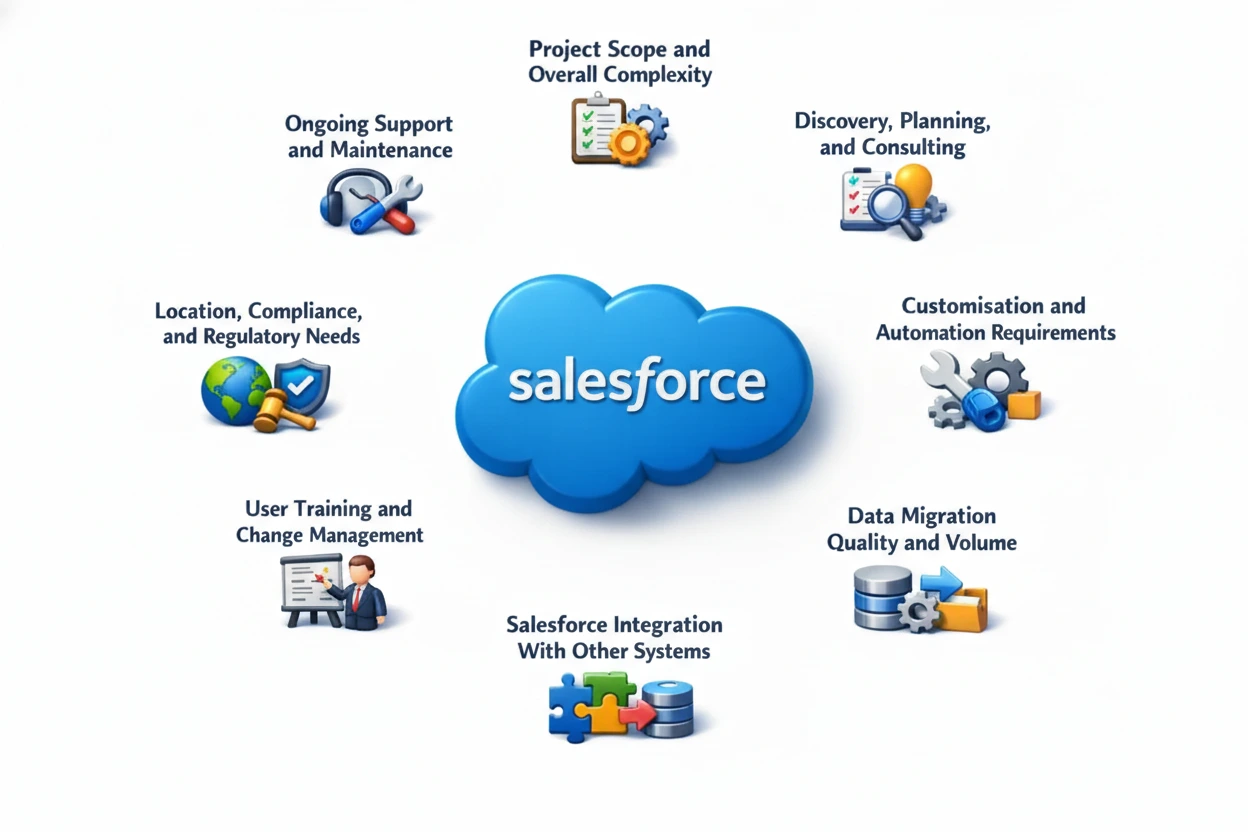
Before estimating the Salesforce implementation cost, it is important to understand what actually drives the price. Many UK businesses assume the cost depends mainly on licences. In reality, implementation costs are shaped by planning, complexity, data quality, and long-term support needs.
Salesforce implementations are not one-size-fits-all. The same Salesforce license can be used by two different companies, and the costs can vary greatly. The difference is usually due to the scope, the execution, and the preparation.
Working with an experienced Salesforce implementation partner in the UK like the IDS Logic helps reduce risk, avoid rework, and control long-term costs.
Below are the most important factors that influence the average Salesforce implementation cost in 2026:
1. Project Scope and Overall Complexity
Project scope is the biggest cost driver. A simple Salesforce setup with standard features, limited users, and minimal automation costs far less. These projects focus on core Sales Cloud or Service Cloud functions.
Costs increase when projects include:
- Heavy customisation
- Complex approval workflows
- Multiple Salesforce Clouds
- Industry-specific processes
- Advanced security or role structures
As business processes become more complex, the cost of Salesforce implementation rises accordingly.
2. Discovery, Planning, and Consulting
Good planning saves money. Poor planning increases costs later. Most UK businesses begin with a discovery and consulting phase. This stage defines goals, use cases, timelines, and risks. It ensures Salesforce aligns with how the business actually works.
For mid-to-complex projects, consulting and planning can cost £4,000 to £16,000+, depending on depth and duration. Skipping discovery often leads to redesigns, delays, and higher total spend.
3. Customisation and Automation Requirements
Salesforce is highly flexible, which is both a strength and a cost factor. Basic customisation, such as custom fields, page layouts, and simple workflows, stays affordable. However, advanced automation increases effort and cost.
Cost rises when projects include:
- Complex Flows and automation logic
- CPQ rules and pricing models
- Custom objects and relationships
- Bespoke Apex development
In many cases, customisation costs exceed data migration costs.
4. Data Migration Quality and Volume
Data migration is often underestimated. Migration involves more than moving data. It includes:
- Cleaning poor-quality data
- Removing duplicates and outdated records
- Mapping old data to Salesforce objects
- Testing data accuracy after migration
Messy or legacy data can increase implementation costs by 30-50%. Clean, well-structured data reduces both time and spend.
5. Salesforce Integration With Other Systems
Integrations significantly affect the salesforce implementation cost in the UK. Many businesses need Salesforce connected to:
- ERP or finance systems
- Accounting software
- Marketing platforms
- Customer support tools
- Data warehouses
Each integration adds complexity through data mapping, security rules, and ongoing sync logic. The more systems involved, the higher the cost.
6. User Training and Change Management
A successful Salesforce launch depends on adoption, not just technology.
Training costs vary based on:
- Number of users
- User roles
- Level of automation
- Ongoing enablement needs
Training ensures teams use Salesforce correctly and consistently. Poor training often leads to low adoption and costly fixes later.
7. Location, Compliance, and Regulatory Needs
Geography affects implementation costs. UK-based Salesforce consulting typically costs more than offshore delivery due to labour rates and compliance requirements. However, UK partners bring strong benefits around data protection, governance, and industry standards.
Highly regulated industries may also need:
- Extra security controls
- Audit trails
- Compliance reporting
These requirements increase both effort and cost.
8. Ongoing Support and Maintenance
Salesforce implementation does not end at go-live.
Ongoing costs include:
- System monitoring
- Bug fixes
- Performance tuning
- Feature enhancements
- Platform updates
Support models vary from ad-hoc hours to monthly retainers. This is a critical part of the average Salesforce implementation cost that many businesses overlook.
Hidden Costs in Salesforce Implementation That UK Businesses Often Miss
The total cost of Salesforce implementation in the UK often rises due to hidden or underestimated expenses that are often overlooked by companies when they calculate Salesforce implementation cost. Many businesses only calculate Salesforce implementation cost based on licensing fees.
These costs do not appear upfront but can significantly affect long-term return on investment.
1. Implementation and Configuration Costs
Implementation is one of the largest hidden expenses. Even a basic Salesforce rollout requires configuration, setup, and testing.
| Business Size | Typical Salesforce Implementation Cost (UK) |
|---|---|
| Small Businesses | £4,000 – £8,000 (simple setups) |
| Medium Organisations | £30,000 – £60,000+ |
| Enterprise | £150,000+ |
These costs cover discovery, configuration, automation, integrations, and quality assurance.
2. Training and User Adoption Costs
Salesforce only delivers value when teams use it properly.
Training costs often include:
- Admin and power-user training
- End-user onboarding sessions
- Ongoing enablement for new features
Many organisations underestimate training, yet poor adoption is one of the main reasons Salesforce projects fail. Investing in structured training improves ROI and reduces rework.
3. Data Storage and Growth Costs
Salesforce includes limited data and file storage with each licence.
As data grows, additional storage may be required:
- Extra data storage is charged monthly
- File storage increases as attachments and documents grow
- Without data governance, storage costs can rise quietly over time.
- Support and Success Plans
Salesforce includes a basic support plan with licences. However, many UK businesses upgrade for faster response times and expert guidance. Higher-tier support plans are priced as a percentage of total licence spend, which can significantly increase annual costs for larger teams.
4. AppExchange and Integration Costs
Many Salesforce features rely on third-party apps or integrations.
Common add-ons include:
- Document automation
- E-signature tools
- Telephony and messaging
- ERP and accounting integrations
Each app adds subscription costs, configuration effort, and maintenance work.
Choosing the Right Salesforce Pricing Plan for Your Business
Selecting the right Salesforce pricing plan is not about choosing the most powerful option. It is about choosing the right fit for your business today and tomorrow.
Start With Business Needs, Not Features
Begin by asking:
- Which teams will use Salesforce?
- What problems are we solving first?
- Which processes truly need automation?
Avoid paying for features that will not be used in the first year.
1. Plan for Growth, Not Rebuilds
If your business expects rapid growth, starting on a higher edition may reduce migration costs later. However, upgrading too early often leads to wasted spending.
The goal is balance.
2. Budget for Total Cost of Ownership
When estimating Salesforce costs, include:
- Licences
- Implementation
- Training
- Support and optimisation
- Storage and integrations
Looking only at monthly licence fees gives an incomplete picture.
3. Work With the Right Salesforce Partner
The right Salesforce implementation partner helps you:
- Avoid unnecessary licences
- Design scalable architecture
- Reduce long-term maintenance costs
- Improve user adoption
This often saves more money than it costs.
Conclusion – Making Salesforce a Smart Investment for UK Businesses
Salesforce implementation cost is not random. It reflects planning, complexity, and long-term business goals. The cheapest option often leads to rework. The most expensive option is not always necessary.
A rushed or poorly planned rollout limits adoption and increases costs over time. This is why understanding how much Salesforce implementation costs, and what drives those costs, is essential. It ensures the platform delivers growth instead of complexity.
Now, what matters is choosing the right scope, the right timing, and the right partner. Businesses that align Salesforce with real business needs consistently see better adoption, stronger ROI, and lower total cost over time.
Frequently Asked Questions
Q1. How much does Salesforce implementation cost in the UK?
Salesforce implementation cost in the UK usually ranges between £8,000 and £175,000+. Smaller projects with limited users, minimal automation, and clean data sit at the lower end. Larger or enterprise implementations with integrations, advanced workflows, and multiple teams fall at the higher end. The final cost depends far more on complexity and planning than on the Salesforce licences themselves.
Q2. What factors influence Salesforce implementation cost the most?
The biggest cost drivers are:
- The scope of the project and number of Salesforce Clouds used
- The level of customisation and automation required
- Data migration volume and data quality
- Integrations with ERP, finance, or marketing systems
- Training, adoption, and post-launch support needs
User count mainly impacts licence fees, not implementation effort.
Q3. Is Salesforce implementation expensive for small businesses or startups?
Not always. For UK small businesses and startups, Salesforce implementation often starts between £8,000 and £40,000 when kept lean.
Costs stay lower when businesses:
- Use Starter or Pro Suite
- Avoid unnecessary custom code
- Focus on core sales or service processes
- Prepare clean data before migration
Salesforce works best for small teams when it stays simple at the start.
Q4. Why do Salesforce implementation quotes vary so widely?
Salesforce quotes vary because each business has different needs.
Two companies with the same licences can receive very different quotes due to:
- Poor or unstructured data
- Complex approval or pricing logic
- Heavy integration requirements
- Weak discovery and unclear scope
Quotes reflect risk, effort, and long-term complexity, not just hours worked.
Q5. Can choosing the right Salesforce partner reduce overall costs?
Yes, significantly. An experienced Salesforce implementation partner helps you:
- Select only the licences you need
- Design scalable architecture from day one
- Avoid over-customisation
- Reduce rework and delays
While upfront fees may look higher, the total cost of ownership is usually lower.
Q6. Is it cheaper to implement Salesforce in-house?
In-house implementations can be cheaper upfront, but they often:
- Take longer to complete
- Suffer from design gaps
- Require rework later
Partner-led implementations usually deliver faster results, stronger adoption, and better long-term value, especially for growing UK businesses.
Q7. Does a higher-priced Salesforce partner guarantee better results?
No. Price alone does not equal quality. What matters more is:
- Clear discovery and planning
- Proven Salesforce experience
- Industry knowledge
- Structured delivery and testing
A well-scoped project with the right team often outperforms a more expensive but poorly planned one.
Q8. What hidden costs should businesses plan for?
Common hidden Salesforce costs include:
- Data cleanup and re-migration
- User training and onboarding
- Additional data and file storage
- AppExchange tools and integrations
- Ongoing optimisation and support
Planning for these early prevents budget overruns later.
Q9. Does Salesforce implementation always include data migration?
Most salesforce implementations include some level of data migration.
Migration effort depends on:
- Data volume
- Data accuracy
- Source systems and formats
Clean, well-structured data reduces time and cost. Legacy or fragmented data increases both.
Q10. How long does Salesforce implementation usually take?
Typical timelines are:
- 4-8 weeks for simple setups
- 8-16 weeks for mid-size implementations
- 4-9 months for enterprise projects
Timelines depend on integrations, testing cycles, and user training needs.
Q11. Is Salesforce still worth the investment in 2026?
Yes, when implemented correctly. Salesforce delivers strong value when:
- Business goals are clearly defined
- Users are trained properly
- Automation is used wisely
- The system is optimised over time
A well-planned Salesforce implementation becomes a long-term growth platform, not just a CRM.