Apple's App Store ecosystem enabled $1.3 trillion in developer billings in 2024 - making iOS one of the most profitable platforms for developers and businesses today. Whether you're a beginner or a business, this guide covers everything you need to learn iOS app development faster in 2026. Talk to our iOS experts today.
The world of mobile technology continues to evolve rapidly. Among all platforms, Apple’s ecosystem remains one of the most influential and profitable. For developers and businesses alike, learning iOS app development is now a valuable skill.
A few years ago, entering the iOS development field was not simple. Developers had to learn Objective-C, which many beginners found difficult. In addition, the developer community was smaller, and finding guidance or support often took time.
However, the landscape has changed dramatically. Apple introduced Swift, a modern programming language designed to make coding faster, cleaner, and easier to understand. As a result, developers today can build powerful applications more efficiently than before.
Creating an iOS app is both exciting and challenging. It requires strong fundamentals, consistent learning, and a clear understanding of Apple’s development ecosystem. To build fast, secure, and reliable apps, developers must understand the core principles of iOS app development, including programming, design standards, and performance optimisation.
The opportunity is also massive. According to Apple’s official reports and industry studies:
Apple’s App Store ecosystem enabled around $1.3 trillion in developer billings and sales during 2024, reflecting the massive economic activity around iOS apps.
- The App Store attracts hundreds of millions of users each week, with roughly 850 million weekly visitors globally.
- The marketplace hosts well over two million applications, covering categories from games and finance to education and healthcare.
- Thousands of new applications continue to appear regularly, showing that the ecosystem is still growing quickly.
- These numbers highlight why businesses and developers continue to invest heavily in iOS apps.
For beginners wondering how to learn iOS app development, the first step is setting up the right environment. This typically includes installing Xcode, Apple’s official integrated development environment (IDE), and creating an Apple Developer account. From there, you can begin learning Swift, exploring the iOS Software Development Kit (SDK), and understanding Apple’s design and performance standards.
Developers must also follow Apple’s guidelines when preparing apps for submission to the App Store. This includes proper privacy policies, user-friendly app descriptions, and clear design practices that meet Apple’s strict quality standards.
In this guide, we will share practical tips for learning iOS app development faster in 2026. Whether you are a beginner exploring mobile development or a developer expanding your skills, these insights will help you build a strong foundation and move forward with confidence.
Practical Tips to Learn iOS App Development Faster
Learning how to learn iOS app development requires consistency, curiosity, and the right learning approach. Many beginners struggle because they try to learn everything at once. Instead, focus on building strong fundamentals step by step.
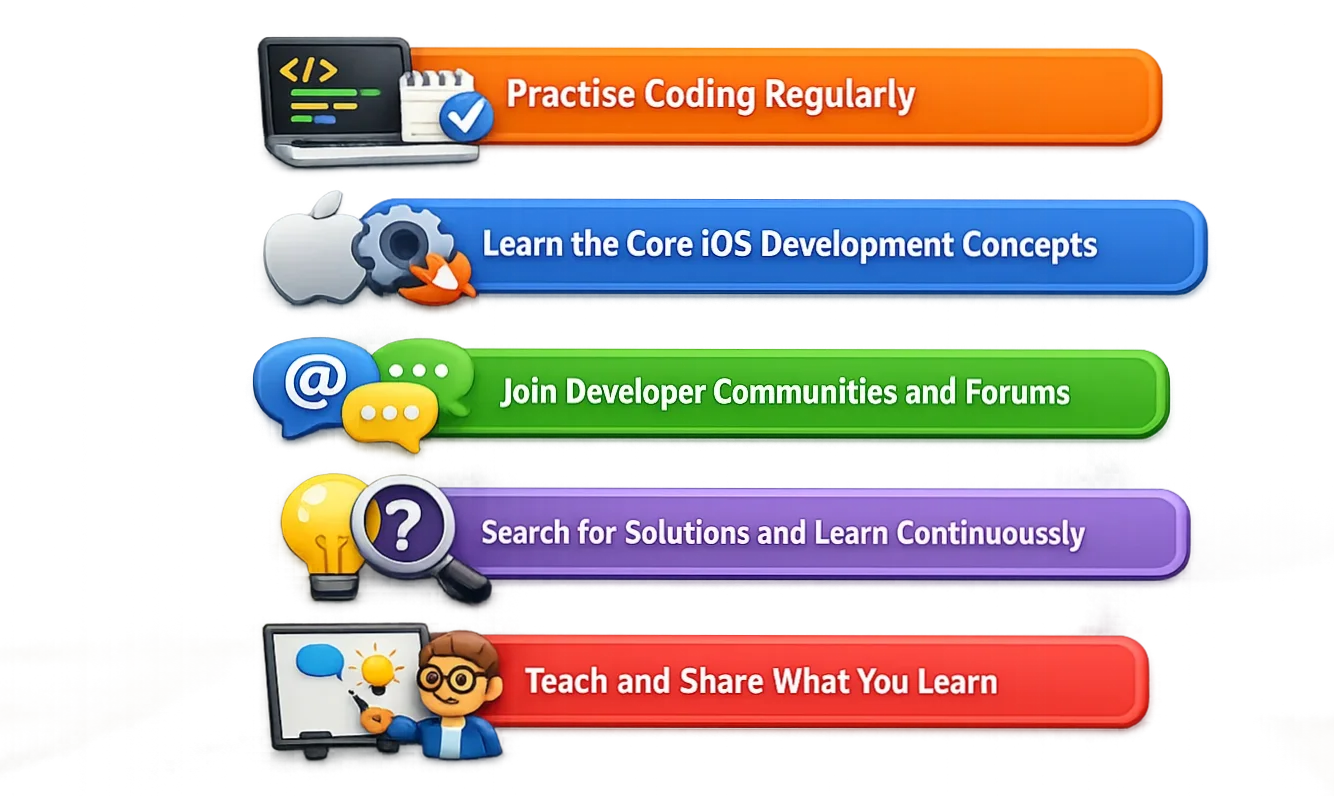
Below are practical and proven tips that can help beginners strengthen their skills and become confident iOS developers.
1. Practise Coding Regularly
Consistency is the key to mastering iOS app development for beginners. Short daily practice sessions often work better than long, irregular study periods.
Try to spend at least one or two hours each day writing code. Focus on understanding how Swift works rather than memorising syntax.
Swift is Apple’s modern programming language for iOS applications. It is faster, safer, and easier to learn compared to older languages such as Objective-C. By practising Swift regularly, you will improve your problem-solving skills and build confidence in creating real applications.
Over time, small practice projects can help you understand how mobile apps actually work.
2. Learn the Core iOS Development Concepts
Before building complex apps, you must understand the core building blocks of the platform.
Start by learning the fundamentals of Swift, including:
- Variables and constants
- Functions and closures
- Data types such as strings and arrays
- Control flow and operators
Once you understand these basics, move towards the iOS Software Development Kit (SDK) and explore key frameworks like UIKit and SwiftUI.
Understanding these tools helps you design app interfaces, manage user interactions, and build smooth application workflows.

3. Join Developer Communities and Forums
Learning alone can slow your progress. Developer communities provide support, knowledge, and inspiration.
By joining online forums and communities, you can ask questions, discuss challenges, and learn from experienced developers.
Popular platforms for iOS developers include:
- Apple Developer Forums
- Stack Overflow
- GitHub communities
- Reddit and developer Discord groups
These communities allow developers to share solutions, tutorials, and code examples. They also help beginners stay updated with the latest iOS app development trends.
4. Search for Solutions and Learn Continuously
Even experienced developers search for answers online every day. Research is part of the development process.
Instead of spending hours trying to solve a problem alone, use trusted resources such as documentation, developer blogs, and technical forums.
When searching for solutions, focus on understanding the logic behind the code. This habit improves your problem-solving skills and speeds up learning.
The more questions you explore, the faster you will progress in learning iOS app development.
5. Teach and Share What You Learn
One of the best ways to strengthen your knowledge is by teaching others.
When you explain a concept to someone else, you review the topic more deeply and identify gaps in your understanding.
You can share knowledge by:
- Writing short tutorials or blog posts
- Answering questions in developer forums
- Helping fellow learners in online communities
Teaching encourages deeper learning and improves your communication skills as a developer.
Why iOS App Development Is a Smart Choice for Businesses?
Mobile applications now play a central role in digital strategy. Many organisations want to reach users where they spend most of their time – on smartphones. For businesses planning a mobile product, iOS app development often becomes the preferred starting point.
Apple’s ecosystem offers a premium audience, strong security standards, and a highly optimised development environment. These advantages make iOS apps attractive for companies that want high engagement and strong return on investment.
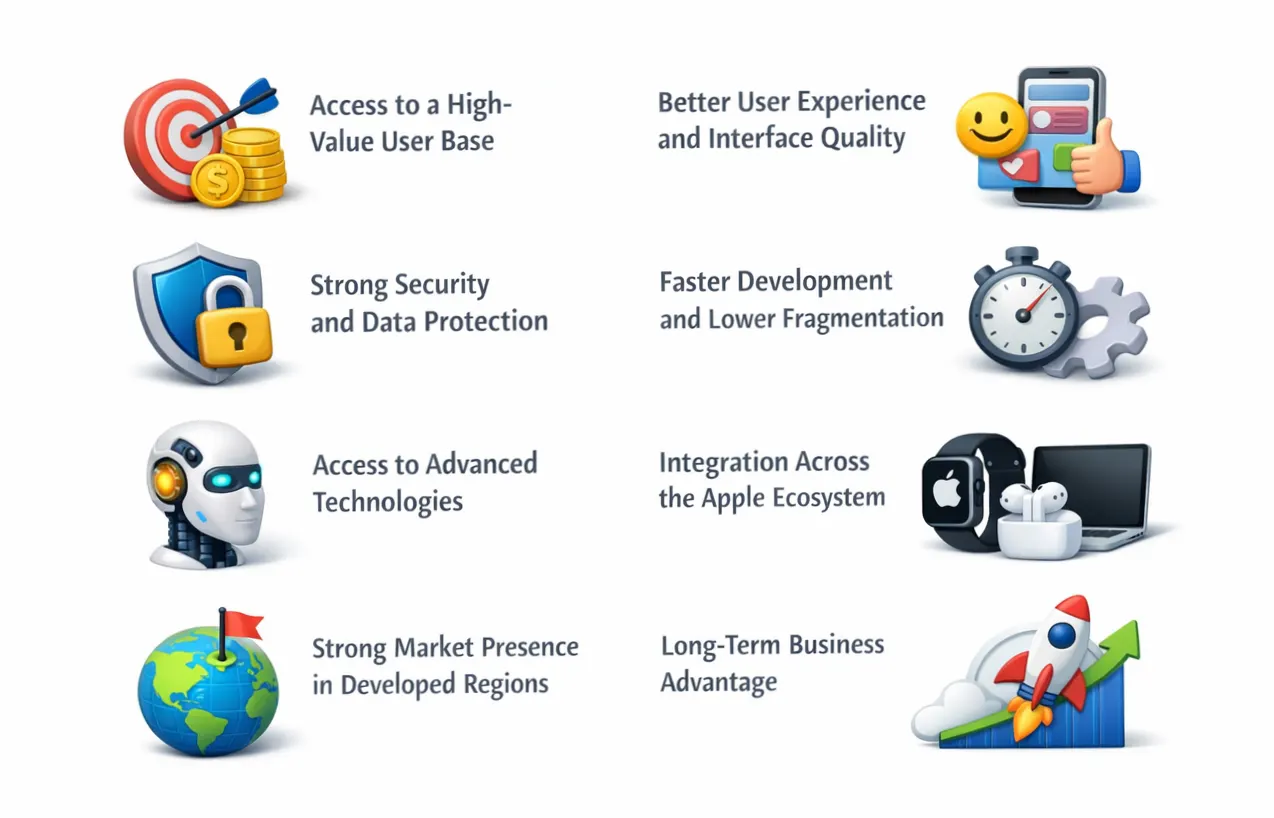
Below are some of the most important reasons businesses prioritise iOS when launching mobile applications:
1. Access to a High-Value User Base
One of the biggest advantages of the Apple ecosystem is its premium audience. iPhone users generally demonstrate higher spending power and strong brand loyalty. Because of this behaviour, many companies experience higher revenue from iOS applications compared to other platforms.
Industry research consistently shows that App Store users spend more on in-app purchases, subscriptions, and digital services. For businesses that rely on mobile commerce or subscription models, this creates strong revenue potential. Even though the audience size may be smaller than other platforms globally, the spending behaviour often results in a stronger return on investment.
2. Better User Experience and Interface Quality
Apple places a strong focus on design and usability. The company provides clear design guidelines that developers follow when building applications. As a result, iOS apps often deliver a consistent and intuitive user experience.
Because Apple controls both hardware and software, developers can optimise apps for a limited number of devices. This reduces compatibility issues and helps ensure smooth performance across iPhones and iPads. A well-designed interface improves engagement.
When users find an app easy to navigate, they are more likely to spend time on it and complete transactions.
3. Strong Security and Data Protection
Security is another reason many businesses choose iOS mobile app development. Apple’s ecosystem is built around strict privacy standards and a controlled App Store review process. Every application must follow Apple’s security policies before being published. This approach helps reduce malware risks and protects sensitive user information.
For businesses handling financial transactions or personal data, these security measures build trust with customers and improve brand credibility.

4. Faster Development and Lower Fragmentation
Compared with many other platforms, Apple’s device ecosystem is relatively standardised. Developers typically work with fewer device models and screen sizes.
This lower level of fragmentation simplifies testing and reduces development complexity. Developers can focus more on functionality and performance rather than compatibility across hundreds of devices. Swift, Apple’s modern programming language, also speeds up development. Its clean syntax and built-in safety features allow developers to build applications more efficiently.
5. Access to Advanced Technologies
Apple devices often introduce advanced technologies that developers can integrate into their apps. These include augmented reality (AR), machine learning, artificial intelligence, and advanced graphics capabilities.
By using these tools, developers can create innovative experiences that stand out in competitive markets. For example, AR features can enhance retail apps, while machine learning can improve personalisation and recommendations. Such technologies help businesses deliver modern digital experiences that customers expect.
6. Integration Across the Apple Ecosystem
Another advantage of iOS app development is seamless integration across Apple devices. Applications can connect with iPhones, iPads, Apple Watch, Mac computers, and even Apple TV.
This interconnected ecosystem allows businesses to create consistent user journeys across multiple devices. Customers can start an activity on one device and continue it on another without interruption. For companies that want strong engagement and long-term user retention, this ecosystem integration is extremely valuable.
7. Strong Market Presence in Developed Regions
In several developed markets, iPhones hold a large share of the smartphone market. Countries such as the United States and the United Kingdom show particularly strong adoption of Apple devices.
This makes iOS app development especially attractive for businesses targeting users in these regions. Access to a premium and technology-savvy audience can improve brand visibility and open new revenue opportunities.
8. Long-Term Business Advantage
Launching an iOS application often provides businesses with a strategic advantage. A high-quality app signals innovation, strengthens customer engagement, and improves brand recognition.
While many companies eventually develop applications for multiple platforms, starting with iOS can help them launch faster and generate revenue earlier. Once the product proves successful, businesses can expand to additional platforms and markets. For organisations aiming to build a strong mobile presence, investing in iOS app development remains one of the most effective strategies available today.
Essential iOS App Development Practices to Follow in 2026
Building a successful mobile application today requires more than simply writing code. Developers must focus on strategy, performance, and long-term scalability. Anyone exploring how to learn iOS app development or planning to launch a new app should understand the practices that modern development teams follow.
The iOS ecosystem evolves quickly. Apple introduces new tools, frameworks, and design standards almost every year. Developers who stay aligned with these changes build apps that perform better, meet user expectations, and remain competitive in the App Store.
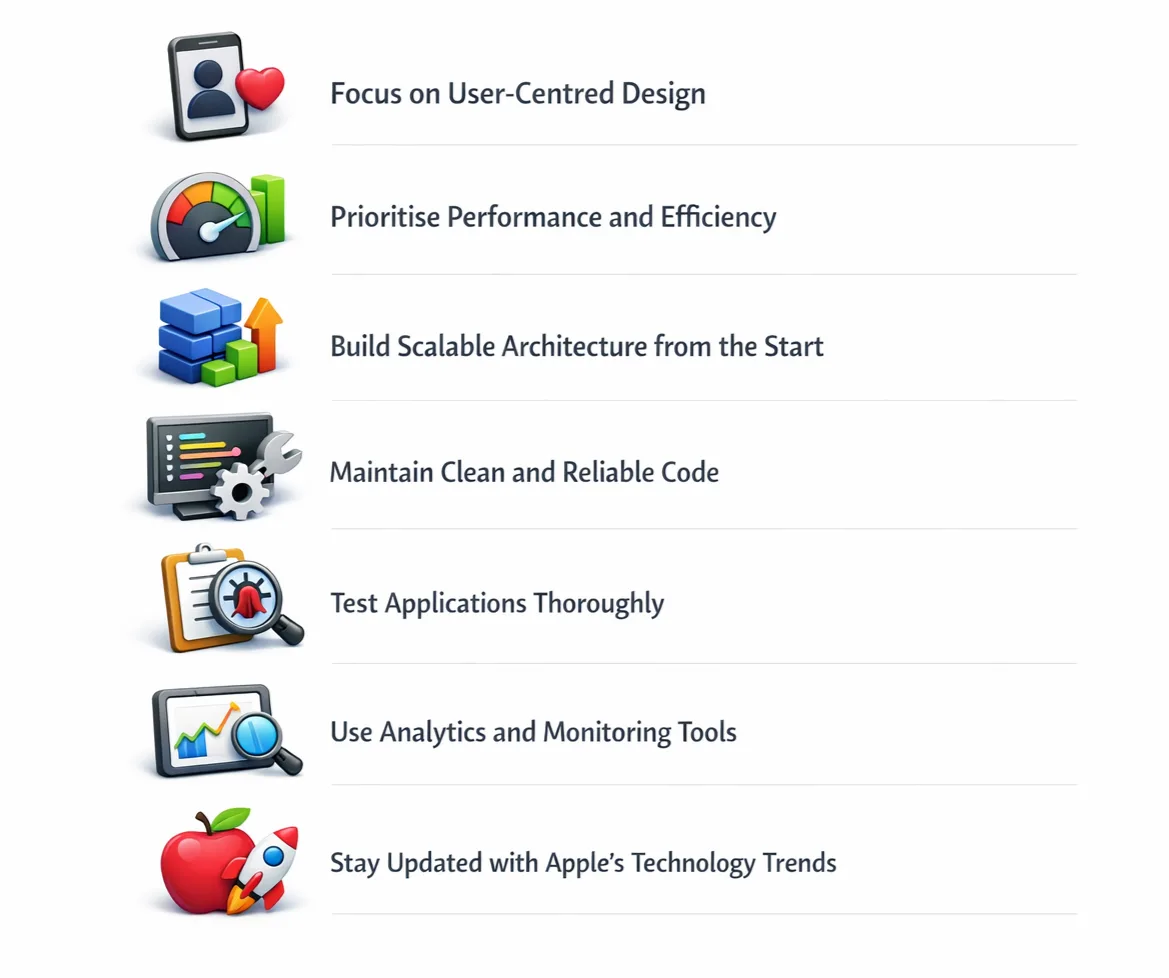
Below are some of the most important practices that developers and businesses prioritise when building iOS applications in 2026.
1. Focus on User-Centred Design
A successful app begins with a strong user experience. Modern iOS development places great emphasis on intuitive design, accessibility, and visual clarity. Apple provides detailed Human Interface Guidelines that help developers create consistent interfaces across devices. By following these standards, developers ensure that navigation feels natural and interactions remain smooth. When apps are easy to use, users spend more time on them. This directly improves engagement, retention, and customer satisfaction.
2. Prioritise Performance and Efficiency
App performance remains a critical factor for success. Slow load times, crashes, or poor responsiveness quickly lead to negative reviews and lower user retention. Developers should optimise animations, manage memory carefully, and reduce unnecessary background processes. These steps help apps run faster while also improving battery efficiency. Well-optimised applications not only perform better but also build stronger user trust.
3. Build Scalable Architecture from the Start
Modern mobile applications must handle growth. As the user base increases, the app should continue to perform reliably. To achieve this, developers often use modular architectures and structured code patterns. These approaches make it easier to expand features, maintain the app, and integrate new services later. A scalable architecture ensures that the application can evolve alongside business needs.
4. Maintain Clean and Reliable Code
Code quality plays a major role in long-term app success. Clean, organised, and well-documented code allows development teams to update applications quickly and safely. Most professional teams use version control systems, automated testing tools, and continuous integration pipelines. These practices help maintain consistent quality across updates and releases. High code quality also reduces bugs and simplifies collaboration between developers.
5. Test Applications Thoroughly
Testing is an essential step in iOS app development. Developers must verify that applications perform correctly across different scenarios before they reach users. This includes unit testing, interface testing, and real-device testing. Apple’s Xcode environment provides simulators and debugging tools that help identify issues early. By detecting problems before launch, teams can avoid costly errors and protect the user experience.
6. Use Analytics and Monitoring Tools
Modern apps rely heavily on data. Monitoring tools help developers track crashes, analyse performance, and understand user behaviour.
Analytics platforms allow teams to identify which features users interact with most often. These insights help developers improve future updates and refine product strategies. Continuous monitoring ensures that the application evolves based on real user feedback.
7. Stay Updated with Apple’s Technology Trends
Apple frequently introduces improvements through events like WWDC and regular iOS updates. Developers must stay informed about these changes to keep their applications modern and relevant. For example, many teams now use frameworks such as SwiftUI to build cleaner interfaces and speed up development. Adopting newer technologies early often gives apps a competitive advantage.
However, developers do not need to rebuild their entire codebase every year. Instead, they should focus on aligning their applications with Apple’s evolving priorities and user expectations.
Smart Strategies to Build a Successful iOS App in 2026
Launching a high-performing mobile application today requires more than technical development. Businesses must think strategically about user behaviour, platform capabilities, and long-term growth. Companies investing in iOS app development in 2026 focus on building meaningful user experiences while ensuring their apps deliver measurable business value.
The iOS ecosystem continues to grow rapidly. Apple devices attract users with strong purchasing power and high engagement levels.
This makes the platform highly attractive for organisations planning new digital products. However, success requires careful planning, constant innovation, and alignment with Apple’s evolving ecosystem.
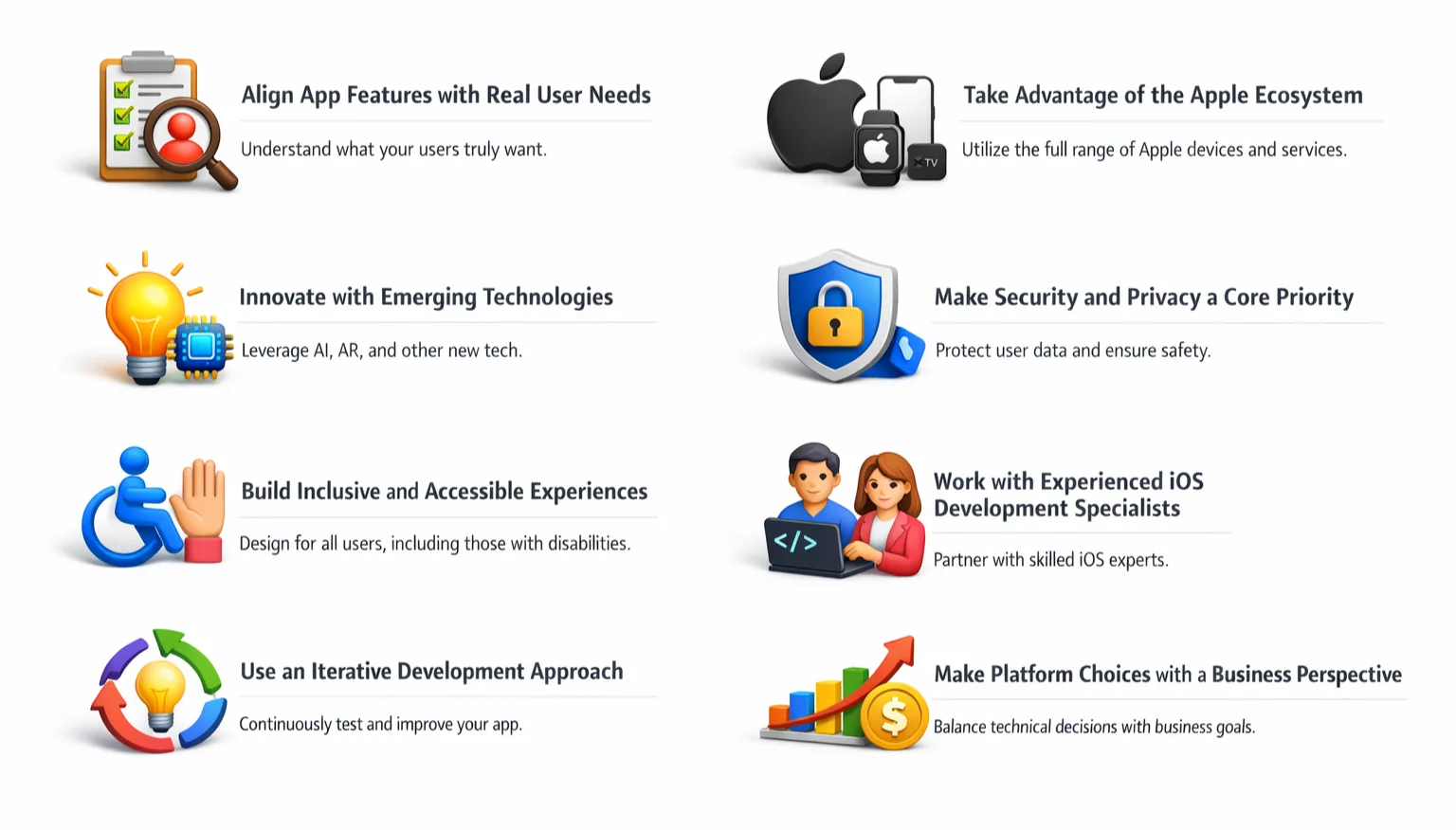
Below are some key strategies businesses and development teams follow when creating successful iOS applications:
1. Align App Features with Real User Needs
Before writing a single line of code, businesses must understand their audience. Successful apps solve clear user problems and match real market demand.
iOS users often show higher engagement and spending patterns compared to many other mobile audiences. Because of this, businesses that align app features with customer behaviour often see better adoption rates and stronger revenue potential. Studying user behaviour, analysing industry trends, and validating ideas early helps developers create apps that deliver measurable outcomes rather than simply launching another product.
2. Take Advantage of the Apple Ecosystem
A modern iOS app is rarely limited to the iPhone alone. Apple’s ecosystem now includes devices such as the iPad, Apple Watch, Mac, and emerging technologies like Apple Vision Pro.
Developers who design experiences across these devices create stronger user engagement. Features like spatial computing, augmented reality interactions, and cross-device syncing allow apps to deliver immersive experiences. Apple’s tightly integrated hardware and software environment also ensures smooth performance, which helps businesses build high-quality digital products that competitors may struggle to replicate.
3. Innovate with Emerging Technologies
Innovation plays a major role in successful iOS app development. Companies that experiment with new technologies often gain an advantage in competitive markets.
Modern applications frequently integrate artificial intelligence, machine learning, and augmented reality features. These technologies help personalise user experiences and improve engagement. Some development teams also add gamification elements or intelligent recommendation systems. These features increase retention and encourage users to return regularly. Continuous innovation ensures an app remains relevant as Apple introduces new platform capabilities each year.
4. Make Security and Privacy a Core Priority
User trust remains critical for any digital product. Apple has built its reputation around strong privacy standards, and developers must follow the same principles. Secure authentication systems, encrypted data storage, and privacy-first design approaches protect user information and strengthen app credibility. Apps that follow Apple’s strict security guidelines also pass the App Store review process more easily and gain greater trust from users.
5. Build Inclusive and Accessible Experiences
Accessibility has become an essential part of modern mobile development. iOS provides powerful accessibility tools that allow developers to design apps for users with different abilities.
Features such as voice control, screen readers, and adaptive layouts ensure that more people can use the application comfortably.
Designing with inclusivity in mind not only expands the potential audience but also improves the overall user experience.
6. Work with Experienced iOS Development Specialists
Developing a robust application requires expertise in architecture, performance optimisation, and Apple’s platform guidelines. Many businesses partner with professional iOS app development services providers to ensure their applications are built for scalability and long-term growth. Experienced development teams can reduce technical risks, accelerate development timelines, and deliver better product quality.
7. Use an Iterative Development Approach
Instead of launching a complex application at once, many companies follow a staged development strategy. This usually begins with a Minimum Viable Product (MVP). After launch, teams gather user feedback, analyse behaviour, and gradually introduce new features. This iterative model helps businesses validate product ideas, manage development costs, and reduce the risk of building features users may not need.
8. Make Platform Choices with a Business Perspective
When planning a mobile strategy, companies often evaluate native, hybrid, or cross-platform development options. Rather than focusing only on technical convenience, businesses should consider factors such as user experience, development cost, time-to-market, and long-term scalability. Viewing platform decisions through a strategic lens ensures resources are invested where they create the greatest impact.
Final Thoughts – Building Successful iOS Apps in 2026
While it is easier to learn iOS app development in 2026 than ever, building a successful application still requires the right approach. Mobile App developers need to combine technical knowledge, user-centered design, and careful planning in order to stand out in a competitive market.
With millions of users depending on iPhones and iPads for daily tasks, shopping, entertainment, and communication, Apple’s ecosystem continues to grow rapidly. In this way, businesses and developers have incredible opportunities to build meaningful digital products. It is important to understand user needs, follow Apple’s development standards, and continue to improve the app after launch if you want to achieve success.
The most successful apps start small but grow strategically. Developers often begin with a simple, well-built product and then expand features gradually. Regular updates, performance improvements, and strong security practices help maintain user trust and long-term engagement.
It is also important to remember that modern iOS development goes beyond writing Swift code. Developers must focus on usability, performance optimisation, scalable architecture, and ongoing testing. When these elements come together, the result is a stable, high-performing application that delivers real business value.
For businesses looking to launch or scale a mobile product, working with experienced developers can make a major difference.
Build Your Next iOS App with IDS Logic
If you are planning to build a powerful iPhone or iPad application, the right development partner can help you turn your idea into a successful digital product.
At IDS Logic, our team specialises in delivering secure, scalable, and high-performance iOS applications customised as per your business goals. From initial strategy and UI design to development, testing, and App Store deployment, we support organisations at every stage of the journey.
Whether you are a startup launching a new app or an enterprise improving an existing product, our developers can help you build reliable mobile solutions that grow with your business.

Frequently Asked Questions
Q1. How long does it take to learn iOS app development?
The time required to learn iOS app development depends on your background and how consistently you practise. Beginners with no coding experience usually take three to six months to understand the basics of Swift, Xcode, and Apple’s development environment. However, building professional-grade apps often requires continuous learning and real project experience.
Many developers start by creating small apps to understand the fundamentals of user interfaces, data handling, and debugging. As skills improve, they move to more complex applications that involve APIs, databases, and cloud services. Regular practice and hands-on projects significantly speed up the learning process.
Q2. What tools do you need to start iOS app development?
To start developing iOS applications, you need a Mac computer and Apple’s official development environment called Xcode. Xcode includes tools for writing code, designing interfaces, testing apps, and publishing them to the App Store. Developers also need an Apple Developer account to test apps on real devices and submit them to the App Store. Most modern iOS applications are built using Swift, Apple’s primary programming language. In addition, developers often use tools such as Git for version control and analytics platforms to track app performance.
Q3. Is Swift still the best language for iOS development?
Yes, Swift remains the preferred programming language for modern iOS app development. Apple designed Swift to be faster, safer, and easier to maintain than older languages like Objective-C. Swift supports modern development frameworks such as SwiftUI, which allows developers to build interfaces more efficiently. It also integrates smoothly with Apple’s libraries and development tools. Because Apple continues to invest heavily in Swift, most new applications and updates rely on this language.
Q4. How much does it cost to develop an iOS application?
The cost of building an iOS app varies widely depending on its complexity and feature set. Simple apps with basic functionality may cost a few thousand pounds. However, more advanced applications with custom features, backend systems, and third-party integrations can require significantly higher budgets. Development costs usually depend on factors such as design requirements, number of features, integrations, testing, and ongoing maintenance. Businesses often start with a Minimum Viable Product (MVP) to validate their idea before investing in a fully developed application.
Want to tap into Apple’s premium user base? Talk to our iOS specialists to explore the right solution for your business.
Q5. Do all iOS apps need to be published on the Apple App Store?
Most consumer apps are distributed through the Apple App Store, which gives developers access to millions of global users. To publish an app, developers must follow Apple’s strict quality and security guidelines and enrol in the Apple Developer Program. However, some organisations distribute apps privately within their companies using enterprise deployment options. This approach is common for internal business tools that are not intended for public users.
Q6. Can beginners build their own iOS apps?
Yes, beginners can absolutely start building iOS apps. With the help of online tutorials, developer communities, and Apple’s official documentation, many people learn iOS development from scratch. Beginners often start with simple applications such as task managers, note-taking apps, or small utilities. These projects help them understand how iOS apps work. Over time, developers improve their skills by experimenting with more advanced features such as APIs, animations, and data storage.
Consistent learning and practice are the key factors that help beginners grow into professional iOS developers.