Few organisations plan a SharePoint migration simply because they want a newer interface. Usually, an existing problem has become too costly, risky or inconvenient to ignore.
An aging server needs attention again. A workflow depends on unsupported technology. Permissions have become difficult to explain. Remote access feels unnecessarily complicated.
An old server needs attention again. A workflow depends on unsupported technology. Permissions have become impossible to explain. Remote access feels clumsy.
For many organisations, 2026 has made those problems more urgent. SharePoint Server 2016 and SharePoint Server 2019 reached the end of extended support in July 2026. Microsoft no longer provides normal security updates or technical support for those versions.
The support deadline changes the conversation. A SharePoint Server to SharePoint Online migration is no longer just a cloud-modernisation project. It can also become part of reducing legacy risk.
Still, moving everything to Microsoft 365 without a plan creates different problems. Old folders remain old folders. Broken permissions stay confusing. Unsupported workflows do not magically modernise themselves.
A successful migration starts by deciding what deserves to move, what needs redesigning and what should disappear.
This guide explains the SharePoint migration benefits that matter in 2026. It also covers planning, risks, intranets, workflows and the migration process itself.
SharePoint End of Life 2026 – What Has Changed?
The deadline has already passed. SharePoint Server 2016 and 2019 both reached the end of extended support during July 2026.
Your existing farm will not suddenly stop loading. The risk comes afterwards. Unsupported software no longer receives the normal security fixes and product support that supported environments depend on. That becomes difficult to justify for business-critical content.
It also makes future integration work harder. Teams, Power Platform, Microsoft 365 services and current governance capabilities continue developing. Older SharePoint environments stay where they are.
For IT teams, that gap usually grows rather than shrinks. This is why SharePoint end of life 2026 should trigger a platform decision, not a rushed file transfer.
You need to decide whether SharePoint Online fits your operating model. If it does, start with readiness rather than migration speed.
Still Running SharePoint Server 2016 or 2019?
A migration assessment can identify content, customisations, workflows and permissions that may block your move.
Why Migrate to SharePoint Online in 2026?
There are plenty of reasons to move. Yet the strongest ones depend on how your organisation actually works. For one company, infrastructure overhead may be the problem. Another may struggle with remote access and collaboration.
A third organisation may have accumulated years of custom workflows that nobody wants to touch. The value of SharePoint Online comes from removing those constraints while improving how information is managed.
Less Infrastructure to Maintain
With on-premises SharePoint, your organisation remains responsible for much of the underlying environment. Servers need capacity planning. Updates require testing. Backups, monitoring and disaster recovery remain your responsibility.
SharePoint Online changes that operating model. Microsoft runs the cloud service and manages the underlying SharePoint infrastructure. Your IT team can focus more on governance, adoption and business requirements.
SharePoint Online still needs active administration. Permissions, lifecycle management, information architecture and security policies need clear ownership. You remove server maintenance. You do not remove governance.
Better Connection With Microsoft 365
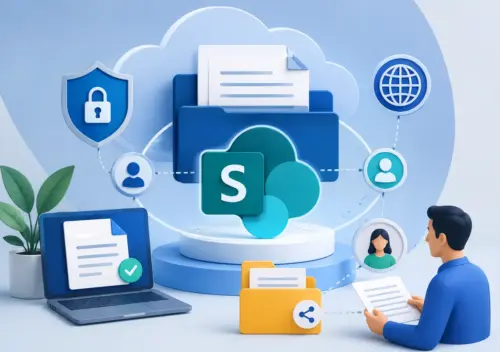
SharePoint Online sits much closer to the rest of Microsoft 365. That matters because modern collaboration rarely happens inside one application.
Microsoft Teams uses SharePoint for files stored within Teams channels. Each team connects with SharePoint sites behind the experience.
This relationship becomes practical in everyday work. Teams handle the collaboration experience, while SharePoint manages the shared content underneath.
Power Automate can support approvals and repeatable processes. Power Apps can replace suitable legacy forms and small business applications.
OneDrive handles individually owned working files. The result is a connected workplace when the architecture is planned properly.
Structured Document Management Instead of Network-Drive Thinking
A common migration mistake happens before any data moves. Teams recreate the old file server inside SharePoint.
Twenty years of folders simply become twenty years of cloud folders. Nothing really improves. SharePoint Online gives you better options through libraries, metadata, views, search, versioning and structured ownership.
You do not need to remove every folder. It means you should decide whether the existing structure still helps people find and manage information. This is one of the most valuable SharePoint migration benefits because it changes how teams work after migration.
Easier Collaboration Across Locations
Remote and hybrid working exposed weaknesses in many older environments. People should not need awkward workarounds simply to reach a document.
SharePoint Online gives authorised users browser-based access through Microsoft 365. Teams can co-author Office documents and work from common libraries.
External collaboration also becomes easier to govern. Clients, suppliers and partners can receive controlled access where your policies allow it.
The important word is controlled. External sharing should follow clear ownership, expiry and permission rules. Convenience should never become uncontrolled access.
Continuous Platform Development
With SharePoint Server, major platform improvements often arrive through upgrades. SharePoint Online develops continuously. That gives organisations access to evolving Microsoft 365 capabilities without planning another SharePoint Server version project each time.
There is a trade-off. Cloud services change more frequently, so administrators need good release management and communication. For most organisations, though, that is easier than maintaining an ageing platform indefinitely.
The SharePoint Migration Benefits Go Beyond Moving Files
A good migration should produce a better operating environment.
If employees still cannot find information, understand permissions or complete routine tasks, the migration has missed its purpose.
Think about outcomes before technology.
- Can somebody find the current policy without asking around?
- Can project teams work from one controlled version?
- Can an employee leave without business knowledge disappearing inside personal folders?
- Can site owners understand who has access?
For organisations migrating to SharePoint, the strongest projects connect the move with information quality, governance and user experience.
Here, the business case becomes much clearer.
Building More Than a File Repository?
IDS Logic can help you modernise SharePoint around intranets, document management, integrations and business workflows.
Migrate SharePoint 2019 to SharePoint Online – What Needs Attention?
The technical move is only one part of the job. If you need to migrate SharePoint 2019 to SharePoint Online, start with everything that surrounds your content.
- Look at custom web parts.
- Review workflows.
- Identify forms, integrations and authentication dependencies.
- Check which sites people actually use.
Older environments often contain years of experiments, abandoned projects and one-off customisations.
You do not need to carry all of that forward. Microsoft’s SharePoint Migration Tool supports content migrations from SharePoint Server 2010, 2013, 2016 and 2019 into Microsoft 365.
The tool can move content. It cannot decide whether an old process still makes sense. That judgement needs people who understand the current environment and the target design.
SharePoint Migration from On-Premises to SharePoint Online – What Actually Changes?
People often describe this project as moving SharePoint from one location to another. That understates the change.
A SharePoint migration from on-premises to SharePoint Online changes your infrastructure, integration options and administration model.
It also changes how users reach content. The cloud environment connects naturally with Microsoft 365 identities and services.
- Custom server-side solutions may need replacing or redesigning.
- Classic publishing approaches may not have a direct SharePoint Online equivalent.
- Authentication and permissions also deserve a fresh look.
You therefore need to distinguish three different things:
Content that can move largely as it is, functionality that needs remediation, and structures that should be redesigned. Treating everything identically usually creates unnecessary technical debt.
Do Not Lift and Shift Your Information Architecture
Migration is a rare chance to fix structural problems without pretending they never existed.
Start with the content estate.
- Which sites remain active?
- Which libraries still have owners?
- Where are duplicates?
- Which documents need retention?
- Which information no longer has business value?
Then look at navigation and metadata.
A SharePoint migration and structure redesign should help employees find information faster after launch. Do not rebuild the organisational chart as your information architecture automatically.
People often search by task, project, customer or subject rather than department name. Design around how content gets used. That creates a platform people can understand months after consultants leave.
Migrate Your Intranet to SharePoint Online Without Recreating the Old Experience
Moving an intranet to SharePoint Online should involve more than recreating the existing portal in Microsoft 365.
Start by understanding what employees actually use. News and policies may matter every day, while some department pages receive little attention. Search, mobile access and clear navigation often matter more than preserving an outdated page structure.
That deserves proper treatment. An intranet migration should not become a pixel-for-pixel recreation of the existing portal.
- Start by understanding what employees actually use.
- News may matter. Policies certainly do.
- Department pages may have little value if nobody visits them.
- Search, mobile access and clear navigation often matter more than preserving an old page structure.
SharePoint Online can support communication sites, hub sites and connected content experiences.
Teams and Viva Connections can also bring intranet content closer to everyday work.
A SharePoint intranet migration therefore offers two opportunities. You move off ageing technology, and you can simplify the employee experience at the same time.
Legacy Workflows and InfoPath Need Their Own Migration Plan
Legacy workflows often determine how complicated the migration becomes. SharePoint 2013 workflows reached full retirement in SharePoint Online on 2 April 2026. Microsoft recommends moving suitable processes to Power Automate or another supported solution.
InfoPath 2013 also reached the end of extended support in July 2026. That means a SharePoint workflow migration cannot simply copy everything and hope it continues indefinitely.
Document the existing process first.
- What triggers it?
- Who approves something?
- What happens when an approval fails?
- Does the workflow update another system?
You may discover that a ten-step workflow exists because of constraints that no longer apply.
Modernisation then becomes more valuable than recreation. Power Automate can handle many Microsoft 365 workflow scenarios. Power Apps may suit forms that need a more modern interface.
Some complex applications may need custom development. Choose based on the process, not the product name.

SharePoint Legacy System Migration Needs More Discovery
Not every project starts from SharePoint Server. Some organisations still depend on network drives, custom document repositories or older content platforms.
A SharePoint legacy system migration requires a different level of discovery. The source system may contain metadata that does not map neatly into SharePoint.
Permissions could rely on structures that no longer exist. File names and paths may also create migration problems. Before moving anything, document the source model. Then design the SharePoint destination around future use.
The goal is not to recreate the legacy platform inside Microsoft 365. It is to preserve valuable information while leaving obsolete constraints behind.
How to Migrate to SharePoint Online Without Creating New Problems
Microsoft’s own migration tooling now puts more emphasis on assessment. SPMT 4.0 includes the ability to scan SharePoint Server sites before migration. The scan surfaces inventory information and potential migration risks.
Microsoft is also retiring the older SharePoint Migration Assessment Tool on 1 October 2026. It recommends using SPMT’s scanning capability instead. The message is simple: assess first, migrate second.
Start With Discovery
Build an inventory of sites, libraries, content volumes, permissions, customisations and integrations.
Use technical discovery alongside administrator knowledge. Large SharePoint estates nearly always contain forgotten dependencies. Large SharePoint estates always contain surprises. Identify business owners as well. A technically active site may have no meaningful business purpose.
Decide What Moves
Classify content before migration. Some information should move unchanged.
Other content needs cleansing, restructuring or archiving. A portion should probably be deleted under your organisation’s retention rules. Moving less unnecessary content reduces complexity later.
Design the Target Environment
Decide how sites, hubs, libraries, metadata and permissions should work before the main transfer. The destination should reflect future use. Let business needs shape the information architecture, not the migration tool.
Run a Pilot
Choose representative content. Include enough complexity to expose genuine risks. Test metadata, permissions, links, workflows and user access. A pilot gives you evidence before the larger cutover.
Migrate in Controlled Waves
Large migrations usually work better in stages. That reduces business disruption and gives teams time to respond when an unexpected dependency appears. Delta migration can help capture later changes closer to cutover.
Validate What Moved
A completed migration job does not automatically mean the project succeeded. Check content counts, metadata, versions, permissions and business processes. Ask real users to complete familiar tasks. User acceptance testing catches issues that technical reports cannot.
Support Adoption After Launch
Migration changes habits. People may still save documents locally or create unnecessary folders because that feels familiar. Training should explain the new working model, not just show where buttons moved. Good adoption protects the investment you just made.
Need a Clear Migration Plan Before Anything Moves?
IDS Logic can assess your current environment, identify migration blockers and plan a controlled route into Microsoft 365.
Permissions Need More Attention in the AI Era
Permissions have always mattered. Copilot and AI-driven discovery make poor permissions harder to ignore.
Microsoft states that Copilot respects existing permissions. That means users only receive content they can already access. The problem appears when those existing permissions are too broad.
SharePoint Advanced Management now includes permission-state reporting and Data Access Governance capabilities for SharePoint and OneDrive. It can help administrators identify potentially overshared content.
Restricted Content Discovery can also stop high-risk sites from appearing in broader search and certain Copilot experiences.
This gives migration teams another reason to clean access before launch. Clean up years of permission drift before those access problems reach the new tenant. Review groups, external access, broken inheritance and site ownership before migration. That work may matter more than moving the files themselves.
SharePoint Online Is Not the Only Supported Route
SharePoint Online is not the right destination for every organisation. SharePoint Online fits many organisations, especially those already investing in Microsoft 365.
SharePoint Server Subscription Edition remains supported under Microsoft’s Modern Lifecycle Policy. Microsoft says support will continue until at least 31 December 2035.
Some organisations may still need on-premises deployment because of regulation, architecture or operational constraints. That should be a deliberate decision.
If your organisation can use the cloud, SharePoint Online usually removes significant infrastructure responsibility and provides closer Microsoft 365 integration. If you cannot, Subscription Edition gives you a supported server path. The right answer comes from requirements, not fashion.
Common SharePoint Migration Mistakes
A technically successful migration can still create a poor working environment.
Moving everything is one cause. Redundant sites, obsolete versions and forgotten documents simply create noise in Microsoft 365.
Permissions cause another problem. Copying years of inherited access without review carries the same confusion into SharePoint Online.
Customisations need equal attention. An old web part or workflow may have no direct cloud equivalent.
Then there is adoption. Some projects invest heavily in migration day and very little in what happens afterwards. Users receive a new platform without clear ownership or guidance.
A better approach treats migration as a change in information management, not a weekend file transfer.
Final Thoughts – Migration Should Leave You With Less Complexity
The strongest reason to move to SharePoint Online is not simply that cloud technology is newer. A good migration gives you the opportunity to leave unnecessary complexity behind.
That could mean ageing infrastructure, unsupported workflows, confusing permissions or content nobody uses anymore.
Keep what still works. Redesign what creates friction. Retire what no longer serves a purpose.
The best SharePoint migration benefits appear when the project improves how people manage and find information.
Done well, you gain more than a successful transfer. You leave with a SharePoint environment your teams can actually use and govern.
How IDS Logic Supports SharePoint Online Migration for UK Organisations
Choosing a SharePoint Server to SharePoint Online migration company should involve more than comparing who can move files fastest.
The difficult work often happens before that stage.
IDS Logic helps organisations assess their existing environment, plan the target architecture and identify migration risks early. That can include content audits, permissions, customisation reviews, workflow modernisation and intranet redesign.
Our SharePoint Online migration services can support phased moves, complex legacy environments and wider Microsoft 365 requirements. Where development is needed, we can also help with SPFx, Power Platform, integrations and custom business processes.
The objective is a platform your teams can manage after go-live. That means avoiding unnecessary customisation and making governance practical for site owners. With delivery teams based in Leeds and a UK-wide presence, IDS Logic supports organisations planning SharePoint modernisation across the country.
Ready to Move With a Clearer Plan?
Talk to IDS Logic about your SharePoint estate, migration risks, intranet or Microsoft 365 roadmap.