Protect your Umbraco site from bots and spam without frustrating users. ALTCHA for Umbraco is a lightweight, GDPR-compliant alternative to traditional CAPTCHAs—fast, privacy-friendly, and easy to integrate. Choose between the free open-source version for flexibility or ALTCHA Sentinel for enterprise-level security with advanced features. A smarter, seamless way to secure your forms.
Why Umbraco Websites Require a Smarter CAPTCHA Solution?
There are still several Umbraco websites that rely on old-fashioned CAPTCHA tools that create more friction than protection. Users are often asked to solve distorted puzzles, pick blurry images, or wait for slow scripts that reduce users’ experience and conversion rates.
UK businesses face an even greater task. Ineffective CAPTCHA systems can:
- Increase form abandonment rates by making the user visibly frustrated during verification.
- Degrade site performance, causing negative impacts on both SEO and user engagement.
- Create unnecessary privacy concerns when CAPTCHA tools rely on tracking, cookies or external data processing.
- Put the site at risk, exposed to spam, fake sign-up submissions, and automated attacks.
Privacy-friendly verification can support a simpler approach to UK GDPR and data-protection requirements.
As a solution, Umbraco can use a modern, user-friendly, and GDPR-compliant CAPTCHA. The ALTCHA tool ensures that websites remain safe from bots and spam while ensuring fast, easy, and seamless interactions for actual users. Umbraco site owners can protect their digital presence while maintaining usability and trust by switching to a privacy-first CAPTCHA.
What Is ALTCHA CAPTCHA?
There are many people who have been frustrated by distorted images, slow-loading Captchas, or concerns about data tracking. ALTCHA proves its value to businesses and developers when they are searching for a smarter, faster, and privacy-friendly CAPTCHA solution that doesn’t get in the way of real users.
ALTCHA (Alternative CAPTCHA) is a new and modern, lightweight and user-friendly CAPTCHA system that protects websites from automated bots while keeping the experience as simple as possible for genuine visitors.
Instead of asking visitors to identify images or solve visual puzzles, ALTCHA uses a small proof-of-work challenge. The browser handles the calculation automatically, while the server verifies the result before accepting the submission.
Why Does ALTCHA For Umbraco Stands Out?
The ALTCHA for Umbraco solution isn’t just another CAPTCHA. The free MIT-licensed version as well as the advanced ALTCHA Sentinel offer businesses of all sizes secure, compliant, and user-friendly bot protection. It provides a combination of privacy, flexibility, and scalability to protect Umbraco websites without affecting genuine users.
Privacy-first approach
ALTCHA does not use cookies or any sort of tracking or invasive scripts; ultimately, making it a GDPR-compliant CAPTCHA solution.
MIT-licensed and open source
The free version is completely MIT-licensed, and organisations can use it, change it, and integrate it at no cost.
Built for everyone
ALTCHA is for anyone – individuals, SMEs, large enterprises – and is designed to scale based on the levels of bot protection each may need.
Flexible deployment
ALTCHA offers a free open-source core, managed ALTCHA Cloud and self-hosted ALTCHA Sentinel for more advanced protection requirements.
ALTCHA for Umbraco protects your Umbraco site from spam, fake sign-ups, and automated attacks with secure, GDPR-compliant bot protection that keeps users’ experience smooth.
ALTCHA for Umbraco Websites
ALTCHA can be integrated with forms and other submission points on an Umbraco website. The widget handles the browser-side proof-of-work challenge, while the solution also needs challenge generation and server-side verification. For .NET-based implementations, the integration approach should match your Umbraco version, form handling and hosting setup.
If your implementation requires custom form logic or CMS development, explore our Umbraco development services.
ALTCHA Open-Source vs. ALTCHA Sentinel (Commercial): A Comprehensive Comparison
Knowing the differences between the open-source ALTCHA and its commercial counterpart, ALTCHA Sentinel, is crucial when evaluating CAPTCHA solutions for Umbraco websites. In addition to protecting against bots and automated threats, both products offer distinctive features. Here’s how they compare:
Cost and Accessibility
Open-Source (MIT License)
The open-source version of ALTCHA is completely free to use, modify, and share. It is ideal for developers, small businesses, or personal projects wanting a free option that keeps their privacy and performance intact.
ALTCHA Sentinel (Commercial)
ALTCHA Sentinel is the self-hosted commercial option for organisations that need more advanced bot protection and control over deployment.
Professional: €99/month
Suitable for production deployments with up to three instances.
Enterprise: €799/month
Designed for larger deployments that need additional enterprise capabilities.
Enterprise Lifetime: Pricing available on request.
ALTCHA also provides a 30-day trial for evaluation. Check the official pricing page before purchasing, as plans and prices can change.
Source Code and Modification
Open-Source
With full access to the source code, developers can inspect, modify, and integrate ALTCHA into their systems as needed. This flexibility is beneficial for custom implementations and self-hosting scenarios.
ALTCHA Sentinel
ALTCHA Sentinel is commercially licensed and self-hosted on your infrastructure. It provides advanced protection without requiring you to hand infrastructure or data ownership to a managed SaaS provider.
Support and Features
Open-Source
Support is community-driven, with resources available through forums, GitHub discussions, and documentation. The open-source version includes essential features like the Proof-of-Work (PoW) mechanism for bot protection.
ALTCHA Sentinel
Sentinel offers dedicated vendor support for timely assistance related to deployment, troubleshooting, and optimisation. Advanced functionality includes:
- Adaptive CAPTCHA: Dynamically adjusts challenges based on risk assessment.
- Threat Intelligence: Utilises data to identify and mitigate emerging threats.
- Rate Limiting: Limits the number of requests to mitigate abuse.
- Text Classifiers: Analyses content to find spam or malicious input.
Control and Ownership
Sentinel gives organisations control over deployment and data because it runs on their own infrastructure. This makes it suitable where data residency, internal security or on-premise requirements matter.
Open-Source
Promotes a decentralised approach, allowing organisations to maintain complete control over their CAPTCHA implementation. This autonomy is beneficial for those who prioritise self-reliance and customisation.
ALTCHA Sentinel
Operates under centralised control by the vendor, with regular updates and maintenance. While this ensures a consistent and secure experience, it may limit flexibility for organisations seeking more control.
Proprietary Use
Open-Source
The MIT license permits the use of ALTCHA in proprietary software, provided the original license notice is included. This is beneficial for businesses looking to integrate CAPTCHA functionality into commercial products without licensing concerns.
ALTCHA Sentinel
The commercial license ensures compliance with data protection laws while offering scalability for large operations. It is designed for businesses requiring enterprise-grade protection while maintaining intellectual property ownership.
Why ALTCHA Is a Stronger Choice Than reCAPTCHA?
When it comes to protecting your Umbraco website, not all CAPTCHA tools are created equal. Many businesses in the UK are moving away from reCAPTCHA because of its heavy scripts, intrusive tracking, and frustrating user experience. ALTCHA CAPTCHA has quickly become the preferred Umbraco CAPTCHA solution thanks to its speed, simplicity, and respect for privacy.
Here’s where ALTCHA differs from traditional reCAPTCHA approaches:
Privacy-Friendly by Design
Unlike reCAPTCHA, ALTCHA doesn’t depend on cookies, behavioural tracking, or browser fingerprinting. It’s a GDPR-compliant CAPTCHA that safeguards visitors’ data while protecting your website.
Smooth User Experience
ALTCHA skips the distorted puzzles and endless “spot the traffic light” tests. Users either see a simple checkbox or are verified invisibly in the background. This creates a frictionless journey for real people while still blocking bots.
Open-Source and Transparent
As an open-source CAPTCHA under the MIT licence, ALTCHA offers complete transparency. Businesses can review the code, self-host it, or even contribute to its growth. This level of openness makes it a trusted alternative to proprietary solutions.
Lightweight and Fast Loading
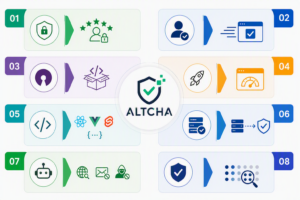
Speed matters for SEO, conversions, and mobile performance. While reCAPTCHA can add over 300 KB to a page, ALTCHA weighs in at under 30 KB. That means faster page loads and better results for your Umbraco site performance.
Flexible for Developers
ALTCHA is built with developers in mind. It integrates smoothly with popular frameworks like React, Vue, and Svelte, while also working with back-end only applications through simple APIs. For Umbraco developers, this flexibility makes it easy to implement across forms, sign-ups, and APIs.
Server-Side Verification Remains Essential
ALTCHA does not rely on the browser check alone. Your server must verify the submitted ALTCHA payload before accepting the form. This prevents a bot from bypassing protection by simply skipping the widget.
Strong Bot Protection
Behind the scenes, ALTCHA uses proof-of-work checks, hashing, salting, and adaptive scoring to spot suspicious activity. It helps stop botnets, spam tools, and data centre IPs while letting genuine visitors through without delay.
Sentinel Technical Requirements: What Your Umbraco Site Needs
You should understand the entire technical setup before deploying ALTCHA Sentinel for enhanced Umbraco bot protection. It’s more than installing a widget; it’s about deploying a secure, scalable, enterprise-ready system.
Here’s how it works:
Supported Environments & Deployment Options
ALTCHA Sentinel supports self-hosted deployments across modern container and cloud environments, including Docker, Kubernetes, AWS and Azure.
- Container orchestration platforms: Kubernetes, Docker Compose, Docker Swarm, AWS ECS, Azure App Services, Podman, etc.
- On-premises or self-hosted installations: Certainly giving you the full control of your environment and your data.
Finally, these options make it an excellent choice for enterprises that want the freedom to operate and a compliance requirement to adhere to.
Running security components alongside an existing CMS also creates an ongoing maintenance responsibility. IDS Logic provides Umbraco maintenance services.
Infrastructure & Performance Baseline
ALTCHA Sentinel is built for heavy load:
- CPU & Memory: Minimum 2 vCPUs and 2 GB RAM are required for a minimum installation, however more will be needed if your environment experiences heavy load or high traffic.
- Persistent Storage: User-defined volumes which will contain data, such as, logs, environmental settings and encryption secrets. If user defined volumes are not preferable, PostgreSQL may be used in place of volumes.
These specifications are required for consistent operations and optimal user experience.
Environment Variables & Secret Management
Sentinel relies on environment variables for secure configuration:
- Automatic Generation: On first launch, the application creates secure defaults (for variables like HMAC_SECRET, JWT_SECRET, HASHING_SALT, and others) and persists them in a .env file.
- Manual Configuration: You can override these through your deployment platform (e.g., Kubernetes Secrets, Docker .env, or via the ALTCHA Sentinel UI).
- Secure Practices: For best security, store secrets in secret vaults and use _FILE environment variables to reference secret files.
Security Posture & Compliance Controls
ALTCHA Sentinel is built with enterprise-grade security in mind:
Security Model: Adheres to frameworks like ISO 27001, SOC 2, GDPR, HIPAA, and EAA (European Accessibility Act).
Preset by Vendor:
- Role-Based Access Control (RBAC)
- Multi-Factor Authentication (MFA)
- Encryption for data both at rest and in transit
- Audit logs and monitoring features
- High availability and disaster recovery design
Your Responsibilities:
- Secure deployment environment (OS, containers, network, firewall, backups)
- Properly manage user access, credentials, and encryption keys
- Monitor logs, run vulnerability scans, and apply patches promptly
License Configuration & “Call-Home” Mechanism
Set-up includes licensing setup and optional telemetry:
- License Setup: Can be managed via the Sentinel dashboard or as an environment variable (LICENSE_KEY).
- Connectivity: Sentinel performs periodic check-ins to its EU-based licensing server (e.g., reporting CPU count, uptime). You can disable this “call-home” telemetry by using a provided LICENSE_JSON file instead.
Final Thoughts – Choosing the Right CAPTCHA for Your Umbraco Website
ALTCHA for Umbraco offers practical advantages to developers and digital teams using Umbraco CMS. The invisible CAPTCHA mode ensures visitors are only confronted with challenges when suspicious behavior is detected, while its lightweight design keeps page loading times fast and prevents tracking. It is easy to integrate with Umbraco, making it both developer-friendly and user-friendly.
When it comes to choosing between versions, the open-source ALTCHA (MIT Licence) is a great fit for individuals and small to mid-sized businesses that need free, flexible protection without extra infrastructure. On the other hand, ALTCHA Sentinel is customised for enterprises, regulated sectors, and high-traffic websites that demand advanced features such as adaptive CAPTCHA, threat intelligence, and vendor-backed support.
No matter whether you choose the free open-source option or the enterprise-grade Sentinel plan, ALTCHA is the future-ready, GDPR-compliant CAPTCHA solution Umbraco users can trust. With this solution, your site will remain protected from evolving bot threats, without ever compromising visitor experience.