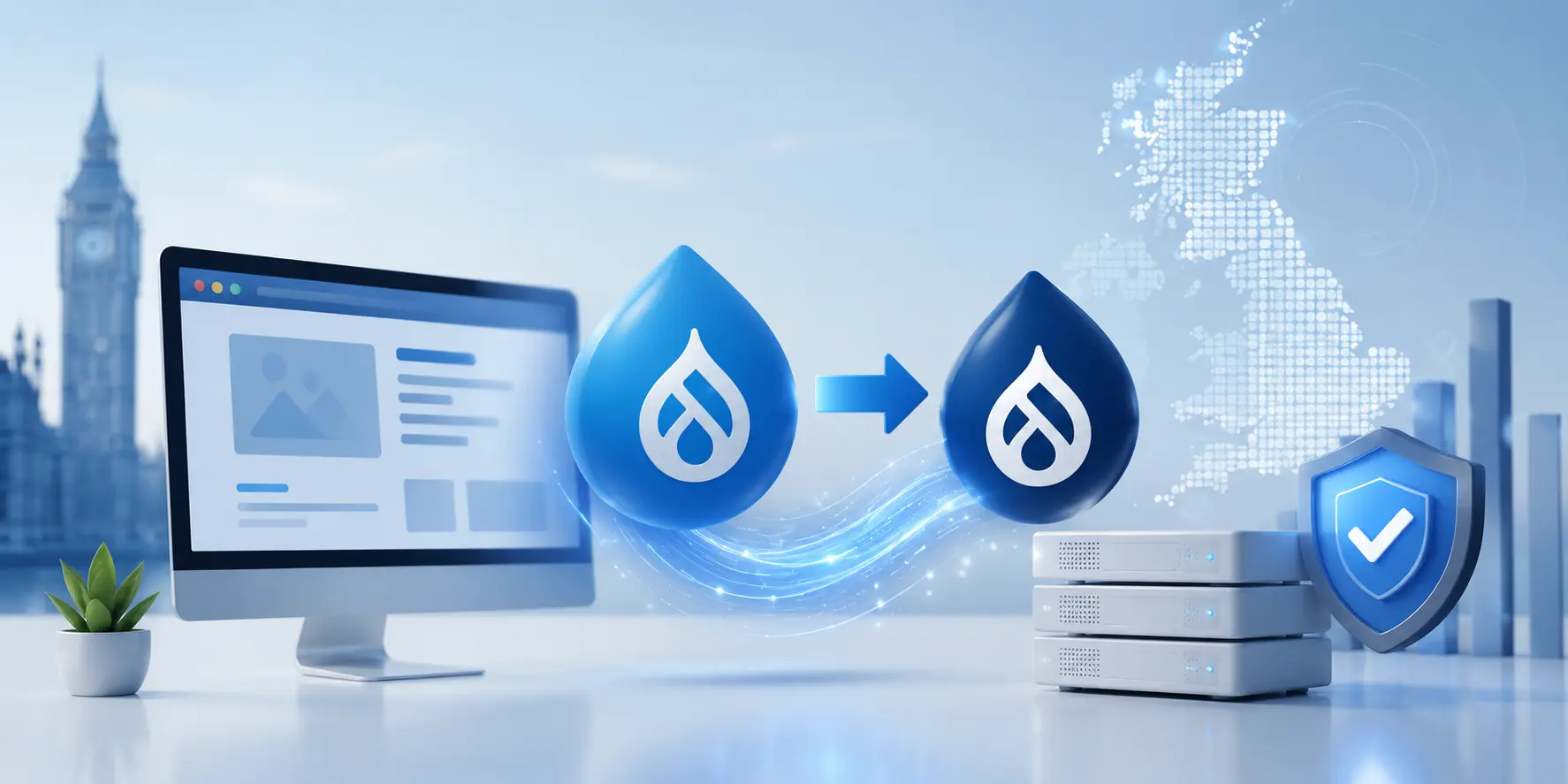
If your website still runs on Drupal 10, the upgrade conversation has changed. Drupal 10 remains supported today, but only for a limited time. Its end-of-life date is 9 December 2026. After that date, Drupal will stop releasing Drupal 10 security updates and maintenance releases.
Waiting until December creates unnecessary pressure. A rushed Drupal 10 to Drupal 11 upgrade leaves less time to test modules, custom code and integrations properly. Problems that seem minor today can quickly become release blockers.
The good news is that this is not another Drupal 7-style rebuild.
Drupal designed recent major versions around a more manageable upgrade path. A well-maintained Drupal 10 site can usually move forward without rebuilding its content and configuration from scratch.
The real work lies elsewhere. You need to understand your codebase, dependencies, hosting environment and business-critical journeys before changing the core version. This guide explains when to upgrade, what Drupal 11 gives you and how to reduce migration risk.
Drupal 10 End of Life Is Now a Business Deadline
Drupal 10.6 is the final Drupal 10 minor release. Community security support ends on 9 December 2026. Drupal 12 is also scheduled for release during the same week.
Your website will not suddenly stop working after that date. The site may keep running, but unsupported core changes the risk profile.
New Drupal 10 vulnerabilities will no longer receive normal community security releases. Over time, compatible extensions and development tooling may also move towards newer versions. That can turn planned maintenance into urgent remediation.
For a public website, member portal or revenue-generating platform, that is rarely a sensible position. An upgrade gives you control over the timing.
You can inspect the platform, resolve dependencies and test important user journeys before the deadline starts driving decisions.
Why Upgrade Drupal 10 to Drupal 11?
Avoiding end of life is the immediate reason, but the Drupal 11 benefits go further. Current Drupal 11 features improve performance, maintainability, administration and the underlying development platform.
Drupal 11.4.0 arrived in July 2026. Drupal 11.4.5 followed on 6 August as a production-ready patch release. That means businesses are no longer evaluating an early Drupal 11 release. The platform has already moved through several feature cycles.
Faster Core Performance
Performance improvements deserve careful explanation because website speed claims are often exaggerated. Drupal does not claim that every Drupal 11 website suddenly becomes three times faster.
Drupal 11.4 significantly reduces the work core performs during requests. Drupal reports just over one-third of the database and cache lookups used by Drupal 11.0 or Drupal 10.6. JavaScript and CSS compression also improved by around 15–25%.
Your real-world result still depends on hosting, themes, modules, caching and integrations. Even so, a more efficient core gives developers a stronger starting point. For larger content platforms, reducing unnecessary database work can make a meaningful difference under load.
A More Efficient Editorial Experience
Website performance matters to visitors. Editor efficiency matters to the people running the site every day. Drupal 11.3 stabilised the newer Navigation module and improved CKEditor workflows. It also introduced native content export and further interface improvements.
Drupal 11.4 continues that work.
The Gin administration theme has entered Drupal core as an experimental administrative theme. It also includes a dark mode option. Gin has not yet replaced the existing administration theme by default.
Still, its inclusion shows where Drupal’s administrative experience is heading. For content-heavy organisations, easier publishing can matter more than another technical feature. Marketing teams should not need developer support for routine content tasks.
A Cleaner Technical Foundation
Older APIs and deprecated code create invisible maintenance work. They may not affect visitors today, yet they make future upgrades and development harder.
Drupal 11 removes older deprecated components and raises its technology requirements. Current Drupal 11 releases require at least PHP 8.3. Drupal 11 also raises minimum database requirements to MySQL 8.0, MariaDB 10.6 or PostgreSQL 16.
The higher requirements do create some technical housekeeping. It also reduces the amount of ageing infrastructure your development team must carry forward.
For organisations with several custom modules, this is an important Drupal 11 benefit. Cleaner dependencies generally make future maintenance easier to plan.
Stronger Security Through Supported Software
A version number does not make a Drupal website secure by itself. Configuration, permissions, custom code, modules, hosting and maintenance still matter.
However, supported software gives your team access to current security releases. As of August 2026, Drupal 11.4.x receives security coverage until June 2027. Drupal 11 itself remains supported until Drupal 13 arrives.
Drupal also continues strengthening security inside the core. Drupal 11.4 includes improved password hashing among its platform changes. Your team then works from a maintained foundation instead of an ageing one.

Drupal 10 Improvements Still Matter
Moving to Drupal 11 does not mean Drupal 10 suddenly became a poor platform. Several important Drupal 10 improvements created the foundation for today’s easier upgrade model.
This continuity matters. Drupal 10 and Drupal 11 are much closer architecturally than older major-version transitions.
As a result, a complete content migration is often unnecessary when the site already follows modern Drupal standards. Easier does not mean automatic. A site with outdated contributed modules or old custom code may still require substantial preparation. The version change is only one part of the job.
What Should You Check Before a Drupal 11 Upgrade?
The best upgrade projects usually start with an audit, not a Composer command. Drupal’s official guidance requires the source site to run at least Drupal 10.3.x. Your hosting environment must also satisfy Drupal 11’s platform requirements.
Start by understanding what your current website actually depends on.
Look at contributed modules, custom modules, themes, integrations and deployment processes.
Then review deprecated code. Drupal recommends tools including Upgrade Status and Drupal Rector for identifying and addressing compatibility issues. The Upgrade Status project remains actively maintained for current Drupal versions.
Hosting deserves equal attention.
A Drupal 10 server may still use PHP or database versions that Drupal 11 will not accept. Finding that during the readiness stage is manageable. Finding it during production deployment is not.
Module Compatibility Often Determines the Real Upgrade Effort
Drupal core may be ready while the rest of your stack still needs work.
Some contributed modules already support Drupal 11. Others need an updated version, replacement or compatibility patch.
Custom code deserves closer inspection because deprecated Drupal 10 APIs can block the upgrade.
Upgrade Status can identify many of these gaps. Drupal Rector can also help address supported deprecations.
Neither tool replaces testing. Forms, search, payments, CRM connections, authentication and editorial workflows still need to work after deployment.
How to Approach a Drupal 10 to Drupal 11 Upgrade
A safe Drupal 11 upgrade should happen away from your live production environment first.
Begin with a reliable backup and a controlled working copy. Bring Drupal 10 core and contributed extensions to suitable supported versions. Then run compatibility checks against Drupal 11.
Next comes custom-code remediation. Update deprecated APIs, review themes and resolve Composer dependency conflicts before changing the major core version. Once the application becomes Drupal 11 compatible, complete the core upgrade using Composer.
Drupal specifically recommends Composer for managed Drupal installations. Its documentation also warns against using manual minor-update instructions for major upgrades. Afterwards, run database updates and rebuild caches.
Then the test. The testing stage should cover far more than pages loading without errors.
- Editors need to create and publish content.
- Forms need to submit successfully.
- Integrations must still exchange the right data.
- Search, authentication and scheduled tasks deserve attention too.
- Finally, review performance and logs before production release.
Following this sequence helps uncover problems while rollback remains straightforward.
Do Not Treat the Upgrade as a Redesign Unless You Need One
An approaching EOL date often raises a bigger question. Should you upgrade the website or redesign it at the same time?
There is no universal answer. A technically healthy Drupal 10 site may only need a focused version upgrade. Combining an unnecessary redesign can increase scope, testing effort and release risk.
The situation changes when the current site already has deeper problems. Perhaps editors struggle with the existing structure. Maybe accessibility needs significant work, or the website requires custom Drupal development
You may also have ageing integrations or a frontend that no longer supports business goals. In those cases, coordinating selected improvements with the upgrade can save duplicated effort.
The important part is separating required upgrade work from optional modernisation. Separating those two workstreams makes budgets and timelines easier to manage.
What Does Drupal 11 Mean for Website Performance and SEO?
The old version of this article suggested that upgrading Drupal automatically improves SEO.
That is too simplistic. Google will not reward your website simply because it runs Drupal 11.
Search performance depends on content quality, crawlability, internal linking, page experience and many other factors. The underlying platform still matters.
Drupal 11’s performance improvements can support faster delivery when the wider implementation is well optimised. A cleaner upgrade can also remove outdated components that complicate ongoing technical optimisation.
Be careful during deployment, though. Changing URLs, metadata, canonical tags or robots settings unnecessarily can create SEO problems.
Preserve working URL structures whenever possible. If URLs must change, map redirects before launch and verify them afterwards. An upgrade should protect your existing search equity, not reset it.
What If Your Website Still Runs Drupal 9?
Drupal 9 reached end of life on 1 November 2023. If you still run it, you cannot jump directly to Drupal 11.
Drupal requires websites to move through consecutive major versions. You must first upgrade to Drupal 10, then continue to Drupal 11. For a Drupal 9 site, the Drupal 10 upgrade remains a necessary bridge before moving to Drupal 11.
It should no longer be the final target. The Drupal 9 benefits your organisation already relies on can continue through the supported upgrade path.
However, staying on Drupal 9 leaves the core platform outside normal community support. Organisations in this position should treat the work as a priority.
Why Drupal 11 Matters Before Drupal 12 Arrives
Drupal 12 is scheduled for the week beginning 7 December 2026.
That creates an understandable question. Why not remain on Drupal 10 and jump straight to Drupal 12?
Drupal does not support that path. Major versions cannot be skipped. A Drupal 10 website must move through Drupal 11 before Drupal 12.
Waiting therefore does not eliminate work.
It compresses the timeline. Moving to Drupal 11 now gives your team a supported platform and prepares the codebase for the next release cycle.
It also gives you time to separate upgrade problems from future Drupal 12 planning. That is a much healthier position than handling both under deadline pressure.
When Should You Start Upgrading to Drupal 11?
Start with readiness work now if Drupal 10 supports an important business website. A small, well-maintained installation may need limited remediation.
A large platform can require much more. Custom modules, bespoke themes, integrations and older infrastructure all affect effort.
Procurement and internal approval can also take longer than development. That is why waiting for the final weeks creates risk. You do not need to put the live website through an immediate upgrade.
A readiness assessment can identify the work first.
Once you understand the blockers, you can decide how quickly implementation needs to move. That turns an EOL deadline into a manageable technical roadmap.
Common Drupal Upgrade Mistakes That Create Problems Later
One frequent mistake is treating green compatibility reports as proof that the project is finished. Automated tools help, but they cannot understand every business process.
Custom forms, payment workflows and external integrations still need human testing. Another problem appears when teams update core while leaving old technical debt untouched.
Deprecated code may survive one release and block the next. A third issue comes from combining too many changes.
Changing Drupal, hosting, design and integrations simultaneously makes failures harder to diagnose. Finally, teams sometimes forget editor testing.
A technically healthy website can still frustrate people if publishing workflows change unexpectedly. The safer approach is controlled change. Know what must move, what can stay and what deserves separate improvement.
Final Thoughts: Upgrade Before Drupal 10 Becomes the Problem
There was a time when the question was simply whether Drupal 10 offered enough improvements to justify upgrading. That question has moved on.
Drupal 10 now has a fixed end-of-life date.
Meanwhile, Drupal 11 has matured through several feature releases and continues receiving active development.
The sensible approach is not to rush. It is to prepare early.
Audit your platform, resolve compatibility issues and test the upgrade in a controlled environment. Use the project to remove technical friction where it genuinely helps. Most importantly, avoid waiting until support ends.
A planned Drupal 10 to Drupal 11 upgrade gives your organisation choices. An emergency upgrade rarely does.
How IDS Logic Supports Drupal Upgrades for UK Organisations
A Drupal upgrade involves more than changing core files.
The work needs to protect business processes, content, integrations and the user experience around them.
IDS Logic supports Drupal development, migration, customisation and ongoing maintenance for organisations across the UK. Our Drupal services also support businesses in Leeds and other major UK locations.
Our wider delivery experience spans 19+ years across web platforms, CMS projects, applications and integrations. IDS Logic also provides ongoing Drupal maintenance for security fixes, upgrades and performance optimisation.
For this major-version transition, we start by understanding the existing platform.
That means reviewing core, contributed modules, custom code, hosting and integrations before recommending changes.
We then identify which issues block Drupal 11 compatibility.
Testing covers the journeys that matter to your organisation, not only technical installation checks.
After launch, maintenance remains important. Drupal maintenance and support helps keep the website updated, secure and performing reliably after the upgrade.
Drupal continues releasing minor and security updates, so the upgrade should form part of an ongoing platform plan.