AI is no longer a future idea. It now sits at the centre of how UK businesses improve customer experiences, automate tasks, and make better decisions. Teams across retail, finance, healthcare, and education now use AI apps to save time, reduce manual work, and offer smarter services. Yet one question still worries most leaders:
How much does it cost to build an AI app in 2026?
Many people expect either extremely high numbers or a very small budget. In reality, the true AI app development cost sits somewhere between both extremes. Costs vary because each AI app needs different features, data volumes, and model requirements. A basic AI solution may cost around £25,000, while an advanced enterprise build can cross £400,000, especially when it includes machine learning, generative AI, or large data pipelines.
Over the past few years, our team has delivered AI apps of all sizes. Some projects required simple chatbots, while others needed custom AI models that scale for thousands of users. These real projects taught us that AI pricing depends on clear planning, the right development approach, and a practical understanding of what you want your AI to achieve.
Today’s businesses use AI to handle customer enquiries instantly, process data in seconds, and support daily operations without extra staff. Tasks that once needed long hours now happen automatically. That shift gives teams more room to focus on meaningful work and long-term growth. But to reach this level of efficiency, you must know what shapes the cost of an AI app and how to budget with confidence.
In this guide, we’ll explain every part of AI app development cost in simple terms. You’ll learn what influences the price, how different budgets impact features, and what stages go into building AI apps. We’ll also explore the latest 2025–2026 trends, cost ranges for different app types, and real examples showing how companies use AI to solve everyday problems.
By the end, you will have a clear view of what it takes to build your AI-driven app and how to plan your budget wisely.
What AI App Development Cost Really Means in 2026?
AI is shaping how businesses work, grow, and serve their customers. Yet when people ask about AI app development cost, they often imagine two extremes: either a huge research project with custom-built models or a cheap tool that delivers instant results. The truth sits comfortably in the middle.
To help you understand it better, here’s a simple and clear breakdown of what AI app development cost actually includes and why it matters in 2026.
AI App Development Cost: What You’re Really Paying For?
When we talk about AI app development cost, we do not mean building new models from the ground up. That work belongs to big research labs with multi-million budgets. Most companies need something more practical and budget-friendly.
In reality, AI apps use reliable pre-trained models and proven frameworks. Developers combine them with your business data and fine-tune them for better accuracy. This approach keeps costs under control while still delivering strong performance.
Your AI app may use:
- Machine learning
- Predictive analytics
- Natural language processing
- Recommendation engines
- Automation tools
- Generative AI
The total cost includes planning, design, development, integration, testing, optimisation, and ongoing support.
Read More: Is Your Business Prepared to Embrace AI?
Why AI Costs Are Rising: The Global AI Boom?
The global AI market is expanding fast. Industry reports predict it will reach USD 1.8 trillion by 2030. Several factors fuel this growth:
- Businesses now have easier access to large datasets.
- Storage has become cheaper, so companies can use more data.
- Deep-learning and neural networks have become more advanced.
- New computing systems allow faster training and deployment.
- Computer-vision tools now support real-time image analysis.
This rapid expansion influences overall AI app development cost, as demand for skilled engineers and advanced tools continues to rise.
Why Are Businesses Investing in AI in 2026?
AI has moved from being optional to becoming a core business requirement.
Here’s why more companies are investing in AI app development:
1. Higher Revenue and Lower Costs
AI has direct financial benefits. It has been seen that 64% of organisations using AI have already seen increased revenue or major cost reductions. These results show that AI delivers measurable ROI, not just experiments.
2. Massive Economic Value
Generative and predictive AI could unlock £2 trillion to £3.4 trillion in global value each year. Early adopters gain the most because they scale faster and operate more efficiently.
3. Better Customer Experience
AI-driven personalisation improves conversions and customer loyalty. Faster support, tailored suggestions, and predictive behaviour increase engagement. Studies show personalised digital experiences can increase revenue by 10% or more.
4. Less Manual Work
AI automation reduces repetitive work like data entry, documentation, scheduling, and customer queries. Automation can cut manual workload by 30–40%, allowing teams to focus on strategy and innovation.
5. Strong Competitive Advantage
With 88% of companies already using AI in at least one area, the performance gap between AI adopters and late adopters continues to grow. Businesses that ignore AI risk losing market share and efficiency.
Key Factors That Influence AI App Development Cost
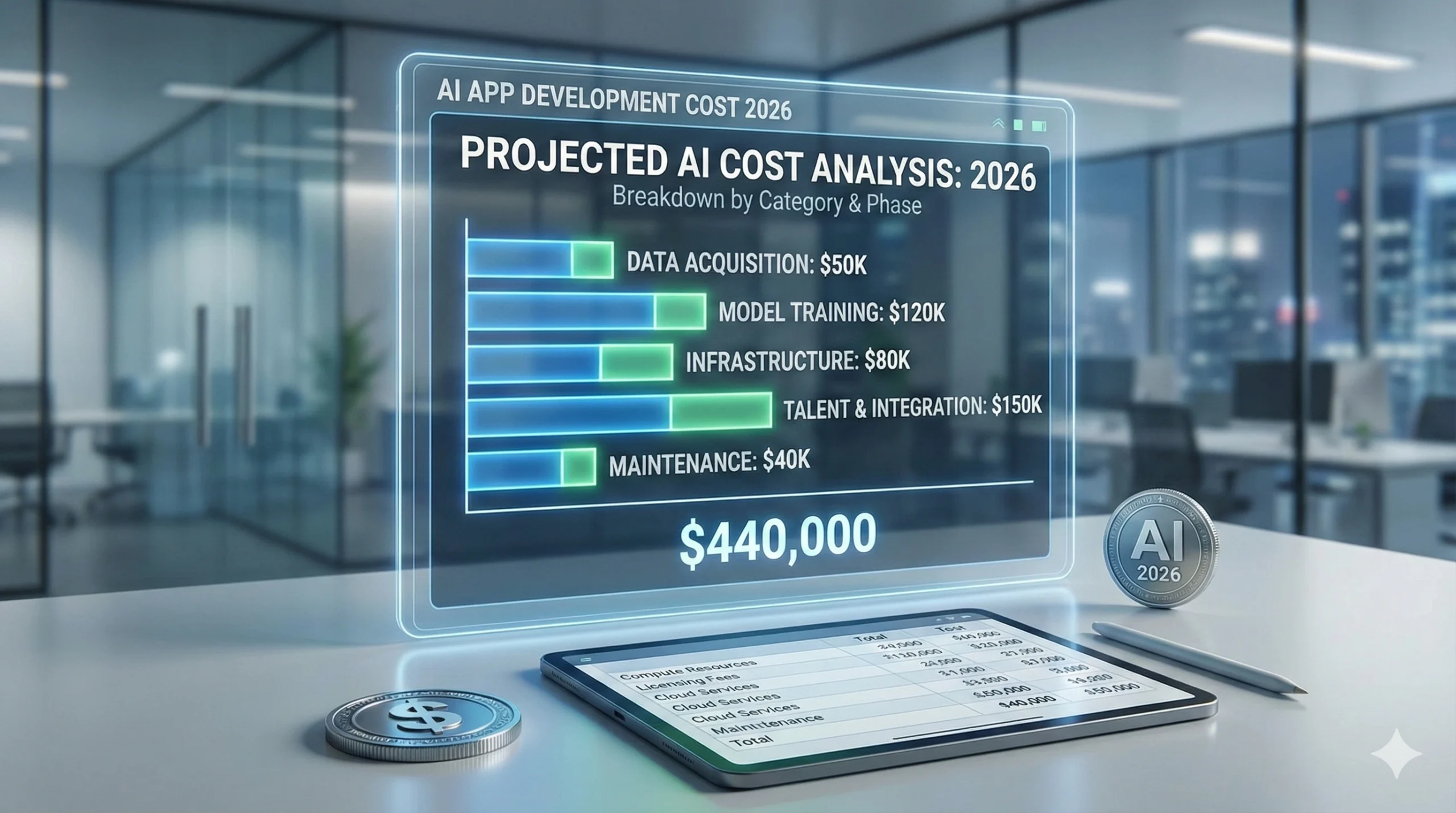
Understanding what drives the cost of AI app development helps businesses plan better and avoid surprises later. AI development isn’t only about writing code; it involves design, data, compliance, cloud costs, and long-term maintenance. Below are the major factors that affect the final price of AI applications today.
1. App Complexity and Feature Depth
The level of complexity has the biggest impact on AI app development cost. Simple AI features, like a chatbot or document parser, fall on the lower end of the budget. But when you add dashboards, workflows, real-time analytics, payments, or CRM links, the price goes up.
Building a full AI-enabled platform with multiple modules, automation, and enterprise-grade security can easily cross six figures. Each extra workflow means more coding, testing, and long-term support.
2. AI Capabilities and Intelligence Level
What your AI is expected to do shapes the cost quickly. Basic AI features may start small, but more advanced use cases – speech recognition, object detection, anomaly alerts, or deep learning, need specialised skills and heavier infrastructure.
Lightweight AI tasks can be built for modest budgets, but projects using computer vision or predictive modelling often start above the £80K–£100K mark. Ambition determines whether you spend tens of thousands or move into enterprise-level investment.
3. AI Model Type and Build Approach
There are two broad routes:
a) Using ready-made APIs (OpenAI, AWS, etc.)
This option reduces the upfront cost and speeds up delivery. Many smaller apps land in the £5K–£15K range when the scope is simple. The trade-off? Ongoing usage fees and limited control.
b) Creating a custom model
Training or fine-tuning your own AI model adds more accuracy and long-term ownership. But it comes with higher early costs, usually from £40K to £150K+, depending on data size and compute needs.
If you want to test an idea fast, plug-and-play APIs help. If you need precise control and scalability, a custom model is the better long-term choice.
4. Data Quality, Labelling, and Preparation
AI apps are only as smart as the data they learn from. If the information is clean, structured, and available in one place, development moves quickly. But messy data – spread across emails, spreadsheets, CRMs, or PDFs, takes time to prepare.
Cleaning records, removing duplicates, labelling samples, and setting up pipelines can double the project cost. In many 2025 AI projects, nearly 40% of development time is spent on data readiness.
5. Security, Compliance, and Risk Management
AI applications often handle sensitive information, especially in finance, education, retail, healthcare, and public services. This makes robust security non-negotiable.
Features such as data encryption, role-based access, multi-factor authentication, and real-time monitoring all add to the final cost. Regulations like GDPR, HIPAA, COPPA, and local data-handling laws require audits, documentation, and technical safeguards.
Skipping compliance can lead to fines or legal issues, so most UK organisations treat it as an essential investment rather than an optional add-on.
6. User Interface and Design Complexity
Design plays a major role in the cost of building an AI app. Clean dashboards, detailed user journeys, and visual analytics take time to build and test. If you add dynamic elements such as live feedback, real-time results, or interactive displays, the design phase becomes longer.
Good UI/UX helps reduce user errors and support requests, which saves money later, but it does increase the initial budget.
7. Platform Selection and Technology Stack
Building an AI app for a single platform keeps costs manageable. A basic web app is usually the cheapest option. However, developing native apps for both Android and iOS doubles the design and testing work.
Cross-platform tools like React Native reduce duplication, but they may not always support heavy AI workloads. If your app uses multiple AI modules, a carefully chosen tech stack saves money on long-term maintenance.
8. Third-Party Integrations and API Costs
Modern AI apps rarely work alone. They depend on payment systems, cloud services, social platforms, maps, identity providers, or analytics tools. Each integration requires configuration, testing, and occasionally custom code.
Every extra API adds upfront development time and ongoing subscription charges. Smooth integration is vital in AI development, especially for apps that need real-time data exchange.
9. Cloud Hosting, Infrastructure, and Compute Needs
Infrastructure costs grow as AI features become more advanced. A simple AI feature may work with basic cloud hosting, but tasks like video processing, image analysis, or large-scale predictions require stronger GPU resources.
In 2025, GPU-based cloud servers can cost hundreds to thousands of pounds per month depending on usage.
Choosing between AWS, Azure, Google Cloud, or hybrid systems affects long-term overheads. Getting this wrong can mean a working app with a painful cloud bill.
10. Development Team Location and Expertise
Hourly rates vary widely across regions. Locations with high-end AI talent charge more, while offshore teams offer cost-effective solutions. UK businesses often blend local strategy with global delivery teams for better value.
Rates range from:
India: £15–£35/hour
Eastern Europe: £35–£55/hour
Western Europe: £60–£100/hour
UK & USA: £80–£160+/hour
The location of your team can shift the overall budget by thousands.
11. Long-Term Maintenance and AI Model Updates
AI apps are living systems that need regular updates. Models require refreshing, APIs change, device updates break features, and usage patterns evolve. Most organisations set aside 15–20% of the initial cost each year for maintenance.
Support packages or on-demand AI engineers help keep your product stable and competitive over time. Neglecting maintenance leads to slow performance and accuracy drops.
12. Additional 2025 Factors Affecting AI App Cost
AI development in 2025 has seen new trends that influence cost:
- Higher compute prices due to global GPU shortages
- Stricter regulatory requirements in the UK and EU
- Growing demand for AI explainability (XAI) in finance and healthcare
- Need for ethical-AI practices to reduce bias
- Faster model updates from major AI providers, requiring more frequent app upgrades
Businesses planning for next year should consider these emerging elements in their budgeting.
Smart and Practical Ways To Reduce AI App Development Cost
Keeping AI app development affordable is not about cutting corners; it’s about making smart, strategic choices from day one. When you understand what truly drives the cost, you can plan better and avoid unnecessary spending.
These cost-saving methods help you stay in control, build faster, and still deliver a high-quality AI product.
1. Begin With a Lean MVP (Minimum Viable Product)
One of the quickest ways to control your AI app development cost is to start with an MVP. Instead of building everything at once, you only ship the core AI features first. It helps you:
- Test your idea early
- Check if users actually need the feature
- Avoid spending money on functionality that may never be used
- Reduce your initial AI app cost and speed up launch times
Working with MVP development services is a smart way to validate your concept and plan future upgrades without blowing your budget.
2. Focus on the Features That Truly Matter
Every extra feature increases design work, testing, infrastructure, and long-term upkeep. So, prioritising essential functionality keeps your AI development budget predictable and efficient. This approach lets you:
- Cut down development hours
- Reduce expensive rework
- Keep the AI app simple and scalable
- Add advanced features later when you have real user insights
This is one of the easiest ways to keep the AI app development cost grounded while still delivering real value.
3. Use Cross-Platform Development To Speed Up Delivery
Instead of building three separate apps for Android, iOS, and web, cross-platform development gives you one codebase for all. You benefit from:
- Faster delivery
- Lower maintenance costs
- Consistent UI and performance across devices
- A single development team instead of three
Using React Native or Flutter helps lower the overall AI software development cost, especially for startups aiming to move quickly.
4. Outsource to Cost-Efficient Regions With Strong Expertise
Many UK businesses reduce the AI app development cost by working with teams in regions that offer high skill at a lower cost. This helps you:
- Scale faster
- Access specialist AI, ML, and data engineering skills
- Reduce operational overheads
- Build enterprise-grade AI solutions without paying premium local rates
Partnering with an experienced firm like IDS Logic allows you to build smart, scalable AI solutions without overspending.
5. Plan Maintenance Early To Avoid Heavy Future Bills
An AI app is not a one-time build. Models need tuning, APIs change, and security standards evolve. Setting aside 15–20% of your initial budget per year avoids sudden expenses later. Ongoing support ensures:
- Stable performance
- Better accuracy as the model learns
- Strong security
- Smooth updates across devices and operating systems
Long-term planning keeps your total AI app development cost under control.
Future Trends That Will Impact AI App Development Cost
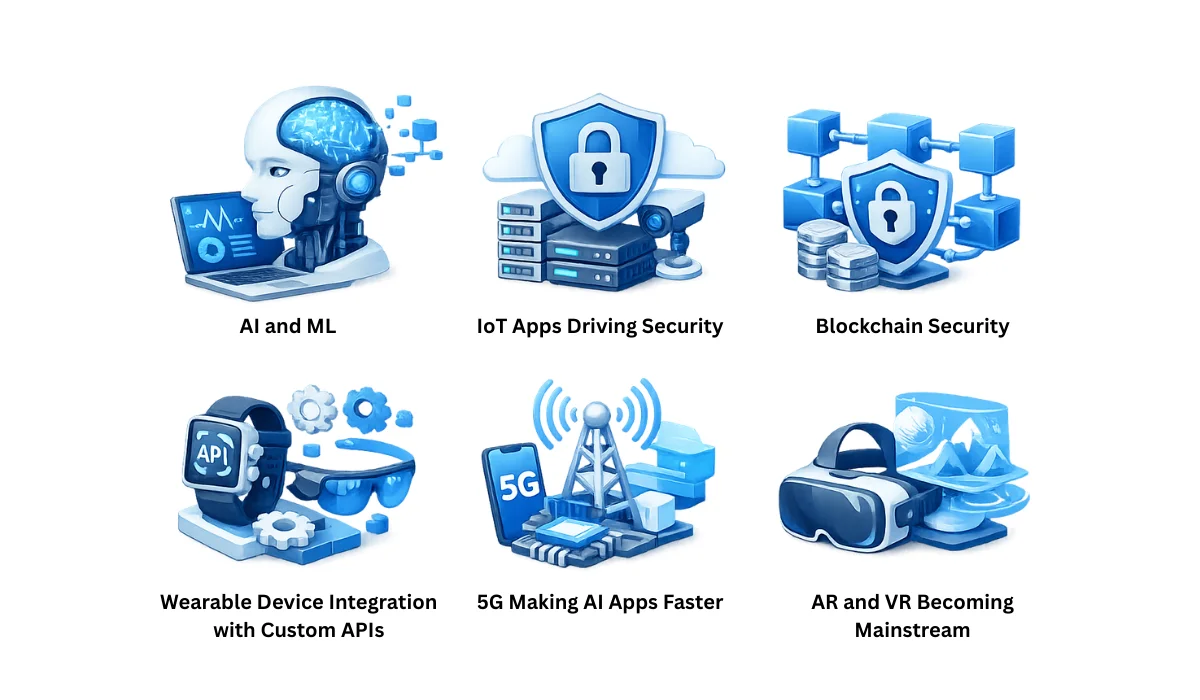
The cost of building an AI app will continue to shift as new technologies, regulations, and user expectations evolve. Understanding these trends helps you prepare for real-world budgets and build solutions that stay relevant beyond 2026.
1. AI and Machine Learning Becoming Standard, Not Optional
AI features such as predictive analytics, chatbots, speech recognition, and personalisation are no longer “nice to have.” They are shaping the future of digital products. However, integrating AI often increases the development cost due to:
- Advanced algorithms
- Data pipelines
- Testing and fine-tuning
Still, the return on investment is high. In 2025 alone, AI-driven apps improved user engagement rates by 20–35% across many industries.
2. IoT Apps Driving Higher Security and Infrastructure Costs
IoT is becoming essential in healthcare, logistics, smart homes, and manufacturing. But building IoT-driven AI apps requires:
- Device integration
- Secure data flows
- Strong back-end architecture
These elements can increase development costs, yet IoT brings immense value through automation and real-time insights.
3. Blockchain Security Becoming a Key Investment Area
As data privacy laws tighten in the UK and Europe, blockchain adoption is rising. Adding blockchain into your AI app enhances transparency and security but adds to the budget due to:
- Smart contract development
- More complex architecture
- Additional testing and audits
Still, for fintech, healthtech, and eCommerce, it’s a long-term investment.
4. Wearable Device Integrations Increasing Demand for Custom APIs
Apps built for smartwatches, fitness trackers, and medical wearables require:
- Custom APIs
- Sensor connectivity
- Precise performance tuning
These integrations increase the mobile app development cost but deliver high engagement and accessibility.
5. 5G Making AI Apps Faster – and More Complex to Build
The rise of 5G enables real-time features such as:
- AR
- VR
- Real-time streaming
- High-speed predictive analytics
Optimising an app for 5G conditions may increase the development cost slightly, but it ensures long-term performance and scalability.
6. AR and VR Becoming Mainstream Across Industries
AR/VR is no longer limited to gaming. Retail, education, travel, and real estate now use immersive tech to enhance user experience. However, AR/VR development increases the app cost because it needs:
- High-quality graphics
- Specialised frameworks
- High-performance devices
- Skilled developers
When combined with AI, these technologies unlock more personalised, interactive journeys.
Final Words
AI app development costs in 2026 can vary widely, but the key to staying on budget is smart planning, a clear roadmap, and choosing the right experts from the start. A simple AI tool may cost around £40K–£50K, while enterprise-grade platforms with large-scale data processing or GenAI models can exceed £200K–£250K. When you understand how model training, infrastructure, data preparation, and integrations influence the overall spend, you gain better control over both time and money.
The smartest approach is to begin lean: validate your idea with an MVP, gather real user insights, and scale only when the value is proven. This prevents overspending and ensures every feature supports genuine business outcomes. With transparent planning and the right technical decisions, AI applications can deliver long-term efficiency, automation, and competitive advantage.
At IDS Logic, we have successfully delivered over 200 digital solutions, including AI-driven platforms, automation tools, and enterprise applications. We understand where budgets leak, where they pay off, and how to build AI systems that are scalable, secure, and aligned with business goals.
Our team operates across Leeds, London, Birmingham, and Liverpool, helping UK organisations access local experts who understand industry requirements, compliance needs, and digital transformation priorities.
If you’re ready to build an AI application that delivers measurable business impact, speak to our UK team today. With expert delivery capabilities across Leeds, London, Birmingham, and Liverpool, we can help you plan smartly, reduce risks, and develop AI solutions built for scale. Let’s bring your AI idea to life – efficiently, securely, and within budget.
Frequently Asked Questions
Q1. Do we need large datasets to build an AI application?
Not always. Some AI solutions work well with smaller, high-quality datasets or use pre-trained models that only need light fine-tuning. A detailed data assessment helps determine whether you need new data, synthetic data, or integration with existing business systems.
Q2. Which industries benefit most from AI applications?
AI brings strong ROI in sectors such as finance, healthcare, retail, logistics, and education. It assists with automation, personalisation, forecasting, risk detection, and customer experience improvements. The biggest gains occur in processes that rely heavily on manual work or data interpretation.
Q3. What skills should we look for in an AI development team?
You’ll need a mix of machine learning engineers, data scientists, solution architects, cloud specialists, and QA testers who understand model optimisation, data governance, and secure deployment. A strong team like the one at IDS Logic should also guide you on compliance and long-term scalability.
Q4. Should our AI app be cloud-based or on-premises?
Most modern AI applications perform better in the cloud due to scalability, easier model retraining, and access to GPU resources. However, certain industries may opt for on-premises solutions to meet strict data residency or compliance requirements. A hybrid approach is also common.
Q5. How do we measure the success of an AI application?
Success is usually tracked through metrics such as reduced operational time, accuracy improvements, cost savings, user adoption, customer satisfaction, and revenue impact. Before development begins, it’s important to define the KPIs so the AI model can be trained and evaluated correctly.
Q6. Can AI be added to an existing app or does it require a new build?
AI can be integrated into an existing platform through APIs, microservices, or modular components. However, older systems may need upgrades or restructuring for smooth integration. A technical audit helps determine the best approach without unnecessary redevelopment.
Q7. What ongoing support does an AI application require?
AI systems need periodic model retraining, performance monitoring, bug fixes, infrastructure optimisation, and feature updates. As user behaviour and data evolve, the model must adapt to maintain accuracy and reliability.