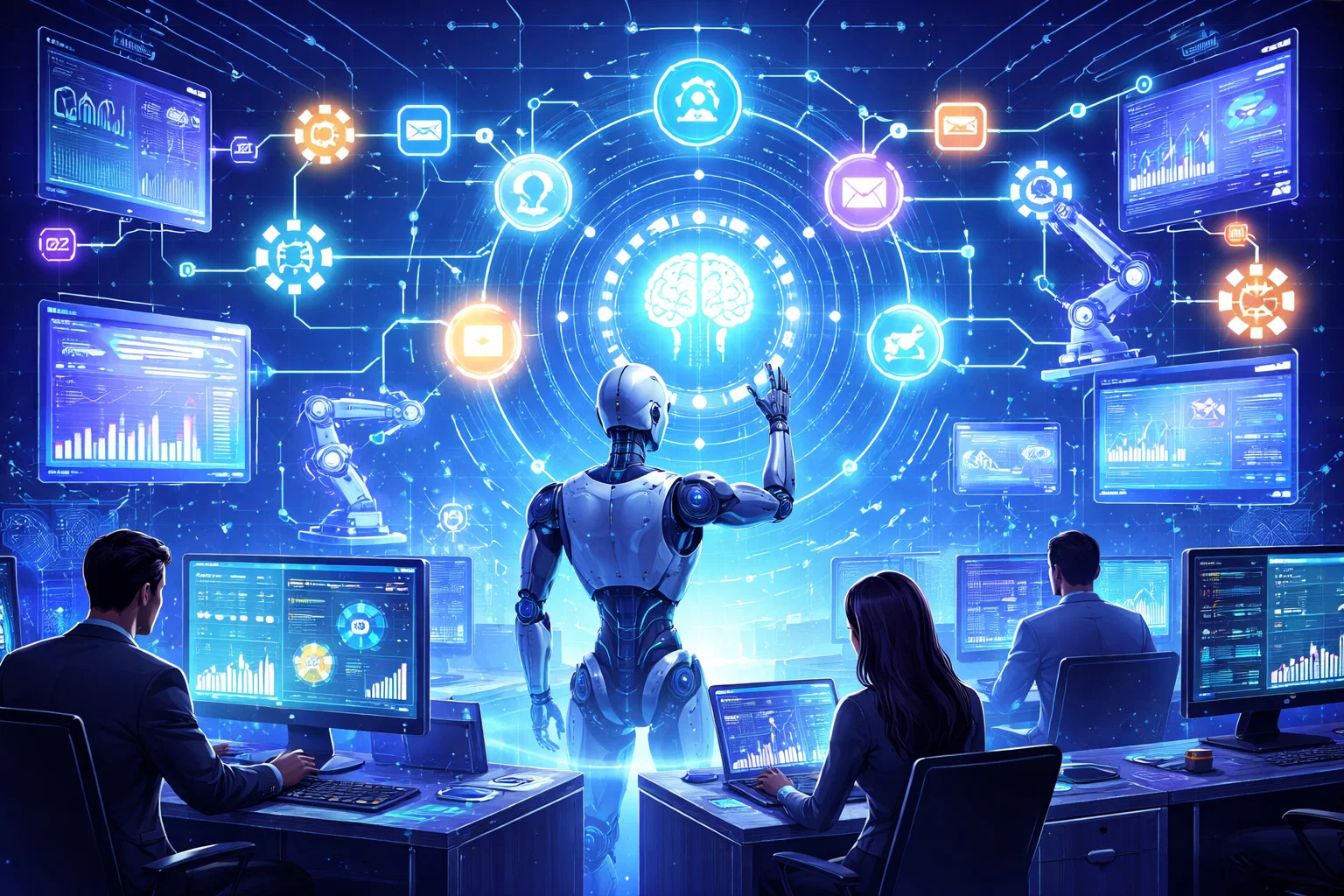
AI agents in 2026 are transforming how businesses operate — automating end-to-end workflows across customer support, sales, marketing, and operations. Discover how AI workflow automation delivers real business value, the top use cases, key benefits, and how to implement it successfully.
Key Takeaways:
- AI agents in 2026 are transforming business operations, with up to 40% of enterprise applications expected to embed AI agents.
- These systems use advanced AI models to analyse data, make decisions, and automate multi-step workflows end-to-end.
- Businesses are already seeing strong results, with AI agents resolving up to 70% of support queries and reducing admin work by 40-60% per process.
- Organisations adopting AI workflow automation report 20-40% cost savings, along with faster turnaround times and improved accuracy.
- AI agents enable 24/7 operations, helping businesses scale output without increasing headcount.
- The shift in 2026 is moving from rule-based automation to intelligent, decision-driven systems that continuously learn and improve.
- Common risks such as data privacy, integration challenges, and adoption issues can be managed through clear governance, phased rollout, and human oversight.
- A successful implementation typically includes workflow assessment, setting guardrails, system integration, testing, and scaling across teams.
- Real-time monitoring and AI insights allow businesses to move from reactive problem-solving to proactive workflow management.
As businesses move beyond basic automation and into a new phase of digital transformation, AI agents for automation will change the way work gets done in 2026. These systems will not simply follow instructions, but will be able to comprehend tasks, make decisions, and take actions without human assistance.
Across the UK, companies face growing pressure to improve efficiency, reduce costs, and deliver faster services. At the same time, teams deal with complex workflows, scattered data, and increasing customer expectations. This is where AI workflow automation is making a real difference.
Recent industry projections show that nearly 40% of enterprise applications now include AI agents, highlighting how quickly adoption is growing. In addition, many organisations report measurable gains in productivity after implementing AI-driven automation.
Unlike traditional automation tools, AI agents bring context, reasoning, and adaptability into business operations. They connect with systems, analyse data in real time, and help teams make faster and better decisions.
In this blog, we explore how AI agents in 2026 are transforming workflows, what benefits they offer, and how businesses can use them to build smarter, more efficient operations.

What Are AI Agents for Automation and How Do They Work?
AI agents for automation are intelligent software systems that can handle tasks on their own. They can understand information, make decisions, and take action without constant human input.
Unlike traditional automation tools, AI agents do not rely only on fixed rules. Instead, they adapt to different situations, learn from data, and improve over time. This makes them more suitable for modern business environments where processes are often complex and unpredictable.
In simple terms, AI agents act like digital co-workers. They can manage tasks, respond to changes, and complete workflows from start to finish.
Core Capabilities of AI Agents
AI agents combine several capabilities that allow them to go beyond basic automation. These features help businesses move towards smarter and more flexible operations.
1. Understanding Human Input
AI agents can interpret text, emails, or voice commands in a natural way. This allows them to understand user requests and respond accurately.
2. Decision-Making and Planning
They analyse available data and decide the next steps based on defined goals. This helps automate tasks that require judgement rather than simple repetition.
3. Learning and Improvement
AI agents improve over time by analysing past actions and outcomes. As a result, they become more accurate and efficient with continued use.
4. System Integration and Execution
They connect with tools such as CRM systems, cloud platforms, and business applications. This allows them to trigger actions, update data, and complete workflows automatically.

Where AI Agents Deliver Real Business Value in 2026?
Today businesses are no longer testing automation in isolated areas. Instead, they are using AI agents in 2026 to solve real operational challenges across departments. The focus has shifted from automating small tasks to transforming complete workflows. This is where AI workflow automation delivers measurable value for organisations looking to improve efficiency and reduce manual effort.
Across the UK, businesses face increasing pressure to deliver faster outcomes while managing limited resources. Teams often deal with repetitive tasks, disconnected systems, and growing customer expectations. As a result, organisations are adopting AI for business automation to streamline processes and improve consistency. AI agents now operate across multiple functions, helping businesses scale operations without increasing complexity or headcount.
What makes this shift significant is the ability to manage entire processes end-to-end. Instead of relying on fragmented tools, companies are now building connected systems powered by AI business process automation. This allows them to operate more efficiently and respond quickly to changing business demands.
AI Agents Use Cases Across Key Business Functions
AI agents for business are widely used across departments to automate everyday processes. From customer support to operations, these systems help organisations reduce manual work and improve efficiency. With AI workflow automation, businesses can streamline tasks, improve accuracy, and deliver faster outcomes across key functions.
1. Customer Support and Service Automation
Customer service remains one of the most common and impactful AI agents use cases. Businesses use AI agents to manage high volumes of customer queries with speed and accuracy. These systems can read messages, understand intent, and resolve issues without human involvement.
Many organisations report that AI agents can handle over 50-70% of support queries independently, which significantly reduces response times and improves customer satisfaction . When complex issues arise, the system can seamlessly transfer the case to a human agent with full context, ensuring a smooth experience. This combination of automation and human support creates a more efficient and reliable customer service model.
2. Sales and Lead Management Automation
Sales processes often involve repetitive and time-consuming tasks such as lead qualification, follow-ups, and CRM updates. With AI agents for business, these activities can be automated effectively. AI agents analyse customer behaviour, identify high-potential leads, and trigger personalised communication based on real-time data.
This approach allows sales teams to focus on strategic activities such as closing deals and building relationships. At the same time, it ensures that no opportunity is missed due to delays or manual errors. By integrating AI process automation into sales workflows, businesses improve both efficiency and conversion rates.
3. Marketing Campaign Optimisation
Marketing nowadays relies heavily on personalisation and data-driven decisions. Managing campaigns manually can be complex and resource-intensive. With AI business process automation, marketing teams can automate audience segmentation, campaign execution, and performance optimisation.
AI agents analyse customer behaviour, adjust campaigns in real time, and allocate budgets based on performance. This ensures that marketing efforts remain relevant and cost-effective. As a result, businesses achieve better engagement and higher returns on investment without increasing workload.
4. Operations and Administrative Workflow Automation
Administrative tasks often create hidden inefficiencies within organisations. Processes such as reporting, scheduling, and document handling consume valuable time and resources. With AI workflow automation, these tasks can run independently, reducing delays and improving accuracy.
Businesses using AI agents often report a 40-60% reduction in administrative workload, which allows teams to focus on more valuable work . This not only improves operational efficiency but also enhances overall productivity across departments.

How AI Agents Power End-to-End Business Process Automation?
By using AI workflow automation, organisations can connect multiple steps, systems, and decisions into a single, seamless process. This allows businesses to improve efficiency, reduce delays, and manage operations more effectively through AI business process automation.
1. Connecting Workflows Across Systems
The true value of agentic AI automation lies in its ability to connect different stages of a workflow. Unlike traditional automation, which focuses on individual tasks, AI agents manage entire processes from start to finish. This creates a seamless flow of information and actions across systems.
AI agents collect data from multiple sources, analyse it in context, and decide the next steps based on business goals. Once a decision is made, they execute actions through integrated systems such as CRM, ERP, and cloud platforms. This eliminates manual handoffs and ensures that workflows run smoothly without interruptions.
2. Adapting and Improving Over Time
A key advantage of AI agents in 2026 is their ability to learn and improve continuously. These systems analyse past outcomes and adjust their behaviour to deliver better results over time. This makes them more effective than traditional automation tools, which require manual updates to improve performance.
By leveraging AI integration services, businesses can ensure that AI agents work seamlessly with existing infrastructure. This creates a connected ecosystem where processes are not only automated but also optimised for efficiency and accuracy .
Key Benefits of AI Agents for Business Automation
Businesses are adopting AI for business automation to improve efficiency, reduce costs, and scale operations. With AI workflow automation, organisations can streamline processes, minimise errors, and achieve faster outcomes across departments.
1. Improved Efficiency and Productivity
One of the most immediate benefits of AI automation solutions UK businesses adopt is improved efficiency. AI agents can operate continuously, handling repetitive tasks faster and more accurately than manual processes. This allows teams to focus on strategic activities that drive business growth.
2. Cost Reduction and Resource Optimisation
By reducing reliance on manual work, businesses can achieve significant cost savings. Many organisations report 20-40% reduction in operational costs after implementing AI process automation. This makes AI agents a valuable investment for long-term scalability.
3. Enhanced Decision-Making
AI agents provide real-time insights by analysing large volumes of data. This enables businesses to make faster and more informed decisions. Instead of relying on guesswork, organisations can act based on accurate and up-to-date information.
4. Scalability Without Increasing Headcount
As businesses grow, managing increased workloads becomes a challenge. With AI for business automation, companies can scale operations without hiring additional staff. AI agents handle the extra workload efficiently, ensuring consistent performance.
5. Better Employee Experience
Automation also improves the employee experience by removing repetitive tasks. Teams can focus on creative and strategic work, which leads to higher engagement and better outcomes across the organisation.
How to Successfully Implement AI Agents in Your Business?
Adopting AI agents for business requires a clear and structured approach. To get the best results from AI business process automation, organisations need to identify the right workflows, integrate systems effectively, and scale automation in a controlled way.
1. Identifying the Right Workflows
The first step in adopting AI business process automation is identifying processes that deliver the highest impact. These are usually repetitive, time-consuming, and critical to operations. Focusing on these areas ensures quick and measurable results.
2. Setting Clear Goals and Governance
Businesses need to define clear objectives for what AI agents should achieve. It is also important to establish control mechanisms to ensure that automation operates within defined boundaries. This helps maintain accuracy and reliability.
3. Integrating with Existing Systems
Successful implementation depends on seamless integration. Through AI integration services, businesses can connect AI agents with existing tools and platforms. This ensures smooth data flow and efficient execution across departments.
4. Testing and Scaling Strategically
Before full deployment, organisations should test AI agents in controlled environments. This helps identify issues and refine workflows. Once proven, automation can be scaled across the organisation in a phased manner to ensure consistency and performance.
Conclusion – Why AI Agents Are the Future of Business Automation
AI agents have moved from experimentation to real-world application. In 2026, they are becoming the foundation of modern business operations. With the ability to manage end-to-end workflows, AI workflow automation is helping organisations improve efficiency, reduce costs, and scale faster.
However, successful adoption depends on the right approach. Businesses need clear objectives, proper integration, and strong governance to ensure that automation delivers measurable value. Without this, even advanced systems may fail to achieve expected results.
Industry insights show that a significant percentage of enterprise applications will soon include AI agents. At the same time, many projects fail due to poor planning or lack of strategy. This highlights the importance of working with experienced partners who understand both technology and business needs.
For organisations looking to stay competitive, investing in AI for business automation is no longer optional. It is a strategic move towards building smarter, more agile operations.
How IDS Logic Helps You Leverage AI Agents for Business Automation?
At IDS Logic, we help businesses unlock the full potential of AI agents for business by building solutions that are practical, scalable, and aligned with real business goals.
We begin by understanding your current processes, identifying gaps, and highlighting opportunities where AI workflow automation can deliver immediate value. This ensures that automation is not just implemented, but strategically aligned with your operations.
Our team specialises in designing and developing intelligent systems that go beyond basic automation. From AI integration services to custom AI agent development, we ensure seamless connectivity across your existing platforms, including CRM, ERP, and cloud environments.
We also focus on building solutions that are secure, compliant, and easy to manage. With the right governance and monitoring in place, businesses can confidently adopt AI process automation without operational risks.
Whether you want to automate customer workflows, improve decision-making, or scale operations, IDS Logic delivers tailored AI automation solutions UK businesses can rely on for long-term success.